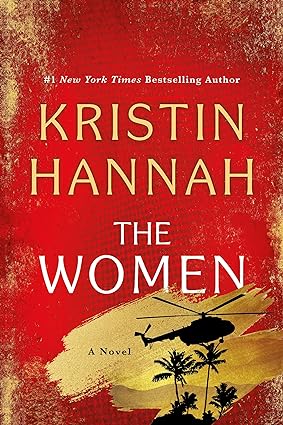
 The Women was released this month by Kristin Hannah. That’s good news for those of us who love her work. According to Publishers Weekly, “Hannah’s emotionally charged page-turner (after The Four Winds) centers on a young nurse whose life is changed by the Vietnam War. Before Frankie McGrath begins basic training for the Army in 1966, her older brother Finley is killed in action. Frankie excels as a surgical nurse in Vietnam and becomes close with fellow nurses Ethel and Barb. After Ethel’s tour ends, Frankie and Barb gets assigned to the base at Pleiku, near the Cambodian border, where some of the heaviest fighting occurs. There, she reunites with Navy officer Rye Walsh, Finley’s best friend, and they become lovers. When Frankie returns to the U.S., she’s met with indifference for her service from her parents, who are still grieving her brother’s death, and disdain from people who oppose the war. She leans on alcohol and drugs while struggling to acclimate to civilian life. Though the situations and dialogue can feel contrived (Rye, after announcing he’s re-upping, says to Frankie at the close of a chapter, “I’m not leaving my girl”), Hannah’s depictions of Frankie tending to wounded soldiers are urgent and eye-opening, and a reunion of the three nurses for Frankie’s benefit is poignantly told. Fans of women’s historicals will enjoy this magnetic wartime story.”
From the Publisher
“Women can be heroes. When twenty-year-old nursing student Frances “Frankie” McGrath hears these words, it is a revelation. Raised in the sun-drenched, idyllic world of Southern California and sheltered by her conservative parents, she has always prided herself on doing the right thing. But in 1965, the world is changing, and she suddenly dares to imagine a different future for herself. When her brother ships out to serve in Vietnam, she joins the Army Nurse Corps and follows his path.
“As green and inexperienced as the men sent to Vietnam to fight, Frankie is over-whelmed by the chaos and destruction of war. Each day is a gamble of life and death, hope and betrayal; friendships run deep and can be shattered in an instant. In war, she meets―and becomes one of―the lucky, the brave, the broken, and the lost.
“But war is just the beginning for Frankie and her veteran friends. The real battle lies in coming home to a changed and divided America, to angry protesters, and to a country that wants to forget Vietnam.
“The Women is the story of one woman gone to war, but it shines a light on all women who put themselves in harm’s way and whose sacrifice and commitment to their country has too often been forgotten. A novel about deep friendships and bold patriotism, The Women is a richly drawn story with a memorable heroine whose idealism and courage under fire will come to define an era.”
From the Author’s Website
 “From master storyteller Kristin Hannah, #1 New York Times bestselling author of The Nightingale and The Four Winds, comes the story of a turbulent, transformative era in America: the 1960s. The Women is that rarest of novels―at once an intimate portrait of a woman coming of age in a dangerous time and an epic tale of a nation divided by war and broken by politics, of a generation both fueled by dreams and lost on the battlefield.”
“A former attorney, Kristin lives in the Pacific Northwest.”
–Malcolm


 Malcolm's Round Table