The writer’s friend: the voice you hear while reading silently

Years ago, I was told that sounding the words out inside my head while reading silently was a very slow way to read. (No, I didn’t move my lips while reading.) Sometimes it’s my voice. Sometimes it’s my approximation of the author’s or the character’s voice. I’ve always found that helpful because it made the material more real. I didn’t tell other people this after hearing how stupid I was to read that way.

Research summarized in an article in “Psychosis,” however, indicates that “the vast majority (82.5 per cent) of contributors said that they did hear an inner voice when reading to themselves.”

Perhaps one’s view of the good or ill of hearing an inner voice while reading depends of your language focus. It is a spoken means of communication that’s sometimes translated onto the page or a written communication that it’s possible to read aloud?

If you write–or if you read a lot of fiction–storytelling might seem first and foremost an oral tradition whether you’re hearing the story told to you in person, on TV or in an audiobook, or whether you’re reading it from the printed page.

Since I have always heard an inner voice speaking the words I read or write, I am very conscious of what each sentence sounds like from one draft or a story to the next. The sound of that printed sentence in the manuscript is either awkward or it isn’t, has a rhythm to it that’s suitable to the story or the character, or it doesn’t.

In Ursula Le Guin’s Steering the Craft: a 21st-Century Guide to Sailing the Sea of Story, she writes, “The sound of language is where it all begins. The test of the sentence is, Does it sound right? The basic elements of language are physical: the noise the words make, the sounds and silences that make the rhythms marking their relationships. Both the meaning and the beauty of the writing depend of those sounds and rhythms. This is just as true of prose as it is of poetry, though the sound effects of prose are usually subtle and always irregular.”

Some writers read their material aloud. Others ask a spouse or friend to read it to them. Not a bad idea, though I’ve never found that necessary. The first thing is being able to hear the voice, either your voice “talking the words” to yourself or a gifted narrator saying each line. Once you hear your work, it becomes so much easier to craft.

–Malcolm
Getting Started in Fantasy Reading

wikifantasy

“Fantasy: A general term for any kind of fictional work that is not primarily devoted to a realistic representation of the known world. This category includes several literary genres describing imagined worlds in which magical powers and other impossibilities are accepted.” – The Concise Oxford Dictionary of Literary Terms

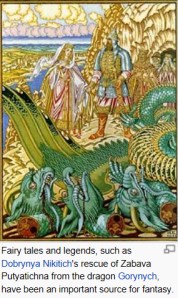
When I tell people I write contemporary fantasy, sometimes they say, “wow, cool” and sometimes they say, “I read the Chronicles of Narnia when I was little, but know little about the genre.”

There are so many types, styles, flavors an sub-genres in fantasy, the wealth of material out there to read is often hard to explain to those wanting to know more. I agree with Terry Pratchett when he says that  “Fantasy is an exercise bicycle for the mind. It might not take you anywhere, but it tones up the muscles that can. Of course, I could be wrong.” However, here are a few links and ideas that are a bit more specific.

Wikipedia has a decent article on fantasy that works as a starting point. (Click on the graphic to read it.) The main article branches off into a series of additional links for sub-genres, books, and authors.

When people want to know more about the types of fantasies, I often send them to sites like Focus on Fantasy for a quick overview and Top 50 SciFi & Fantasy Novels blogs where they can sample some of the viewpoints and commentary out there.

bestfantasyI like Best Fantasy Books because it introduces newcomers to fantasy by listing books in various groupings and then, for each book, showing others that are similar to it. If you look at this site, you’ll find stand-alone books, books in a series, influential books, and a cool list called “Fantasy That Blows Your Mind.”

To keep up with recent books and new titles, you can subscribe to Amazon’s list via RSS. This puts it on your browser where you can click on it easily and see the names of the titles. You’ll find recent fantasy book reviews on Fantasy Book Critic. This site also displays an excellent blogroll that will send you off on an exploration of fantasy blogs, most of which links you to more blogs.

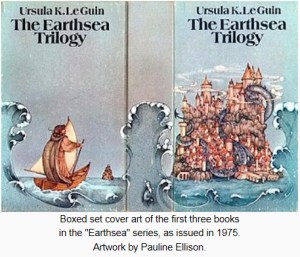
earthseaOnce you find a favorite author and genre, s/he will often be another source via comments, interviews and viewpoints in a personal blog or web site.  Fantasy is so diverse, that it’s really hard to nail it down and say that any one book of series is representative of the genre. Personally, I like contemporary fantasy the best because it overlaps are known world as J. K. Rowling did with her Harry Potter series. Rowling, though, is apples and oranges different from, say, Tolkien, or Erin Morgenstern’s recent The Night Circus or Ursula K. Le Guin’s classic Earthsea series.

Kindle, Nook and other e-readers make it easy to sample a variety of fantasy books at a lower cost before adding your newly discovered favorites to your bookshelf in hardcover or paperback. You can even find some of the older fantasies available on Project Gutenberg and other sites as free downloads. Happy exploring!

–Malcolm

Malcolm R. Campbell is the author of contemporary fantasy, including “The Sun Singer,” “Sarabande,” and the upcoming “The Seeker” (March 2013).

trilogybanner