Atomic Clock ‘Glitch’ Sends Earth Back to January 1, 2023

Washington, D.C., January 1, 2023, Star-Gazer News Service

While TV viewers watching last night’s New Year’s Eve celebration in Times Square weren’t allowed to see it, at the stroke of midnight, the world cycled back to January 1, 2023. Officials urged people to stay calm while the software of the Atomic Clock was checked for evidence of hackers.

According to Time Tsar James Maxwell, “Clock time is independent of historical events. It would be premature at this point to speculate on whether or not we will relive the events of 2023 or if we will experience something new.”

Atomic Clock HQJames Clerk Maxwell, “Clock time is independent of historical events. It would be premature at this point to speculate on whether or not we will relive the events of 2023 or if we will experience new events with year-old dates.”

According to informed sources, the International Earth Rotation and Reference Systems Service (IERS) that mandates when “leap seconds” are added to the official time to synchronize the earth’s rotation with with the official time, 20234 is a leap year. However, that does not mean IERS is considering adding an entire year to the clock to bring time up to what everyday people think the world’s date and time should be.

“That would be unprecedented,” said Maxwell.

Observers at IERS and the Atomic Clock HQ are closely monitoring events and are “happy to report that so far the world is not seeing a replay of the opening days of 2023.”

Joe Smith, the janitor at HQ said, that Wikipedia is correct when it reports that, “In 1968, the duration of the second was defined to be 9192631770 vibrations of the unperturbed ground-state hyperfine transition frequency of the caesium-133 atom. Prior to that, it was defined by there being 31556925.9747 seconds in the tropical year 1900. The 1968 definition was updated in 2019 to reflect the new definitions of the ampere, kelvin, kilogram, and mole decided upon at the 2019 redefinition of the International System of Units. Timekeeping researchers are currently working on developing an even more stable atomic reference for the second, with a plan to find a more precise definition of the second as atomic clocks improve based on optical clocks or the Rydberg constant around 2030.”

“Most kids learn this math in grade school,” said Smith, “so they can keep track of time on their cell phones all of which stubbornly maintain this is 2023 all over again.”
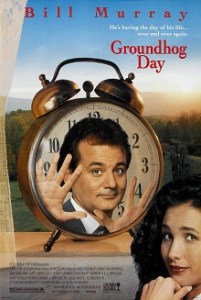
According to Sue Campbell, head of the National Institute of Standards and Technology, people are encouraged to report deja view experiences that suggest events from 2023 are repeating themselves. “Until we sort this out, many of us will be experiencing the movie ‘Groundhog Day.'”

“Audiences enjoyed watching the movie,” said Maxwell, “so we believe folks will have fun with the strange things happening in the world of time while officials work to discover just when this moment is.”

At the crack of dawn, Congress passed legislation that mandates that all states and U.S. territories will consider the year to be 2024, prohibiting jurisdictions from “rolling their own” about the current date and time.

“Thank goodness there’s no precedent for this,” said Speaker of the House Mike Johnson, “for that would mean time has been off track for years.”

“No worries,” said President Biden, “since quantum scientists say that time is not real.”

Story Filed by Jock Stewart, Special Investigative Reporter

The time at the tone is: NOW

“If I write in the present yet digress, is that real time? Real time, I reasoned, cannot be divided into sections like numbers of the face of a clock. If I write about the past as I simultaneously dwell in the present, am I still in real time. Perhaps there is no past or future, only the perpetual present that contains this trinity of memory.”

– Patti Smith in “M Train”

Writers are seldom in real time. We’re writing about yesterday or years ago and we’re writing about tomorrow and aeons into the future, creating time machines with words. If I’m sitting in a room in the purported here and now and you walk in and sit down in a vacant chair, you may soon observe that I’m not really there; I’ve gone deep into the past where time and space are so real that I can taste her breath in my mouth while noticing that the color of her lipstick matches the color of the dawn’s “sailor take warning sky.”

Patti Smith follows–figuratively speaking in her own time–the gurus who postulate an “eternal now.” Interesting, perhaps true, but that concept doesn’t help us get to work on time or remember when to feed the cats. Time used to be all mixed up before the railroads created time zones at high noon on November 8, 1883. Before that, time was a roll-your-own approximation of the sun, moon, stars and custom. But, you cannot run a railroad–other than the Polar Express–through roll your own or the eternal now.

As the New York Times said looking back at the date and time in 1983, “Some citizens grumbled about ‘railroad tyranny’ and tampering with ‘God’s time.’ The Mayor of Bangor, Me., deplored the change as an ‘attempt to change the immutable laws of God Almighty.’ The Indiana Sentinel lamented, ‘The sun is no longer boss of the job.'”

I’m reminded of the verse in Isaac Watts’s old hymn “Our God, Our Help in Ages Past”:

A thousand ages in Thy sight
Are like an evening gone,
Short as the watch that ends the night
Before the rising sun.

That verse made quite an impression on me the first time I sang it in church. I felt small, awash in an almost-timeless universe, awash in the power of my own thoughts and words to take me away from the “now”–as defined by the railroads–into fluid moments so far away most people have forgotten them or not yet imagined them.

When a writer writes, the time is always now or, if not now, whatever we say it is. From time to time, I ask people, “Is it yesterday yet?” Nobody seems to know. They haven’t yet noticed that the right creative thought and/or the well written book will take them into yesterday with or without clocks and time zones.

I guess people notice the eternal now when they read and become lost in the story. Writers are always lost in the story, and I think that’s a blessing even though it plays hell with temporal appointments ruled by clocks.

1960 movie poster

When I read H. G. Wells’ novel The Time Machine, I thought what a wonderful invention that would be, this long before “Star Trek” invented the “temporal prime directive” stating that the people in our time couldn’t tamper with the people in another time.  Science fiction writers love playing with the notion that if a person simply strolls through the past, his/her presence there might change the world. What would happen to you if you accidentally killed your great great grandfather?

If there really is an eternal now, then the answer to that question is probably “nothing.” For years, writers have wondered if a time machine might make it possible to “go back” and save President Lincoln. Some say that, had he lived, reconstruction wouldn’t have become the hellish mess that it was. A character in Stephen King’s 11/22/63 figures out how to return to Dallas on the date in question and save President Kennedy. The world resulting from that was a horrible mess, darker than the dark ages. As it turns out, playing God is dangerous because we don’t know what God knows in the “evening gone” since Lincoln and Kennedy were shot.”

Yet, when we write, we are playing God. Sometimes I wonder if our play is confined to the pages of our novels. Perhaps our stories have impacts we can’t imagine and will never know. Best we can do is hope that our muses keep us on the straight and narrow so that we always write the right thing when the time is right.

–Malcolm

Malcolm R. Campbell is the author of magical realism and contemporary fantasy novels, a fact that shouldn’t surprise you after reading this post.

It’s convenient, isn’t it, to believe in 2015?

“The idea that time is an illusion is an old one, predating any Times Square ball drop or champagne celebrations. It reaches back to the days of Heraclitus and Parmenides, pre-Socratic thinkers who are staples of introductory philosophy courses. Heraclitus argued that the primary feature of the universe is that it is always changing. Parmenides, foreshadowing Einstein, countered by suggesting that there was no such thing as change. Put into modern language, Parmenides believed the universe is the set of all moments at once. The entire history of the universe simply is.”

– Smithsonian in “What Does ‘Happy New Year’ Really Mean?

newyearclockIt remains fashionable to kiss somebody, have a drink and say “Happy New Year” wherever (and possibly whenever) we may be when midnight occurs in our time zone.

We don’t concerns ourselves unless we’re really drunk or excessively sober and alone at that magic moment that people in some parts on the word said “Happy New Year” hours ago or that other people have yet to say it.

As a writer of fantasy and magical realism, I believe it’s my duty to say yes, Mr. Einstein, time does not exist. The appearance of time is convenient. But beyond that appearance everything is simply now.

So, you see that as long as I claim time is an illusion, I don’t have to get drunk at midnight on New Year’s Eve or, worse yet, look at all the things I didn’t get around to this “past” year and resolve with much fanfare to do them “this coming” year.

I realize that one can use the “time is an illusion” philosophy as an excuse for variously not planning ahead or for forgetting the “past,” much less showing up anywhere on time. Likewise, one doesn’t have to believe that time flies, that the “past” is over and done with or that there’s any reason to plan for the “future.”

Whichever side of the time debate we choose, we’ll always have all the rationalizations we need for doing whatever we like. That’s the beauty of these questions. They remain cryptic and mysterious and (possibly) filled with doubletalk. Maybe we really are, as the movie said, going back to the future. Maybe people who are said to be living in the past really are very forward-looking folks. Nonetheless, the “eternal now” remains illusive.

That said, best wishes for a Happy New Year even though such a thing might already be past history.

Malcolm

Kindle Version
Kindle Version

Malcolm R. Campbell is the author of contemporary fantasy novels and paranormal short stories which may or may not exist in your time zone depending your belief system.