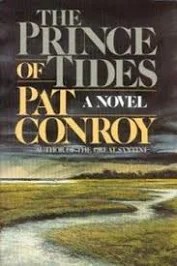
It’s time to re-read Pat Conroy’s ‘Prince of Tides’

Along with Gibbon’s A Scots Quair and Allende’s The House of Spirits, Pat Conroy’s  The Prince of Tides (1986) is one of those “comfort food” books that I return to again and again even though it tells the story of a doomed family with some the worst personal events ever consigned to print.  Most readers, I think, need “comfort food” books not for the comfort they provide but for familiar stories, beautifully told.

I suppose most readers are more familiar with The Great Santini and The Lords of Discipline, in part because their stories are more straightforward and the movies were better made. I like all of Conroy’s work but come back to The Prince of Tides because the story is a poem to the South Carolina low country and the flaws of a Southern upbringing of the era in which the book was set.

I grew up in the South along the Florida coast, and I am familiar with the beauty of marshland, tides, fishing, coastal waters, and what Southern society “did wrong,” so I know the tropes typically found in Southern fiction set in the 1950s and 1960s. When I read The Prince of Tides, I see where I came from without the worst of times that confront the Wingo family.
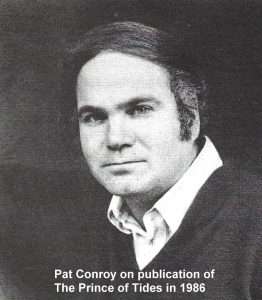
Conroy in 1986

The San Francisco Chronicle wrote, “A big, sprawling saga of a novel this epic family drama is a masterwork by the #1 New York Times bestselling author of The Great Santini.” Some reviewers would say the book is overwritten and/or that most of Conroy’s work is overwritten. Perhaps so, but I don’t care because the settings and circumstances almost demand that his novels should be overwritten.
From the Publisher

“Set in New York City and the low country of South Carolina, The Prince of Tides opens when Tom, a high school football coach whose marriage and career are crumbling, flies from South Carolina to New York after learning of his twin sister’s suicide attempt. Savannah is one of the most gifted poets of her generation, and both the cadenced beauty of her art and the jumbled cries of her illness are clues to the too-long-hidden story of her wounded family. In the paneled offices and luxurious restaurants of New York City, Tom and Susan Lowenstein, Savannah’s psychiatrist, unravel a history of violence, abandonment, commitment, and love. And Tom realizes that trying to save his sister is perhaps his last chance to save himself.

“With passion and a rare gift of language, Pat Conroy moves from present to past, tracing the amazing history of the Wingos from World War II through the final days of the war in Vietnam and into the 1980s, drawing a rich range of characters: the lovable, crazy Mr. Fruit, who for decades has wordlessly directed traffic at the same intersection in the southern town of Colleton; Reese Newbury, the ruthless, patrician land speculator who threatens the Wingos’ only secure worldly possession, Melrose Island; Herbert Woodruff, Susan Lowenstein’s husband, a world-famous violinist; Tolitha Wingo, Savannah’s mentor and eccentric grandmother, the first real feminist in the Wingo family.

“Pat Conroy reveals the lives of his characters with surpassing depth and power, capturing the vanishing beauty of the South Carolina low country and a lost way of life.”

According to Publishers Weekly, the book is, “A seductive narrative, told with bravado, flourishes, portentous foreshadowing, sardonic humor and eloquent turns of phrase. … For sheer storytelling finesse, Conroy will have few rivals.” 

As I re-read this familiar novel, I am sick with an infection of unknown origin that I contracted in June and that still has doctors perplexed. Plenty of tests, but no answers. The story fits my mood as I wonder whether or not at my age I can survive this illness. This is why we need comfort books. They help us remain sane because they present greater insanities than we can endure.

–Malcolm

Comfort Food

Comfort food is food that provides a nostalgic or sentimental value to someone and may be characterized by its high caloric nature, high carbohydrate level, or simple preparation. The nostalgia may be specific to an individual, or it may apply to a specific culture. Wikipedia

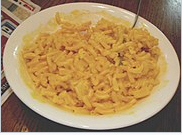
Mac & Cheese – Wikipedia photo.

Wikipedia lists about thirty popular comfort foods for the United States. I like many of them, including mac & cheese. I don’t like the green bean casserole because I got tired of it soon after it first showed up in everybody’s houses. Mashed potatoes are fine, but I prefer them baked, preferably in an oven rather than a microwave. I love grits, always with a lot of butter on top. Cornbread is great, but cornbread dressing is wonderful.

We all have our favorites, the kinds of meals we could eat multiple times per week without getting tired of them.

Books as Comfort Food for the Mind

Every year, magazines, newspapers, and websites choose the best books of the year. Some of these may, in time, become “comfort food,” the books we read over and over.
I’ve read The Prince of Tides and A Scots Quair multiple times. One is set in the southern U.S., the other in Scotland. I never tire of these two books, as some people never tire of mac & cheese.  We find something new in the books we like best every time we read them. They inspire us in some way. They might even impact our life’s journey.

Whatever they do, we keep them on our nightstands as old friends, wise teachers, or worthy competitors.

Escape or Smart Choice?

Some people call fast food an easy way out, one that’s not very nutritious and probably has too much salt and fat in it.  That’s probably true. I don’t see our comfort foods and comfort books that way. They give us what we need for body and soul without allowing us to escape into stuff that really isn’t good for us. Comfort stuff gives us what we need, whether it’s a food, book, movie, song, game, or often-taken hike in the woods.

Some say that when you crave certain things, it’s because your body or your mind need them. I think that’s true–not counting addiction, of course. When I run out of factory fresh new books to read, I usually grab an old book off the shelf and read it again. It’s almost always the very best thing I could possibly read at that moment. There’s usually synchronicity in the book grabbed off the shelf with whatever the gods think I need to know, remember, or act upon. Perhaps the same thing can be said for mac & cheese and grits.

–Malcolm

Malcolm R. Campbell is the author of the three-novel collection, “Florida Folk Magic Stories.”


Great Fiction: Location, Location, Location

These days, most people say they like character-driven novels. As Barbra Streisand sang years ago, “People who need people, Are the luckiest people in the world.” We want to read about people, pretend to be them, laugh at them, hate them, learn from them and, if nothing else, see what they’ll do next.

nixNonetheless, location can make or break a novel. Picture this:

  • The Night Circus set in the day time or, worse yet, Dubuque.
  • The Prince of Tides without the tides or, worse yet, without the the lush bays and swamps an estuaries of the South Carolina coast. (“It was growing dark on this long southern evening, and suddenly, at the exact point her finger had indicated, the moon lifted a forehead of stunning gold above the horizon, lifted straight out of filigreed, light-intoxicated clouds that lay on the skyline in attendant veils.”)
  • Jonathan Strange & Mr Norrell set in modern times or, worse yet, within the 1950s neighborhood of Happy Days or the early 1960s city ambiance of American Graffiti. (“Where does the wind come from that blows upon your face, that fans the pages of your book? Where the harum-scarum magic of small wild creatures meets the magic of Man, where the language of the wind and the rain and the trees can be understood, there we will find the Raven King.”)
  • All the Pretty Horses moved from Texas onto a Star Wars planet or, worse yet,  the Catskill Mountains.

Setting is more than a generic backdrop for the action

In his essay, “Setting as Character,” Crawford Kilian wrote, “Whether it’s Scott Fitzgerald’s 1920s Long Island or Tolkien’s Shire, the setting really is a kind of character in the story. Geographically and socially, the setting shapes the other characters, making some actions inevitable and others impossible.” The novels I listed above not only didn’t happen somewhere else, they couldn’t.

ozmapOn a similar note, a recent post on ProActive Writer, explored the importance of settings with the idea that “ignoring setting, or even giving it only a passing consideration, will lead to an unconvincing story.” The post views setting as the framework or the skeleton that holds up your plot and characters. Some authors build worlds for their novels before writing the novels; others let the worlds evolve while they write their stories. Either way, the worlds—real or imagined—must be convincing, they must fit the story like a warm mitten on a winter evening.

My Location Settings

I say all this as a way of introducing a series of posts on my Sun Singer’s Travels blog about the location settings in my novels. These easy-to-read posts explain each setting, show or describe what happened there in the novel, and explain why I chose the setting.

My approach to settings is organic and intuitive. By that I mean that I don’t make fiction-class lists of the attributes of the settings I want to use. No literary theory here; just places and reasons why I liked them. So far, the series has three installments:

Future posts will look at the world of a city in the Midwest, an aircraft carrier, a bridge over a wild river, and a sailor town. Stop by and see what you think. Whether you agree or disagree with my rationale, perhaps these posts will help you choose the best possible settings for your short stories and novels.

Malcolm

Malcolm R. Campbell is the author of contemporary fantasy novels.

Read it now on your Kindle