Erosion came out in 2019. My apologies for not mentioning here sooner. Perhaps my bias in favor of Williams’ activism and writing made me too cautious to talk about it as though I might inadvertently “oversell it.”
Wikipedia provides a quick overview of her life and work: “Terry Tempest Williams (born 8 September 1955), is an American writer, educator, conservationist, and activist. Williams’ writing is rooted in the American West and has been significantly influenced by the arid landscape of Utah. Her work focuses on social and environmental justice ranging from issues of ecology and the protection of public lands and wildness, to women’s health, to exploring our relationship to culture and nature. She writes in the genre of creative nonfiction and the lyrical essay.” You can learn more on her website here.
From the Publisher
“Timely and unsettling essays from an important and beloved writer and conservationist
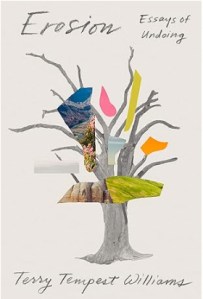 “In Erosion, Terry Tempest Williams’s fierce, spirited, and magnificent essays are a howl in the desert. She sizes up the continuing assaults on America’s public lands and the erosion of our commitment to the open space of democracy. She asks: “How do we find the strength to not look away from all that is breaking our hearts?”
“We know the elements of erosion: wind, water, and time. They have shaped the spectacular physical landscape of our nation. Here, Williams bravely and brilliantly explores the many forms of erosion we face: of democracy, science, compassion, and trust. She examines the dire cultural and environmental implications of the gutting of Bear Ears National Monument―sacred lands to Native Peoples of the American Southwest; of the undermining of the Endangered Species Act; of the relentless press by the fossil fuel industry that has led to a panorama in which “oil rigs light up the horizon.” And she testifies that the climate crisis is not an abstraction, offering as evidence the drought outside her door and, at times, within herself.
“These essays are Williams’s call to action, blazing a way forward through difficult and dispiriting times. We will find new territory―emotional, geographical, communal. The erosion of desert lands exposes the truth of change. What has been weathered, worn, and whittled away is as powerful as what remains. Our undoing is also our becoming.
“Erosion is a book for this moment, political and spiritual at once, written by one of our greatest naturalists, essayists, and defenders of the environment. She reminds us that beauty is its own form of resistance, and that water can crack stone.”
–
“Williams makes a poignant connection between the political and the personal . . . If Williams’s haunting, powerful and brave book can be summed up in one line of advice it would be this: try to stare down the grief of everyday life, speak out and find solace in the boundless beauty of nature.” ―Diane Ackerman, The New York Times Book Review
–Malcolm


 Malcolm's Round Table