The gold in old manuscripts

Those of us who aren’t poets occasionally think up interesting couplets and quatrains that never go anywhere because the rest of the poem never comes together. Maybe professional poets also have this problem.

manuscriptWhat’s more likely for novelists is writing about a wonderful character or an exciting event in novel manuscript that never gels as a whole. Perhaps we write the entire novel, but see that it doesn’t quite work. Unlike the couplet that comes out of the blue without a poem to go with it, the pure gold scenes in unfinished or unsubmitted novels might not have originally caught our attention when we viewed them as part of a larger work.

Old manuscripts gather dust if we printed them out or were often saved in earlier versions of Word and filed away in an archive with a directory (folder) name like “OldStuff” or “Archive.”

If you’re in between major projects–or stuck in your current work in progress–reading through those old manuscripts might be the jolt you need to throw off your temporary writer’s block; or just maybe one of your favorite scenes with a memorable character can be pulled out of the “OldStuff” bin and turned into a short story.

Odds are, the scene will require rewriting so that it stands on its own as a short story with a beginning, middle and end rather than being a wandering slice of life that disappoints readers. Your options are unlimited because the scene you choose no longer has to fit into the novel you extract it from.

goldmineI’m thinking of this idea because I have some older books that are out of print that include a few scenes I happen to like a lot. Fixing them up was a lot more fun than I expected. Characters I liked when I wrote the original, suddenly emerged more fully formed in the revision. If they were evil, they became really evil in the short story. Or, if they were funny, they turned into first class hoots.

We often waste time trying to resurrect old novels that we already know are hopeless messes–good practice works, perhaps. But when we find a scene we can upload as a great Kindle short story, it’s like going into an abandoned mine and finding a shining nugget that got overlooked the last time anyone was there.

–Malcolm

KIndle cover 200x300(1)Malcolm R. Campbell is the author of “Conjure Woman’s Cat,” a 1950s-era story about granny vs. the KKK that will be 99¢ on Kindle February 4, 2016.

Learn more at: http://www.conjurewomanscat.com/

Write sloppy, then cut

penBeginning writers often lack the confidence to write sloppy, anything-goes first drafts. Veterans will tell you these writers have an internal editor that judges every word before it reaches the page or screen.

Sometimes the internal editor looks like Mom, Dad, Reverend Johnson or Professor Smith in the English department. These people have opinions about writing, right and wrong and what you ought to do with your life. If you can hear them saying “tisk tisk” while you write your first draft, that draft is probably going to be anal.

Neither your imagination nor your flow of words needs to be restricted when you write the first draft.

It also takes confidence to cut words. Veteran writers refer to a writer’s favorite scenes and sentences as “your darlings.” These are wonderful in the wrong way. They’re funny, tragic or the best poetry you’ve ever seen. The problem? They don’t fit the story.

Many students in a creative writing or basic news reporting classes are shocked when their short stories and practice news reports come back marked with a red pen. Instructors cut unnecessary words we use in conversation but shouldn’t be using when we write.

Adverbs have a bad reputation. Adjectives are next on the list of suspects. So are weak verbs. Look at each one while you’re cutting words and see if it adds anything to the sentence.

On Facebook these days, it’s rather a fad to say “I’m totally addicted to this TV show.” The word “totally” adds nothing because addicted is addicted. Many TV news reporters didn’t get the message when they took basic reporting in college and heard the instructor say “stop using the words ‘totally destroyed.'” A destroyed condition is already total.

Saying “so totally addicted” might sound “in” on Facebook and at the local mall, but the words slow down your writing. Worse yet, they date your writing; by that I mean, once they do out of style, your story will go out of style, too.

Consider this exercise: Look for short story and creative nonfiction writing competitions with strict maximum word counts. Think of a plot or subject and then write the first draft with the idea that you’re going to have twice as many words as you need. Now cut the first draft so it fits the competition’s requirements. You’ll be amazed at how much stronger the work becomes when the unnecessary words are polished away.

Sculptors have said that creating a statue out of a block of marble is a process of taking away the unwanted stone. You’re doing this when you delete the words you don’t need.  The resulting writing sings just as the sculptor’s best work looks like stone that lives and breathes.

Your first-draft sloppiness gets all the ingredients in place. Editing smooths away everything that will get in the way of the final story.

Malcolm

LandBetweenCoverMalcolm R. Campbell is the author of contemporary fantasies, folktales and paranormal short stories. His latest three-story set, “The Land Between the Rivers,” was released on Kindle September 29.

Review: ‘Butterfly Moon,’ by Anita Endrezze

butterflymoonThe fifteen stories in this finely honed and well-polished collection have the power to cut away assumptions and alter a reader’s focus and direction as only a storyteller’s magic can do. Borrowed and reshaped from older folktales out of Anita Endrezze’s heritage and imagination, these stories take on new life in their contemporary settings.

In her author’s note, Endrezze writes, “I hope Butterfly Moon will take you adrift in another world that challenges and transforms your perceptions, yet leads you back home to yourself.”

Reality, the oldest shapeshifter we know, dances lightly on the pages of Butterfly Moon and often gives way to enchantments, supernatural events, and the whims of gods and fate. As prospective blessings for the reader’s journey, these stories don’t necessarily fit the traditional narrative arc of a problem leading to a climax. Endrezze’s tales are often unresolved slice-of-life glimpses into her characters and settings that end with a dire occurrence, an acceptance of fate, a troubling paradox or the workings of karma.

The joy, anger, life, and death in Endrezze’s vision are not bound by time, nor are they distinctly separate from the active and sentient world in which they’re set. “On This Earth” begins with the words, The house was a forest remembering itself. The pine trees that held up the walls dreamed of stars dwelling in their needles. When Desetnica leaves home to roam the world in “The Dragonfly’s Daughter” because she is the tenth child, it’s clear that the forest is watching when The blackberry bushes parted their thickets as I waded through green knots of fruit. After I passed, still following the dragonfly, the vines knitted together again, so that I was lost to the other side of kinship and orphaned into the unnamed forest.

While tightly knit into the stories’ plots, myth and symbolism add depth without intruding into the author’s economy of words, understated approach and matter-of-fact reverence to the cultural origins of her material. Endrezze does not explain or editorialize, but her omniscient care is everywhere through this collection from the paradoxes of “Raven’s Moon” to the grim unfolding of “The Vampire and the Moth Woman” to the humor of “Jay (Devil-may-care!)”

For the lovers of myths, legends, and folktales, this collection is highly recommended and a unique delight.

Malcolm

Malcolm R. Campbell is the author of paranormal short stories and contemporary fantasy novels, including the recently released mix of love and fate called “The Seeker.”

Briefly Noted: ‘Butterfly Moon,’ by Anita Endrezze

“Endrezze is adept at making her settings and landscape reflective of what is happening in the psyches of her characters and the situations of their lives. She captures her reader with vivid language and some very unique and startling images.” – M. Miriam Herrera

“When I first found Anita Endrezze’s poems, I felt I had come home. Here was the passion, the eloquence, the originality, the insistent song, that I longed to find. But how could I feel so at home? Endrezze is half-West European, half-Yaqui, her origins, her culture, so far from mine.” – Leah Shelleda

butterflymoonWhat we are drawn to, in part when landscapes and psyches are merged, in part when there is a persistent original song, are ideas and images that speak truth to us even though we’re on vastly different temporal world paths than the authors of the poems and stories.

When a read the selection of Endrezze’s poems included in Shelleda’s deep-ecology friendly collection, The Book of Now: Poetry for the Rising Tide, I, too, felt at home within Endrezze’s words. I looked for more of them because they seemed essential. I’m pleased to say that I found them in multiple places, and for a lover of myths and folktales, best of all in her Butterfly Moon collection of short stories.

The world turns, for some of us, where myth and landscape meet, where worlds merge and where tricksters often command the seasons. Trena Machado put this well in her New Pages review of Butterfly Moon:

“In the mythic way of seeing, there is the archaic layer of our anthropomorphizing nature and the earth that we have lost in our Western culture of commerce and science as we strain the limits of the earth’s balance. Nature has its-own-life-to-itself for which we were once more attuned, held reverence and enlivened by: ‘The house was a forest remembering itself. The pine trees that held up the walls dreamed of stars dwelling in their needles. Jointed, branched, rooted, the trees still listened to the wind.’”

The University of Arizona Press blurb is right when it says that Anita Endrezze’s stories are “Enjoyably disturbing, these stories linger—deep in our memory.” This 160-page book was published last September at a time when industrial excesses and environmental concerns occupied much of our attention, if not our overt commitment. No, this is not a Sierra Club tract; it’s pure storytelling at a time when, in addition to the joys of reading, we need to be disturbed and otherwise shaken up.

Malcolm

On Location: Longleaf Pine along the Florida coast

97% of this forest is gone, leaving only isolated pockets of longleaf pines

“The average American’s view of the natural communities of the Southeastern U.S. is that it is comprised mainly of swamps, alligators and big, old moss-hung cypress trees. On the contrary to this view, when early explorers visited the southeastern region they saw “a vast forest of the most stately pine trees that can be imagined, planted by nature at a moderate distance. . . enameled with a variety of flowering shrubs.” Fire defined where the longleaf pine forest was found and fostered an ecosystem diverse in plants and animals.” – Longleaf Alliance

I have been working on another short story for my evolving “Land Between the Rivers” collection about the animals who lived along the Florida Gulf Coast before man showed up and who are now endangered species.

These stories are set in what is now called “Tate’s Hell Forest,” a diverse habitat along the gulf coast near the mouth of the Apalachicola River. This mix of swamps and wet prairies and mixed forests used to flow into the continuous longleaf pine forests as shown on the map.

Why I Like the Setting

When men came, the found a forest they could drive their wagons through. - Longleaf Alliance Photo
When men came, the found a forest they could drive their wagons through. – Longleaf Alliance Photo

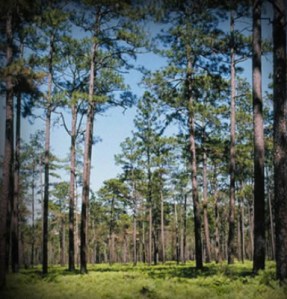
The endangered gopher tortoise, the main character in my current story, loves sandy areas for creating its underground burrows and depends on the grasses and other plants the grow on the floor of a well-maintained longlreaf pine forest. Unlike hardwood and mixed forests, longleaf forests feature widely spaced trees with minimal brambles, mid-level trees and shrubs. These forests are maintained by natural fires that roar through and clean away the clutter that would eventually destroy the forest.

The den of a gopher tortoise is great protection against such fires, fires that often run through quickly without burning as hot as summer fires in hardwood forests, especially where brush has built up.

In addition to logging off most of the longleafs and replanting with slash pines and loblolly pines, many don’t understand the need for fires and tend to put them out before they do what nature intended.

Fortunately, enlightened forest management specalists are showing show landowners, as well as active forest companies, the value of these trees, not only commercially as tree farms, but for the environment as well. Click here if you live in the Southeastern United states and would like to visit a longleaf pine forest park or recreation area near you.

Realism and Magic Together

gophortortoiseAccording to Seminole legends, the Earth’s animals emerged from the Creator’s birthing shell in a specific order long before man arrived. My stories about the animals of this time focus on their learning what their living place is all about—what to eat, how to find shelter, how to raise their young. I mix my talking animals out of myth with settings as realistic as I can make them. So now I’m studying the tortoise’s habitat.

Every time I pick a new animal and a somewhat new habitat, I have a good excuse for learning more about the Florida world where I grew up. I started writing these stories when several sequences in my upcoming novel The Seeker were set here and I fell in love with the place all over again.

Malcolm

Coming March 2013
Coming March 2013

Review: ‘The Infernal Republic’ by Marshall Moore

The Infernal Republic, collected short storeis by Marshall Moore, 228 pages, Signal 10 Media Inc (2/14/2012)

Marshall Moore’s seventeen short stories in The Infernal Republic not only push the envelope, they destroy it. Endlessly inventive and varied, these twisted tales tend to focus on strange—and potentially warped—characters who are often in lose-lose situations that resolve (more or less) in ironic twists of fate. For readers who love outside-the-box storytelling, each normal, abnormal and paranormal gem in this book is a surprising flight of fancy into regions that are portrayed in straight-forward and hauntingly explicit detail.

The collection begins with Liesl and Joanna in “Urban Reef (or, It’s Hard to Find a Friend in the City)” enjoying wine and small talk in a Portland, Oregon restaurant while watching a potential suicide jumper on an adjacent building. If he jumps, how much of a mess will it make. Not for the squeamish, this one, nor many of the other offerings either as the book wends it devious way through incidents and conversations that we watch, rather like Interstate car wrecks, in spite of the fact that we’re really good people who are not in any way part of Moore’s world or his imagination.

The book ends with “The Infinite Monkey Theorem” in which Yaweh and Lucifer make a bet about whether or not a large number of monkeys at a large number of typewriters will or won’t ultimately produce the complete works of Shakespeare. The protagonist in this story gets to manage the operation off in a special pocket of temporary space that is described as “near Hell but not quite in it.” In spite of the space and the deities involved, there are logistical matters to attend to as well as issues of trickery and the wager’s true intent.

En route to “near Hell” via Portland, readers will encounter a building that ejects an apartment “like an enormous video-cassette,” a “well-mannered boy” named Jason who doesn’t want to go home, heroes who compete as Prime Combatants with remarkable (and not always pleasant) paranormal powers, a house that wakes up and suddenly becomes sentient, a boy with detachable body parts, a motivational speaker who’s been kidnapped by a cruelly benevolent organization that wants her to grasp the errors of her ways and then accept a punishment of hero own choosing.

Marshall Moore’s seventeen stories will take you where you’ve never been before and—in some case—where you might prefer not too have gone (had you known at the outset just how strange things were going to get).  The Infernal Republic is rather like a smorgasbord of dishes that you didn’t even know could be consumed as food in polite society. You won’t be able to walk away.  And when you finally learn who won the bet about the monkeys and the typewriters, you’ll be glad you kissed your normal reading habits goodbye and hung on for the ride.

Malcolm

Malcolm R. Campbell is the author of magical realism, contemporary and fantasy novels, including “Sarabande.”