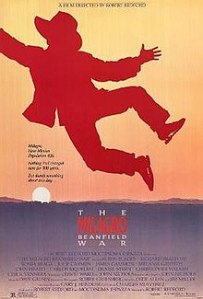
 I’m thinking of this film today because I just learned that John Nichols died at 83 in November, and I’m rather embarrassed that I missed it at the time especially when such publications as The New York Times and The Guardian carried the news. (I can find no public-domain photographs of Nichols.)
The Guardian writes, “Nichols won early recognition with the 1965 publication of his offbeat love story The Sterile Cuckoo, later made into a movie starring Liza Minnelli. The coming-of-age book and subsequent movie were set amid private northeastern colleges that were a familiar milieu to Nichols, who attended boarding school in Connecticut and private college in upstate New York.
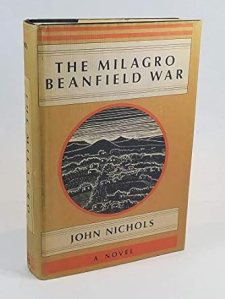
“He moved in 1969 with his first wife from New York City to northern New Mexico, where he found inspiration for a trilogy of novels anchored in the success of The Milagro Beanfield War.”
Wikipedia writes, “Critic Richard Scheib liked the film’s direction and the characters portrayed. He wrote, “Redford arrays a colorfully earthy ensemble of characters. The plot falls into place with lazy, deceptive ease. Redford places it up against a gently barbed level of social commentary, although this is something that comes surprisingly light-heartedly. There’s an enchantment to the film – at times it is a more successful version of the folklore fable that Francis Ford Coppola’s Finian’s Rainbow (1968) tried to be but failed.”
I liked the movie although the reviews were mixed.
From The Publisher
“Joe Mondragon, a feisty hustler with a talent for trouble, slammed his battered pickup to a stop, tugged on his gumboots, and marched into the arid patch of ground. Carefully (and also illegally), he tapped into the main irrigation channel. And so began-though few knew it at the time of Milagro beanfield war. But like everything else in the dirt-poor town of Milagro, it would be a patchwork war, fought more by tactical retreats than by battlefield victories. Gradually, the small farmers and sheepmen begin to rally to Joe’s beanfield as the symbol of their lost rights and their lost lands. And downstate in the capital, the Anglo water barons and power brokers huddle in urgent conference, intent on destroying that symbol before it destroys their multimillion-dollar land-development schemes.
“The tale of Milagro’s rising is wildly comic and lovingly tender, a vivid portrayal of a town that, half-stumbling and partly prodded, gropes its way toward its own stubborn salvation.”
–Malcolm
 Like many avid–or perhaps crazed–readers, I have several go to books that never disappoint me when I re-read them while waiting for something new to arrive in the mail. I always re-read my favorite books of the year several times–such as those by Ruta Sepetys, Sunetra Gupta, and John Hart. But when I truly want to escape reality, I turn to Pat Conroy’s The Prince of Tides or Nicholas Evans’ The Horse Whisperer.
 Malcolm's Round Table