Voice-over monologue in film noir

Film noir is famous for its sarcastic, metaphor-filled voice-over monologue that often shows just how cynical the protagonist is about life. I thought of this while re-reading Ruta Sepetys Out of the Easy which gets the style and ambiance of the New Orleans French Quarter just right. I appreciate this line about Willie, the bordello madam: “The voice was thick and had mileage on it.”

One of my favorite lines comes from the former TV series “Early Edition” (1996-2000) about a guy who knows stuff because he gets the newspaper a day early: “The fog was as thick as hash-house oatmeal and twice as cold.”
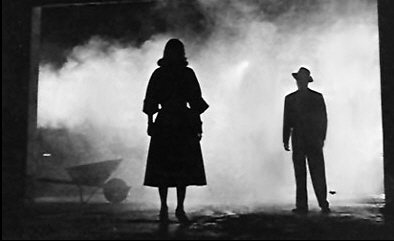
Two silhouetted figures in The Big Combo (1955). The film’s cinematographer, John Alton, was the creator of many of film noir’s stylized images. – Wikipedia

As “Private Eye Monologue” says, “The signature narration style in Film Noir. A bored-looking, world-weary, the utterly cynical detective (hardboiled and/or defective) with his feet on the desk meets a Femme Fatale, while the voiceover gives us his mental play-by-play:” She walked through my door like a tigress walks into a Burmese orphanage — strawberry blonde and legs for hours. No dame her age could afford a coat like that, and the kinda makeup she had on gave me a good idea how she got it. She had bad news written on her like October of ’29.

The 1946 film “The Big Sleep”(Bogart and Bacall) by Raymond Chandler/William Faulkner, and others, is one of the more enduring noir films because of the stars, author, and director, Howard Hawkes. Chandler’s lines are memorable within the genre: “Dead men are heavier than broken hearts,” “I don’t mind if you don’t like my manners. They’re pretty bad. I grieve over them during the long winter nights,” and “Neither of the two people in the room paid any attention to the way I came in, although only one of them was dead.”
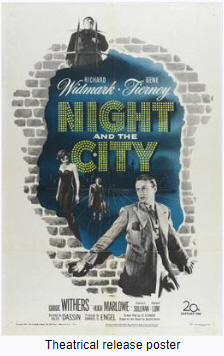
Wikipedia describes Night and the City as “a 1950  film noir directed by Jules Dassin and starring Richard Widmark, Gene Tierney and Googie Withers. It is based on the novel of the same name by Gerald Kersh. Shot on location in London and at Shepperton Studios, the plot revolves around an ambitious hustler who meets continuous failures.” One can’t help but notice: This is like the Greyhound station for DEATH!

From “Murder, My Sweet,” we get: “Okay Marlowe,” I said to myself, ‘You’re a tough guy. You’ve been sapped twice, choked, beaten silly with a gun, shot in the arm until you’re crazy as a couple of waltzing mice. Now let’s see you do something really tough—like putting your pants on.’

From the “Lady from Shanghai”: “Maybe I’ll live so long that I’ll forget her. Maybe I’ll die trying.”

And “Key Largo” “When your head says one thing and your whole life says another, your head always loses.”

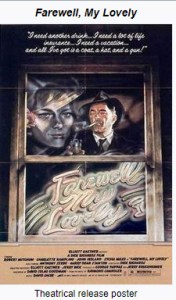
According to Wikipedia, “Farewell, My Lovely is a novel by Raymond Chandler, published in 1940, the second novel he wrote featuring the Los Angeles private eye Philip Marlowe. It was adapted for the screen three times and was also adapted for the stage and radio.” I like the 1975 version (classified more as neo-noir) with Robert Mitchum the best: “It was one of those transient motels, something between a fleabag and a dive” and Moose never would have hurt her. It didn’t matter to him that she hadn’t written in 6 years. It didn’t matter that she turned him in for a reward. The big lug loved her… and if he was still alive… it wouldn’t matter to him that she’d pumped 3 bullets into him… What a world.”

There’s no way to sum all this up except to say that anyone who loves noir has already gone over to the dark side.

–Malcolm
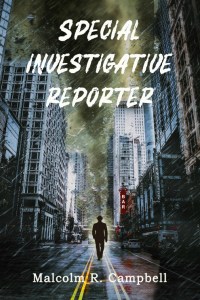
Malcolm R. Campbell is the author of the pseudo-noir thriller Investigative Reporter.
Some of my favorite noir movie lines

I’ve always been a fan of noir movies (and a few neo-noir movies as well). If you like noir and have Turner Classic Movies on your Cable or Satellite, they show a lot of them, especially on Noir Alley, a program with some cool commentary before and after the film. Here are some of my favorite lines, starting out with a 1975 neo-noir film with Robert Mitchum.

  • Wikipedia Photo

    “I needed a drink, I needed a lot of life insurance, I needed a vacation, I needed a home in the country. What I had was a coat, a hat and a gun. I put them on and went out of the room.” ― Raymond Chandler, of course.

  • “Okay Marlowe,” I said to myself, ‘You’re a tough guy. You’ve been sapped twice, choked, beaten silly with a gun, shot in the arm until you’re crazy as a couple of waltzing mice. Now let’s see you do something really tough—like putting your pants on.” – Dick Powell as Philip Marlowe in “Murder, My Sweet” (1944)
  • “I can afford a blemish on my character, but not on my clothes.” – Vincent Price as Shelby Carpenter in “Laura” (1944)
  • “You know what he’ll do when he comes back? Beat my teeth out, then kick me in the stomach for mumbling.” – Humphrey Bogart as Philip Marlowe in “The Big Sleep” (1946)
  • “You knew when a woman loves you like that, she can love you with every card in the deck and then pull a knife across your throat the next morning.” – Van Heflin as Jeff Hartnett in “Johnny Eager” (1941)
  • Wikipedia photo

    “What a beautiful picture. Moonlight. Sagebrush. My wife with a stranger.” Vincent Price as Lloyd Rollins in “The Las Vegas Story” (1952).

  • “With my brains and your looks, we could go places.” – John Garfield as Frank Chambers in “The Postman Always Rings Twice” (1946).
  • “Flossie had looks, brains, and all the accessories. She was better than a deck with six aces. But I regret to report that she also knew how to handle a gun. My gun.” John Hoyt as Spencer in Brute Force (1947).
  • “Maybe I’ll live so long that I’ll forget her. Maybe I’ll die trying.” – Orson Welles and Michael O’Hara in “Lady from Shanghai” (1947).
  • “Decency and integrity are fancy words, but they never kept anybody well fed. And I’ve got quite an appetite.” Howard Duff as Jack Early in “Shakedown” (1950).
  • Wikipedia photo.

    “When your head says one thing and your whole life says another, your head always loses.” – Humphrey Bogart as Frank McCloud in “Key Largo” (1948).

  • “I sell gasoline. I make a small profit. With that I buy groceries. The grocer makes a profit. We call it earning a living. You may have heard of it.” – Robert Mitchum as Jeff Bailey in “Out of the Past” (1947)

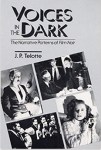
If you’re interested in film noir, one of my favorite books about it, Voices in the Dark: Narrative Patterns of Film Noir just happens to have been written by a colleague of mine, J. P. Telotte, from Berry College, Rome, GA. We saw a lot of noir films whenever we went over to his house for dinner. He’d bring a projector home from work and run one of the films he was discussing in the classroom. While we agreed on the film noir and the Federico Fellini films such as “Juliet of the Spirits” (definitely not noir), we always clashed on whether Katherine Hepburne and Meryl Steep were good actresses. I said “yes,” while he said “no.”

Some people think noir is a bit of a downer. Perhaps that’s true. But the atmosphere, the voice-over narration, and the snappy dialogue always lure me into it.

–Malcolm

You’ll find a touch of noir in Campbell’s audio book “Jock Stewart and the Missing Sea of Fire.”


‘Technique alone is just an embroidered potholder’

“Technique alone is never enough. You have to have passion. Technique alone is just an embroidered potholder.” 
― Raymond Chandler

I just finished a novel (see picture) that was 99% technique and 1% nonsense. The author used a technique that’s so ubiquitous these days, it’s got to be more than a fad. It’s an epidemic.

It works like this. You’re reading a high-stakes chapter, probably a thriller, and at the end of the chapter something untoward happens such as, “Bob kicked open the door and noticed 25 men pointing their guns at him.”

You turn the page wondering, more than idly, how the hero’s going to get out of this mess. Do you find out? No. What you see is the beginning of a new section of the book called SIX MONTHS EARLIER and most of that section seems completely irrelevant or, in writer talk: a very intrusive backstory.

There’s no passion in this, and I’m not talking about the kind of passion Raymond Chandler was referring to when he wrote, “It was a blonde. A blonde to make a bishop kick a hole in a stained-glass window.” The story would have been more interesting if it had been a house of cards rather than a house of gimmicks.

The story lacked passion because when it came down to it the story and the characters didn’t really matter. Instead, they were cheap tricks strung together like the kind of necklace you can buy at a pawn shop for a couple of bucks. Unfortunately, the book cost more than that and didn’t have the gumption to acknowledge that, when compared to cheap hookers, it was more false.

The novel, written by an author whom the blurbs said was the next Stephen King or the next Michael Crichton, had an inventive beginning in which a passenger jet arrives at a small airport where the flight pilot and copilot discover that everyone on the ground is apparently dead. Unfortunately, the main characters immediately out themselves as dysfunctional. Suddenly, the novel reminds me of Chandler’s line, “From 30 feet away she looked like a lot of class. From 10 feet away she looked like something made up to be seen from 30 feet away.”

At a distance, the story has possibilities worthy of King and Chrichton. Up close, it’s dysfunctional characters and a lot of technique. The author has chosen a distasteful stew of technique, characters who are too broken to even speak to each other, and techno-speak with which to engineer this costume jewelry of a story.

Here’s a spoiler: Google, we learn, might be developing products that aren’t good for us even though they have plenty of technique in them and look like they are good for us. Well, that’s hardly a new idea. Nonetheless, it’s the driving force behind why the ground crew at the airport seem to be dead.

In the final analysis, there’s nothing to see here or, as Chandler says, “The moment a man begins to talk about technique that’s proof that he is fresh out of ideas.”

It takes guts, I think, to tell a story straight rather than relying on stale smoke and cloudy mirrors. Dead on Arrival is dead on arrival.

Malcolm