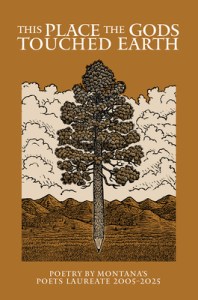
‘This Plade The Gods Touched Earth’, Montana Arts Council

The beauty of this place we now call Montana inspires such awe that words frequently fail us. And that’s when we call for the poets. The book in your hands is a campfire of sorts, around which eleven poets laureate have gathered. Their legacy joins thousands of years of voices speaking across this landscape.

Twenty years is a blip in the reckoning of this place, but in that time Montana’s poets laureate have chronicled the scale and shape of its grandeur and its grace, and the hardships and hopes of the people who call it home. This collection is a glimpse into their work and the importance of the spoken word to this best of places.

Published by the Montana Arts Council in collaboration with the Montana Historical Society, This Place the Gods Touched Earth collects work from Montana’s eleven poets laureate to date, celebrating their responses in words to the people and places of the Big Sky, and commemorating their two decades of service to Montana’s literary landscape so far.

This Place the Gods Touched Earth is the first poetry anthology to come out of the Montana Historical Society Press. But it’s much more than that—speaking as the historian that I am, this anthology is the bottled zeitgeist of Montana over the past two decades of the Poet Laureate program,” says Jeff Bartos, editor, Montana Historical Society Press. “It’s a primary source for the language arts in Montana in the twenty-first century, compiling—by discretion of the individual poets—their most meaningful writings and profound observations into one volume.’

The anthology is a collection of Montana’s Poets Laureate, 2005 – 2025.

–Malcolm

Well-Read Parents Might Be Dangerous

When well-read parents own a lot of books–mine had several thousand or more–multiple ideas lurk on those shelves like landmines and/or philosopher’s stones waiting for curious kids to find. I found plenty. Whether or not I found these by my folks’ and mischievous spirits’ designs or by  coincidence when I was ready to read them, I don’t know except to say that I don’t believe in coincidences.

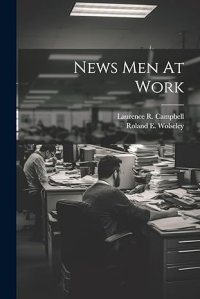
Both of my parents were high school student publications advisers and my dad was a college journalism dean and the author of journalism textbooks. So, I became a writer, a college journalism instructor, and an adviser for a college’s student newspaper. Like my father, I ultimately married one of my students. My father’s journalism school and my journalism program were both destroyed by politics, though our marriages endured.

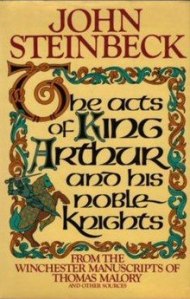
My long-time interest in King Arthur and the Grail romances began when I found John Steinbeck’s posthumously published The Acts of King Arthur and his Noble Knights on the shelf.  After discovering that book, I went on to read everything I could find about King Arthur who, strange as it may seem, actually appears in the genealogy of the Clan Campbell family in Scotland.

I’ve written often here about magic and ancient mysteries books, and without a doubt that interest began with James Allen’s 1903 book As a Man Thinketh. Over time, the beliefs in that book changed my life.

My favorite poet St.-John Perse came into my consciousness when I found a 1944 book published in English and French called Éloges and Other Poems. I remember my college English teacher who threw me out of class for disagreeing with him about the value of journalism, telling me, talk to me after you know about poets like St.-John Perse. I showed him a copy of this book at the next meeting of the class.  “This has been in my family since the year I was born. Any questions?” He wanted to buy the copy which I said belonged to my mother and was not for sale. Nonetheless, I was re-admitted to the class. I don’t deal well with know-it-all English teachers, especially those who say journalistic writing is bad writing.

Perhaps you remember finding some of your parents’ books that influenced your interests years later. I hope so. My parents and I disagreed about a lot of things, many of which stemmed from their books left out in the open on the family’s shelves. Ironic, I think.

I never really needed a library because all I could ever want was under my own roof–for better or worse.

–Malcolm

‘Summer Serenade’ by Elise Skidmore

As a disclaimer, I should mention that I have known Elise online since the days when CompuServe was the pre-eminent social, technical, and professional network in cyberspace. Both of us were participants in the very busy Literary Forum where Elise was on the staff for almost ten years.

Summer Serenade was released on August 10 by Heart Ally Books at 112 pages. Skidmore’s previous books (Looking for the Light: Hindsight is 2020, A Dance of Dreams. among others) show us a prolific poet and short story author. She also produces her books’ illustrations.

From the Publisher

“A New Yorker by birth, Elise Skidmore lives on the south shore of Long Island with her husband. Recently retired, they enjoy spending time together and love to travel. Their nest may be empty, and though she misses her two daughters, she is very proud of the wonderful women they have become.

“She has been a writer since childhood, with poetry being her focus for many years. It’s her way of working through dark times and celebrating the joyful ones. SUMMER SERENADE is her fifth volume of poetry. Two of her earlier anthologies were finalists for Epic eBook Awards. She is also an amateur photographer and her original photography can be seen in all her books. While one may summarize Elise in any number of wonderful descriptors, the chief among them must always be a writer.”

Since I grew up on Florida’s Gulf Coast, I appreciate the book’s dedication: “To anyone who has held a seashell to their ear and heard the ocean singing.” Yes, I have. And then there’s the opening story “You Wanted a Story.” It’s a wonderful prelude to the poems that follow.

Malcolm

New Anthology Of Native Nations Poetry

“There are many of us and we’re not just poets. We’re teachers. We’re dancers. Essentially, we’re human beings. And you would think that at this time we would not have to say that. But we still are in the position, strangely enough, that we still have to remind people and the public that: We’re still here, we’re still active. We have active, living cultures and we are human beings and we write poetry.”

Joy Harjo, NPR Interview

When the Light of the World Was Subdued, Our Songs Came Through: A Norton Anthology of Native Nations Poetry is a remarkable book because of the power of its words, because of its scope (160 poets from 100 indigenous nations), and because it exists at all.

Publisher’s Description

“This landmark anthology celebrates the indigenous peoples of North America, the first poets of this country, whose literary traditions stretch back centuries. Opening with a blessing from Pulitzer Prize–winner N. Scott Momaday, the book contains powerful introductions from contributing editors who represent the five geographically organized sections. Each section begins with a poem from traditional oral literatures and closes with emerging poets, ranging from Eleazar, a seventeenth-century Native student at Harvard, to Jake Skeets, a young Diné poet born in 1991, and including renowned writers such as Luci Tapahanso, Natalie Diaz, Layli Long Soldier, and Ray Young Bear. When the Light of the World Was Subdued, Our Songs Came Through offers the extraordinary sweep of Native literature, without which no study of American poetry is complete.”

Anthology’s Introduction

Executive editor Joy Harjo’s (Mvskoke/Creek) introduction grounds us and prepares us for the great circle of words of power we will take through the book’s five sections: Northwest and Midwest; Plains and Mountains; Pacific Northwest, Alaska, and Pacific Islands; Southwest and West; and Southeast. Each of these regions begins with a descriptive preface, and the work of each poet includes a mini-biography.

The focus, intent, and power of this work are aptly summarized by Harjo’s opening lines: “We begin with the land. We emerge from the earth of our mother, and our bodies will be returned to earth. We are the land. We cannot own it, no matter any proclamation by paper state. We are literally the land, a planet. Our spirits inhabit this place. We are not the only ones. We are creatures of this place with each other. It is poetry that holds the songs of becoming, of change, of dreaming, and it is poetry we turn to when we travel those places of transformation, like birth, coming of age, marriage, accomplishments, and death. We sing our children, grandchildren, great-grandchildren: our human experience in time, into and through existence.”

Harjo notes that while the United States has been here only a few hundred years, “Indigenous peoples have been here for thousands upon thousands of years and we are still here.” Yet unknown to most people, an afterthought to others, and long presumed to be illiterate by most; there never was a level playing field once the outsiders arrived, and so because of all of this, it’s remarkable that this anthology has been lovingly compiled out of the subdued light into our national consciousness. Let’s hope the powerful work it represents remains there.

The Poems

The wonders of four centuries of poetry cannot be adequately summarized or displayed here, much less explicated. So here are a few brief excerpts that caught my attention:

From the Northeast and Midwest

  • EMILY PAULINE JOHNSON (TEKAHIONWAKE) (1861–1913), Mohawk, “Marshlands”

Hushed lie the sedges, and the vapours creep,
Thick, grey and humid, while the marshes sleep.

  • OLIVIA WARD BUSH-BANKS (1869–1944), Montaukett, “On the Long Island Indian

But there came a paler nation
Noted for their skill and might,
They aroused the Red Man’s hatred,
Robbed him of his native right.

Now remains a scattered remnant
On these shores they find no home,
Here and there in weary exile,
They are forced through their life to roam.

From the Plains and Mountains

  • ZITKÁLA-ŠÁ (GERTRUDE SIMMONS BONNIN) (1876–1938), Dakota, “The Red Man’s America”

My country! ’tis to thee,
Sweet land of Liberty,
My pleas I bring.
Land where OUR fathers died,
Whose offspring are denied
The Franchise given wide,
Hark, while I sing.

  • N. SCOTT MOMADAY (1934–), Kiowa, “The Gourd Dancer”

A vagrant heat hangs on the dark river,
And shadows turn like smoke. An owl ascends
Among the branches, clattering, remote
Within its motion, intricate with age.

From the Pacific Northwest, Alaska, and Pacific Islands

  • MARY TALLMOUNTAIN (1918–1994), Koyukon, “There Is No Word For Goodbye”

Sokoya, I said, looking through
the net of wrinkles into
wise black pools
of her eyes.

What do you say in Athabascan
when you leave each other?
What is the word
for goodbye?

A shade of feeling rippled
the wind-tanned skin.
Ah, nothing, she said,
watching the river flash.

She looked at me close.
We just say, Tłaa. That means,
See you.
We never leave each other.
When does your mouth
say goodbye to your heart?

She touched me light
as a bluebell.
You forget when you leave us;
you’re so small then.
We don’t use that word.

We always think you’re coming back,
but if you don’t,
we’ll see you some place else.
You understand.
There is no word for goodbye.

  • FRED BIGJIM (1941–), Iñupiaq, “Spirit Moves”

Sometimes I feel you around me,
Primal creeping, misty stillness.
Watching, waiting, dancing.
You scare me.

From the Southwest and West

  • PAULA GUNN ALLEN (1939–2008), Laguna, “Laguna Ladies Luncheon”

     on my fortieth birthday
Gramma says it’s so depressing—
all those Indian women,
their children never to be born
and they didn’t know they’d been sterilized.
See, the docs didn’t want them
bothered, them being so poor and all,
at least that’s what is said.
Sorrow fills the curve of our breasts,
the hollows behind the bone.

  • EMERSON BLACKHORSE MITCHELL (1945–), Diné, “Miracle Hill”

I stand upon my miracle hill,
Wondering of the yonder distance,
Thinking, When will I reach there?

I stand upon my miracle hill.
The wind whispers in my ear.
I hear the songs of old ones.

From the Southeast

  • JOHN GUNTER LIPE (1844–1862), Cherokee, “To Miss Vic”

My spirit is lonely and weary,
I long for the beautiful streets.
The world is so chilly and dreary,
And bleeding and torn are my feet.

  • RUTH MARGARET MUSKRAT BRONSON (1897–1982), Cherokee, “Sentenced”

They have come, they have come,
Out of the unknown they have come;
Out of the great sea they have come;
Dazzling and conquering the white man has come
To make this land his home.

We must die, we must die,
The white man has sentenced we must die,
Without great forests we must die,
Broken and conquered the red man must die,
He cannot claim his own.

The editors of this anthology read each poem aloud, better to understand, hear them, savor them, and drink them into themselves like a rare elixir. Should time permit–and why would it not?–you will do the same.

Malcolm

National Poetry Month: ‘Sharks in the Rivers’

If Ada Limón stopped writing poetry today–hard to imagine as that is–she would probably be remembered for Bright Dead Things and her most recent collection The Carrying. However, I want to mention her 2010 collection sharks in the rivers because–as with many singers, for example–a writer’s earlier words are often created and executed through raw, wild power that, in time, often becomes more polished as the years go by. I think this searching, magical volume will always stand out as a primal voice that time will always be trying to tame.

Review

In his review in The Brooklyn Rail, Jeffrey Cyphers Wright wrote,

“Rivers and sharks are grand metaphors in these ruminative soliloquies—as much about going with the flow as facing down your demons. Bravery and fear, like opposing eyes peering through the murk, inform Ada Limón’s vision. Not one to be obsessively reductive, minnows, angelfish, and barracudas round out “the City of Sharks” she navigates.

“Limón allegorizes other creatures as well: owls, sparrows, cormorants, and butterflies. ‘Every one of us with a bear inside.’ This penchant for mixed metaphors could be disastrous in a more rigid, less expansive treatment, but here it is compelling. Candor and artifice intertwine with (human) nature and Surrealism—think Sharon Olds (her teacher) dancing with Pablo Neruda.”

Publisher’s Description

“The speaker in this extraordinary collection finds herself multiply dislocated: from her childhood in California, from her family’s roots in Mexico, from a dying parent, from her prior self. The world is always in motion — both toward and away from us—and it is also full of risk: from sharks unexpectedly lurking beneath estuarial rivers to the dangers of New York City, where, as Limón reminds us, even rats find themselves trapped by the garbage cans they’ve crawled into. In such a world, how should one proceed? Throughout Sharks in the Rivers, Limón suggests that we must cleave to the world as it ‘keep[s] opening before us,’ for, if we pay attention, we can be one with its complex, ephemeral, and beautiful strangeness. Loss is perpetual, and each person’s mouth ‘is the same / mouth as everyone’s, all trying to say the same thing.’ For Limón, it’s the saying—individual and collective — that transforms each of us into ‘a wound overcome by wonder,’ that allows ‘the wind itself’ to be our ‘own wild whisper.'”

As you read these poems, you might not always be sure whether the lines are magical realism or metaphor. Or both. Or, just how the speaker has seemingly merged with that about which she speaks.

“I saw myself by the Rio Grande watching
a crane swoops down over the collection pond.

I was the fish in the drainage ditch,
you, the crane’s scissoring shadow.”

“Every one of us has a sparrow
underneath her tongue,
bouncing and burrowing.”

“(Sharks are listening right now, I’m sending out signals.)

I’m dreaming of them. I’m wrapping my arms
around their cold, gray, magnificent bodies.

We’re both sleeping
with our shark-eyes open”

The object (or critter) and the observer become one and the same.

Malcolm

National Poetry Month: ‘She Had Some Horses’

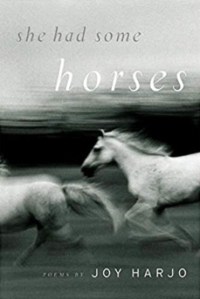
This month I would like to mention several collections of poetry that speak to me. Let’s begin with Joy Harjo’s 1983 collection She Had Some Horses with its powerful title poem of the same name. Harjo’s poems are wind, rain, earth, fire, and spirit. Read them when you have time to meditation upon the pure, non-human and essential wildness of the natural world at its most basic and primitive level. This book is a good first step.

“I discovered “She Had Some Horses” while preparing for the poetry class I teach at an elementary school in San Francisco. Harjo’s poems ache with grit, grief and nature. They feel like that moment of insomnia when twilight breaks. Her lines are curt and heavy but they construct delicate stories. I thought She Had Some Horses would be perfect for kids this young, whose imaginations are still lush and wild. To them, horses are still spirited creatures, not farm workers.” – Julie Morse in The Rumpus

Born in Tulsa, Oklahoma, Harjo is a member of the Mvskoke Nation. She has written seven books of award winning poetry. She also writes and performs original music, available on five CDs

In her introductory remarks to the 1997 edition, Harjo writes, “I do not know how to explain the horses, how to tell you about the genesis of the poems, or the poem “She had some horses.” I am asked often about these poems, to elaborate the process, the history, the mythic sense, the horses, I have changed as much as these poems through the years. Nothing ever stays the same, whether it be poems or humans. When I look back over the many lines between then and now I remember a very young woman with a typewriter, entering the field of imagination with a great trust, even wildness. And there were the horses shimmering in the sun and rain on the battlefield of gains and losses, always revealing the possibility of love.”

For the current 2008 paperback edition introduction, she says, “Horses, like the rest of us, can transform and be transformed. A horse could be a streak of sunrise, a body of sand, a moment of ecstasy. A horse could be all of this at the same time. Or a horse might be nothing at all but the imagination of the wind. Or a herd of horses galloping from one song to the next could become a book of poetry.”

The horse is my totem animal. Perhaps he nudged me into this book. Or maybe it was the wind or the gods. You will find your way into this marvel if the universe wills it. If so, you will never leave. Every time you walk from page to page you will be changed. That’s the nature of the words you’ll find here.

–Malcolm


Poetry – a few favorite first lines

Some poems reach us. We’re not always sure why. In fact, I’m more content when the reasons I like a poem never quite add up because my appreciation of it is beyond logic.

I know that I like the opening quatrain of Poe’s “To Helen” partly because of the rhymes and alliteration. Perhaps I’ve seen such beauty in another from time to time and this reminds me of it:

Helen, thy beauty is to me
Like those Nicéan barks of yore,
That gently, o’er a perfumed sea,
The weary, way-worn wanderer bore
To his own native shore.

Calliope, the muse of epic poetry. – Wikipedia

“Fern Hill,” by Dylan Thomas is probably my favorite poem. We are lucky if we feel the magic of youth this way because it is very nearly a spiritual relationship with the world and the cosmos:

Now as I was young and easy under the apple boughs
About the lilting house and happy as the grass was green,
The night above the dingle starry,
Time let me hail and climb
Golden in the heydays of his eyes,
And honoured among wagons I was prince of the apple towns
And once below a time I lordly had the trees and leaves
Trail with daisies and barley
Down the rivers of the windfall light.

Few people these days remember the poet Saint-John Perse, but his Éloges and other poems published the year I was born is a wonderful collection. The first edition I have, once owned by my mother, displays the poems on side-by-side pages in English and the original French. For today’s reader, these poems are probably overly rich. The opening of “To Celebrate Childhood” is another way at the truth of “Fern Hill”:

…Then those flies, that sort of fly, and the last tier of
the garden…Someone is calling. I’ll go..I speak in esteem
–Other than childhood, what was there in those days
that is not here today?
Plains! Slopes! There
was greater order! And everything was but shimmering
reigns and frontiers of light. And shadow and light in those
days were more nearly the same thing…I speak of an esteem
…Along the borders the fruit
might fall
without joy rotting along our lips.

Natasha Trethewey, a Pulitzer prize winner and former U.S. Poet Laureate, writes strong poems with (quite often) a bite. I’m very fond of them and her way of thinking.  “Domestic Work” is a good example:

All week she’s cleaned
someone else’s house,
stared down her own face
in the shine of copper–
bottomed pots, polished
wood, toilets she’d pull
the lid to–that look saying

Let’s make a change, girl.

“She Had Some Horses” by Joy Harjo builds and builds on itself until its power is strong enough to make one weep:

She had some horses.
She had horses who were bodies of sand.
She had horses who were maps drawn of blood.
She had horses who were skins of ocean water.
She had horses who were the blue air of sky.
She had horses who were fur and teeth.
She had horses who were clay and would break.
She had horses who were splintered red cliff.

She had some horses.

Rabindranath Tagore, a Nobel Prize winner who lived in India and wrote in Bengali has a rich body of work that I first came across when I was in high school in a book my father had on our living room shelf. I like “The Source”:

The sleep that flits on baby’s eyes-does anybody know from where
it comes? Yes, there is a rumour that it has its dwelling where,
in the fairy village among shadows of the forest dimly lit with
glow-worms, there hang two shy buds of enchantment. From there it
comes to kiss baby’s eyes.
The smile that flickers on baby’s lips when he sleeps-does
anybody know where it was born? Yes, there is a rumour that a young
pale beam of a crescent moon touched the edge of a vanishing autumn
cloud, and there the smile was first born in the dream of a dew
washed morning-the smile that flickers on baby’s lips when he
sleeps.

I can’t shoe-horn the beginnings of all the poems that have caught my attention again and again since childhood into one blog post. But, it was fun to share a few, and perhaps start others thinking about the poetry they return to when they’re in need of hope, empathy, and inspiration.

Malcolm


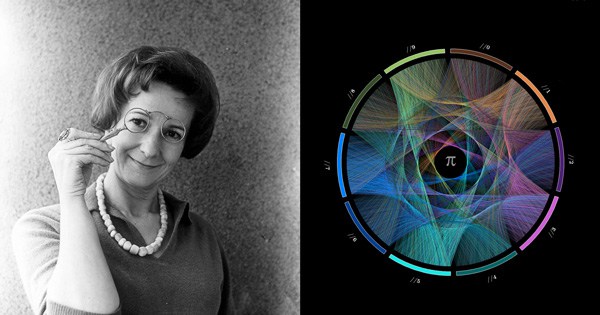
An Ode to the Number Pi by Nobel-Winning Polish Poet Wisława Szymborska 

“I am thinking about time this morning — about how it expands and contracts in the open fist of memory, about how the same duration can feel like a blink or incline toward the infinite, or even do both at once. Eleven years ago today, Brain Pickings began — birthed by what feels like another self, one that was once myself but no longer is and never again will be, and yet tethered to who I am today by some invisible thread of personal sensibility woven by and of time.”

Source: An Ode to the Number Pi by Nobel-Winning Polish Poet Wisława Szymborska – Brain Pickings

Congratulations to Maria Popova and her eleven years of hard work on “Brain Pickings.” Here you’ll find some of the most diverse, exciting, literate, and inspirational essays and articles on the Internet.

Today’s poem is a good example of the wonders to be found here. Take a look. Subscribe. Feel enriched.

–Malcolm

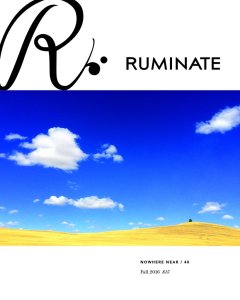
Ruminate’s Janet B. McCabe Poetry Prize Deadline is May 15th

“For people feeling overwhelmed by life’s frantic pace, a contemplative and imaginative space changes everything. Join our community, and let’s practice staying awake together.” – Ruminate Magazine

  • What: Two previously unpublished poems per entry; 40 lines each or less
  • Entry Fee: $20. Includes copy of the magazine
  • Deadline: May 15th; winners notified in August
  • Prizes: $1,500 + publication for first place, $200 + publication for second place
  • Submission Page: https://www.ruminatemagazine.com/pages/poetry-prize; full guidelines page (more info than the submission page)
  • Finalist Judge: Shane McCrae
  • More: Scroll down from the submission page for a link to a free excerpt of the winning poems from a past year. This will give you an idea of what the magazine is looking for if you’re not a subscriber.

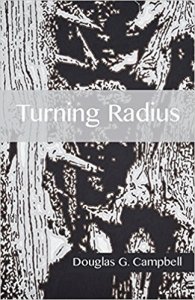
Briefly Noted: “Turning Radius’ by Douglas G. Campbell

Reader reviews and editorial book reviews written by husbands, wives, brothers, sisters, mothers, fathers, colleagues and next door neighbors are quite rightfully looked upon with a jaundiced and cynical eye by prospective readers. So, I cannot review my brother’s book of poems Turning Radius (Oblique Voices Press: March 2017). Nor can I rate it with stars on Amazon or GoodReads.

I can tell you that it exists.

From the PublisherA book of 100 poems written during the years before the author’s stroke in 2012. Rather than organizing the poetry as a volume with a single formal or thematic focus, this book’s seven sections coalesce as something more like an omnibus, or, on closer reading, like a jewel with seven facets, each of which displays a different aspect of the author’s rigorously lived inner life.

The book’s seven sections are Lemonade Days, Canticles of Humanness, Turning Radius, Spirits of the Earth, Nature’s Continuum, Listen to the Earth, and War and Art. In his foreword, William Jolliff writes that these sections suggest “an unsettling consistency, and that consistency is discovered as a complex of attributes that have characterized all of Campbell’s artistic work: an attention to everyday details, startling in its intricacy; a sense of irony that laughs and rages but is slow to anger; a knowledge of natural phenomena that attests to many hours in the wilderness as well as in the studio; and a practiced craft that inevitably chooses the perfect form for the message conveyed.”

From “Dark Canticle”When I should be resting/vast empty spaces of the earth/ swallow my heart.

From “Carnival”Embrace your wrinkled exteriors/for they are your salvation;/in this nation of smooth talkers/they are a testimony/bearing witness to truth.

From “Turning Around”Too many times/I have not stopped/to turn around/to stoop/to bring into focus/some curiosity/clinging/to the edge of sight.

The book is available in paperback. I enjoyed reading it from cover to cover: I think I can tell you that.

Malcolm