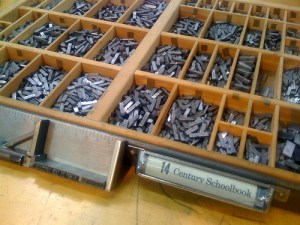
The term “pied type” refers to handset type that’s been dropped on the floor, scattering in a mess.
Handset type was stored by font in a California Job Case, a removable drawer in a cabinet. The letters were arranged in the case in order of their frequency of use. Printers created words, one letter at a time in a composing stick–a small hand-held tray which the typesetter viewed upside down. (The Linotype did this automatically, one line at a time–quite a time savings)
When the typesetter finished a column or part of a column, he tied the type tightly together with string and then transferred it to a form to be mounted on the press. If he dropped it, he said he had pied his type. “Pi” or “Pie” type refers to mixed up stuff whether it’s a dropped block of type or pieces of the wrong font mixed up in a job case.
Handset type was still prevalent enough in the late 1960s that my journalism course work included a printing class in which we were all trained to set type this way. Years later, I would still find some printers–especially those doing formal invitations on small platen presses–to be setting type in a stick and letting lose with a lot of profanity whenever the type got pied.
Malcolm
-
Subscribe
Subscribed
Already have a WordPress.com account? Log in now.
 Malcolm's Round Table