If you have watched movies set on board Navy ships, you have probably seen the captain use the “1-MC” shipboard-wide public address system to make announcements. Or, if the main characters weren’t bridge officers, you probably heard 1-MC announcements in the background. Some, like “General Quarters” require an immediate response. Others are informational in nature and/or apply to certain people.
In my recent contemporary fantasy The Sailor, I wanted to give a bit of the flavor of ship board life by interspersing 1-MC announcements in between segments of action and dialogue. If my book were an audio book, complete with sound effects, I might have these playing in the background. In print, I hope I achieved the same effect by distributing them throughout the text.
My book is set aboard an aircraft carrier. A sailor on a large ship can easily get the feeling that 1-MC announcements are impersonal, come out of nowhere, and are examples of a lot of paperwork and regimentation and tradition that doesn’t always mesh with the reality of most of a man or woman’s hour-by-hour duties. Typical 1-MC announcement:
“Now hear this, now here this, secure from General Quarters. Now set Condition Yoke.” Condition Yoke was the readiness condition set while at sea or in port during wartime.
I added to the atmosphere by also using interspersed bits of “from the bridge” dialogue and official “from the deck log” comments. These are rather stylized in nature and further serve to make the ship at times seem like a rather alien place. Typical bridge dialogue:
“Left five degrees rudder.” “Left five degrees rudder, aye sir, my rudder is left five degrees.”
Each 1-MC message begins with a specific call from a boatswain’s pipe to get the crew’s attention.
Typical deck log entries:
00-04 Maneuvering on various courses and speeds while conducting flight operations 04-08 Steaming as before. 08-12 Steaming as before. 0939 Received daily muster report. No new additions or deletions. 12-16 Steaming as before. 1225 Completed flight operations for this date. Set course 140° Speed 25 knots.
If I were writing about a downtown Chicago car chase, I might mention the weather, the sound of the elevated, and the horns of taxis. For a wilderness scene, there are birds, animals, bad weather and inhospitable terrain. Some times, such things provide ambiance and sometimes they directly impact the plot.
As both a reader and a writer, I like it when a story contains the sighs and sounds around the edges of the action because such things provide atmosphere and even some unexpected plot twists.
“Sweepers, sweepers, man your brooms. Give the ship a clean sweep down both fore and aft. Sweep down all lower decks, ladder wells and passageways! Now sweepers.”
As I work through the final edits for my upcoming novel The Sailor, I find myself smiling at all the weird, strange, and often crude navy slang and acronyms that were a part of daily life when I served aboard the four acres of sovereign soil better known as an aircraft carrier or a bird farm.
Since this is a family blog (don’t ya think?), I won’t mention the profane slang other than to say you can find it quickly enough in a Google search.
One of the first things you learn on an aircraft carrier is that the navy does not fly choppers. If you call a helicopter a chopper, you’ll probably be placed on mail buoy watch (more on that later) or sent off in search of various kinds of equipment and supplies that don’t exist. The helicopter is a Helo (hee-low).
A liberty port
Going ashore is going on the beach whether it’s a beach, a pier, or liberty (free time) in a foreign port where you might get screwed, blued, and tattooed. (Oops, I forgot this is a family blog.) Now hear this, if you get back late from liberty you are not AWOL, you are UA. UA = authorized absence, as in, “I was UA” or “Mr. A.J. Squared Away (a sailor with a perfect shave, perfect uniform, etc.) went UA.”
Once you become a member of Uncle Sam’s Canoe Club, called the Gulf of Tonkin Yacht Club during the WESTPAC (western Pacific) Vietnam War days, your first duties involve listening up, taking a good set of notes, and otherwise learning the rocks and shoals (regulations). If the chief (chief petty officer) thinks you’re slacking off, otherwise known as skating, and aren’t learning, he’ll either write you up (put you on report) or send you off to the galley to wash the flavor extractors.
If you get written up, you’ll end up shooting pool with the captain, that is, brought before a captain’s mast hearing after which you might variously be sent to the brig, demoted, or served a big chicken dinner (bad conduct discharge).
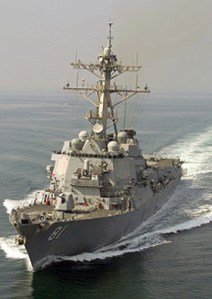
A Tin Can is a destroyer, like the one escorting your carrier, not a metal outhouse.
If you’re serving on an aircraft carrier, you’ll soon learn to stay off the flight deck during flight ops unless you are authorized to be there. If you work on the flight deck, the color of your shirt (yellow, green, white, red, blue, purple, brown or black) identifies the job you’re supposed to be doing. Red is, of course, for crash and smash (firefighters). If you want to watch launch and recovery operations, head up to the windows called vulture’s row in the island (AKA superstructure) where the view is perfect.
Old salts will try to fill your head (brain, not the rest room) full of crap (lies, yarns, and obviously erroneous scuttlebutt) that will only result in your being considered as gear adrift or a good candidate for mail buoy watch. “Mail buoy watch” is mandated by lifers (old salts) when the weather is poor.
During bad weather, somebody (you) is dressed up in foul weather gear and sent topside (AKA, a weather deck) with a hook. Your job will be to watch for the mail buoy, that is to say, the place where the ship’s mail will be waiting because either the COD (the mail plane) or some mythical mail ship can’t deliver the mail in a storm.
Before you head out to snag the mail, your uniform of the day (helmet, life jacket, etc.) will be critiqued by those in the know. Pictures will be taken and then you’ll be on your own in the rain until you realize you’re a victim of the kind of good-natured hazing that will give a guy a lot of grief, a bad cold, and a trip to sickbay for some Corpsman Candy (an ineffective cough drop).
It’s always best to at least look like you know what you’re doing, that is to say staying 4.0 (pronounced four-oh) and squared away during your tour of duty on the big gray ship (BGS). Who knows you might stop saying FTN (you can figure out what that means) and ship over (reenlist). On the other hand, if you’re a bent shitcan, then you’re too hopeless to even be in the navy.
Everyone aboard every Navy ship that cruised between California and Vietnam in the late 1960s knew about liberty in Olongapo, Republic of the Philippines. The city stood just outside the main gate of the U. S. Naval base at Subic Bay, a regular port of call for Western Pacific (WESTPAC) ships.
Old salts called the town “hell” and promised Seaman Recruits coming on board the carrier USS Ranger out of bootcamp that anyone leaving the main gate of the base on liberty would be corrupted immediately by booze, drugs, girls, gambling and crime. They called the drainage ditch separating the base’s main gate from the town “the shit river,” though I saw it as the River Styx.
I crossed the shit river multiple times and found the world there to be everything the old salts described. As a former Eagle Scout, it crossed my mind on more than one occasion, “if only my Scout master could see me now.” Our Scout troop was sponsored by a church, so the Scout master was the least of my worries when I thought of how the deacons, elders and Sunday school teachers should they ever see a photo taken on Magsaysay Drive.
As a writer in training, I saw Magsaysay Drive and the Galaxy Bar and the touts and the constant ruckus in the streets as “research.” But I doubt my Scout master would have understood, or anybody else I knew, for that matter. Luckily, webcams and cell phones hadn’t been invented yet. There was no Facebook either in 1968. This meant that no pictures of me crossing the shit river appeared anywhere–and since a lot of time has gone by since then, I doubt they ever will.
Everyone who might know the Eagle Scout and paperboy who went to hell and then put his research into a novel called Garden of Heaven is long gone by now. So, I think I can safely post this excerpt without word getting back to the old neighborhood.
Excerpt from Garden of Heaven:
Standing on the bridge over the Shit River listening to the half-naked children in flimsy boats below shouting for a handful of centavos, the city in his face was—with more pride than apology—very much a city with its tattered underwear showing. If Magellan only knew what was here now. If Dad only knew David was here now.
Night was settling down over the hazy first lights of the bars and hourly rate hotels along Magsaysay Drive and the razor-sharp edges of Kalaklan Ridge like an old whore.
David dropped several 25-centavo coins over the railing, heard an explosion of whitewater, heard the laughter and the shouting, ‘Salamat, Joe, Salamat.’
He crossed Perimeter Road, ignored the hopeful greetings of the money changers behind their well-caged windows, then dodged a badly mixed throng of sailors, girls and honking multi-coloured jeepneys that swelled out into the Gordon Avenue intersection. He cut across the street, smiling, waiving at imagined friends in the distance, and moved with the deliberate intent of a man who had crossed this street hundreds of times.
‘Casual alertness, that’s the key to surviving Olongapo’s jungle of thieves, gangs, girls, high-strung Marines, bored Shore Patrol and Hard Hats, and drunk boatswain’s mates and snipes,’ Lowell had said.
Touts were everywhere below the slapdash smorgasbord of disheveled signs and awnings, leaning telephone polls, and the rag-tag assortment of buildings with upper floors stacked up in odd strata.
Assorted conversations flew past, barely audible in the close heat… ‘Hintayin mo aki,’ …‘Magandang amaga, Carlo, kumusta ang bagong sanggol?’… ‘Hey Joe’… ‘Tao po! Tao po!’… ‘Hoy, tulungan mo akong magdiskarga sa trak na ito, pwede ba?’… ‘Good food here, Joe!’… ‘Galing akong Maynila. Nasaan ang Zambales Bank?’… ‘Balut, Balut!’… ‘Tayo na’t kumuha ng makakain’ ‘Magandang ideya, handa na ako sa napunan’… ‘Nagustuhan mo ba ang bago kong kamera?’
The sign for the Galaxy Bar was plainer than most. An unadorned interior stairway led to the second-floor club, a large room strewn with tables occupied by sailors, many with girls whose eyes caught the low light like predators or gods. David didn’t see anyone he knew. He had a small envelope in his back pocket for Maria.
Two girls who had bathed in perfume and spackled their faces with makeup were leaning against the bar watching a waitress organise a tray full of San Miguel beer bottles.
“Maria, tingnan mo itong malambing na lalaki.”
“Lamayo ka sa kanya, Adelaide.”
Assuming he’d actually heard her name in those quick Tagalog comments, Maria was the one wearing a red dress, thrusting herself forward to him as he approached, posing her sweet curves, allowing her long hair to seductively frame her face, smiling as though they were friends with a history. He could almost see himself in the high gloss of her lipstick.
The USS Ranger has been decommissioned. The USS Ranger Foundation is working diligently to convert the aircraft carrier into a museum on the Columbia Driver near Portland, Oregon. The effort requires multiple phases, the next being a comprehensive environmental site analysis of the propose mooring location.
The Foundation is seeking donations to help pay for its on-going work. If you would like to contribute to the $15 million dollar fund raising project to bring a historic ship to Oregon as a museum, please click on the link above. Once you’re there, you’ll find some handy PayPal buttons.
When a sailor reports aboard Navy ship right out of boot camp, s/he will have four immediate concerns: (1) Not being fooled by old salts into searching the boat from stem to stern for pieces of equipment that don’t exist, (2) Getting lost, (3) Following the proper General Quarters “traffic pattern,” and (4) learning Navy phraseology.
1MC Speaker
The Navy insists upon standard phraseology in its deck logs, phone talker communications, reports and 1-MC (ship-wide public address system) announcements. 1-MC announcements are accompanied by boatswain’s pipe calls which all sound the same at first.
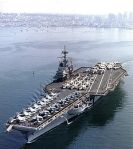
While I was working on a novel about the sea, I remembered what it was like being transferred to the aircraft carrier USS Ranger (CVA-61) right out of boot camp. Compared to boot camp, the ship was much better duty, but there was still a lot to learn.
When I reported aboard, I was informed that I had been assigned to a floating city with an airport where the residents spoke a foreign language. Soon, I would have to learn what was supposed to happen when we “set condition zebra” (a readiness condition with certain hatches and fittings closed); and that a “shot line” didn’t refer glassware on a bar but to a small-diameter line fired over an alongside ship prior to an underway replenishment (UNREP).
Reveille throughout the city came a lot earlier than one expected even though the chief petty officers in charge of our boot camp companies at Great Lakes had brainwashed us that squared-away sailors loved getting up early. But they didn’t tell us that aboard ship a BMOW (Boatswain’s Mate of the Watch) would announce over the 1-MC to “Heave out and Trice Up.”
My first thought was that everyone aboard ship was being asked to vomit on command in the head. I was wrong. The phrase means get up. If you’re sleeping in a hammock, tie it up. If you’re sleeping in a rack (bunk) tilt it up against the bulkhead (wall). This makes it possible for the sweepers or compartment cleaners to sweep the deck (floor) underneath it. In the old days, a trice hook held the rack/hammock to the bulkhead.
The Public Affairs Officer as the Lone Ranger
Planning to join the Navy and–as we always said–let the world see you? Be ready to learn fast. When it’s time to get up, you won’t have time to study your Bluejacket’s Manual for instructions. But one way or the other, you’ll need to know the difference between heave, heave in, heave around, heave out, heave to, and heaving line.
Scuttlebutt (gossip) isn’t always “the straight skinny” (accurate facts) especially when it comes from the fabled all-knowing (and mythical) “port butter cutter.” With luck, the old salts will soon tire of sending you off to find fictional left-handed crescent wrenches, cans of relative bearing grease, buckets of prop wash, or of asking you stand “mail buoy” (huh?) watch on the bow. Then they’ll remind you (if you need reminding) that all stairs on ships are called ladders and doors are called hatches and dogs are what keep them closed.
Maybe they’ll tell you the handy general quarters acronym FUSDAP so that in the three-minute rush to get to your duty station you’re moving with traffic rather than against it. Forward and up on the starboard side, down and aft on the port side is very handy to know.I hope they don’t have to tell you not to head for the flight deck looking for a Quidditch game when the BMOW comes on the 1MC and says “sweepers sweepers man your brooms.”
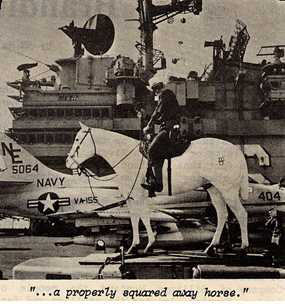
On the other hand, our ship really did have a horse, fiberglass, that is, so if the chief sent you to give it a bucket of oats, it was best to disappear for a while until everyone else in the compartment was done laughing at the joke.
–
Update: Since this post was written, the USS Ranger was sold for scrap because in all the years it was available to be purchased by a group willing to turn it into a museum, no viable plan was submitted to the navy. Movie stars spend more on their houses than was needed to preserve this ship and all the history it contained. Screwed up priorities, I guess.
Malcolm R. Campbell is the author of the Vietnam War-era novel set on board an aircraft carrier, “At Sea.” For David Ward, going in harm’s way seems to apply more toward the people back home than life in the sailor towns and the ship.




 Malcolm's Round Table