
Although my novels (The Sun Singer, Sarabande, and The Seeker) are set in Glacier National Park, I haven’t set foot in the park for many years. (I worked there as a seasonal employee in the 1960s and visited in the 1970s and 1980s.)
Later this summer, I’m looking forward to seeing the place I have always thought was the most beautiful place on Earth. All my photographs and slides are old and faded, so I hope to capture some new memories along with some new pictures.
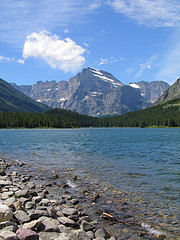
And yes, I plan to take a red bus ride up to Logan Pass and back, have a nice meal in the now-renovated Many Glacier Hotel dining room, and walk around Josephine and Swiftcurrent Lakes on a trail I once knew like the back of my hand.
I’ll be there with my wife and my brother and his wife. We travel well together and pretty much take a casual approach to sightseeing, dining and hanging out in scenic locations with a variety of activities.
But, like anyone going back anywhere, I worry about it being anticlimactic or that it will be changed more than I want to know.

I already know that there are fracking operations on the Blackfeet Reservation a stone’s throw from the park’s eastern boundary. I want to say, “I told you so” about such problems because after Glacier was called the most threatened park in the system in the 1980s, I campaigned strongly for legislation that would keep certain kinds of development farther away from pristine wilderness areas. This is worse than having a tar factory go up in city subdivision.
The response was, “we can only protect the park itself.” My reply was, “if you don’t restrict development outside the park, you’re not protecting the park.” And so it went.
Also, I already know there are 300 miles fewer trails than there were when I worked in the park. Inadequate funding is the main cause. On the plus side, Many Glacier and other park structures have been seeing some renovation work through various campaigns and grants. That makes our historic, National Register structures last longer so more people can enjoy them.
I can tell I’m out of touch. When I called reservations at Many Glacier Hotel, I asked for the Alpine Suite. That was the hotel’s best suite when I worked there. Nobody had ever heard of it. I described where the two Alpine Suites were, and learned they’d been converted into regular rooms.
The first few times I went back, the bellmen would always show me that the wall of names in the bellman room was still there. My name was there along with many other familiar names from past years. I already know this space has long-since been converted into a restroom.
If we stay on an upper floor in the main section of the hotel, we’ll appreciate the standard elevator that took the place of the old manually operated, cage-style elevator that guests were seldom allowed to ride. It was a great old elevator, one that probably would fail most building codes in the country if it were still there.
The last time I was in the Swiftcurrent Valley, my knee went out on a hike up to Grinnell Glacier. I was astounded. Those of us who worked at the hotel used to stroll up there dozens of times during the summer. Since then, my knees and ankles have grown weaker, so I wonder how much hobbling around I’ll be able to do.
In the past, I’ve always seen people there that I know. This time I won’t. It was fun having the manager, fishing guide, houskeeper, wranglers and others remember me on past return trips. This time, it will be rather like going back to your old high school long after the teachers, coaches, bus drivers, and administrative staff have all retired.
So, how will it go? I think we’ll all come home with some genuine new memories, memories of Glacier and ourselves in the here and now rather than Glacier as it was or might have been. And if that means our pictures show a bunch of weak-kneed, out-of-shape people sitting on the balcony watching the boats on the lake and the ospreys flying high over the nearby peaks, so be it. Maybe a young couple will talk by and ask, “have you folks ever been here before.”
Maybe I’ll say, “Sure, I used to jog up to the glacier and back after dinner and climb with the mountain goats.”
They’ll pretend to believe me.


 Malcolm's Round Table