 According to Radio Free Europe, “Russian officials have accused Ukraine of mounting a helicopter attack early on April 1 on the fuel depot located near Belgorod, not far from Russia’s border with Ukraine.” My first thought was, “Stop Whining. You’ve destroyed Ukraine and now you feel put upon when they strike back?” While conceding the depot was a viable target, Ukraine says they didn’t do it. Oh really. Well then, kudos to whoever did do it.
 Spring means watching the yard get shaggy and then trying to figure out what it’s going to take to get the riding mowers running after a winter of just sitting there. One finally cranked up after we put the trickle charger on the battery for a while. Apparently, the other one will need a new battery inasmuch as the charger message said BATTERY SHOT TO HELL.
 I’m looking forward to reading The Librarian of Auschwitz, next up on my nightstand. Written by Antonio Iturbe, the novel is based on the true story of Dita Kraus. Here’s the publisher’s description: “As a young girl, Dita is imprisoned by the Nazis at Auschwitz. Taken from her home in Prague in 1939, Dita does her best to adjust to the constant terror of her new reality. But even amidst horror, human strength and ingenuity persevere. When Jewish leader Fredy Hirsch entrusts Dita with eight precious volumes the prisoners have managed to sneak into the camp, She embraces the responsibility―and so becomes the librarian of Auschwitz.”
 Meanwhile, author Luis Alberto Urrea announced on his Facebook page a soon-to-be-released book of poetry. I like his work a lot, so I’ll be looking forward to Piedra as soon as it becomes available on Amazon and other online sellers. While I’m waiting, perhaps I should re-read my favorite from him The Hummingbird’s Daughter, a historical novel.
- Speaking of new books, my publisher Thomas-Jacob will soon release a collection of poetry, excerpts, and short stories that includes my story “The Smokey Hollow Blues.” I’m excited about this volume and am looking forward to reading everyone else’s contributions.
Tag: Luis Alberto Urrea
Review: ‘Queen of America’ by Luis Alberto Urrea
“Although Urrea has stitched a seamless end to the saga initiated in The Hummingbird’s Daughter, Queen of America lacks the clarity of vision of its prequel. Having left behind Mexico’s rich landscape and languages, the Urreas — Tomás and Teresita, and the author as well — grasp for inspiration.” – New York Times 2011 review by Mythili G. Rao
If Urrea’s powers as an author of magical realism and his great-aunt Teresa’s powers as an inspiring healer reach their apex in The Hummingbird’s Daughter, they become a lingering, bittersweet denouement in Queen of America. Urrea writes in the novel’s notes and acknowledgements that “The story is not the history.” Writing a novel rather than a non-fiction account of his family’s history led Urrea on a twenty year journey to pull together myths and stories and facts into a cohesive whole that is whole as an impression of what happened rather than–as he says–a textbook.
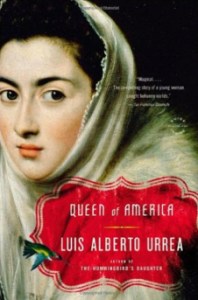 After she flees Mexico at the end of The Hummingbird’s Daughter, Teresa is carried by multiple tides more powerful than even her imagination can grasp. Initially, she settles with her father in a variety of locations in the Southwest. It’s closer to what they know, but it’s also dangerous inasmuch as the Mexican government still considers her an enemy of the state and persists in sending assassins to put an end to it. Until her father manages to land on his feet and start a profitable life in the States, finances are in short supply.
After suffering through an assault, Teresa leaves her family behind and looks for a way to continue her healing work elsewhere. Unfortunately, her upkeep and life are taken over by a consortium that primarily seeks profit out of her fame. Her life becomes, in today’s terms, a lengthy tour where she is at once visiting royalty and a caricature of her former self.
She experiences many wonders on this journey, including a prospective chance for love, companionship and normality. And she experiences many heartbreaks. In these highs and lows, readers will find her to be wonderfully human. Urrea knows his character and brings out her soul in this sequel.
By the time she frees herself from the sweep of events controlled by others, she has spent her capital. In many ways, it’s a well-deserved rest, one that she’s ultimately at peace with.
Urrea has handled her story with humor, more of his rich language, and a deep look into the psyches of the major characters. The story is told well and Teresa emerges as a complete person. While Urrea did not write a textbook and was free to interpret events (perhaps more truthfully as fiction than as facts) he is nonetheless constrained by the realities of Teresa’s life. No doubt, he would disagree. Suffice it to say, the historical Teresa did not lead a revolt against the Mexican government or become a catalyst for Indian rights and freedom while on tour, nor go on to accomplish great and mythic deeds in the U. S. If she had, Queen of America might have reached the stunning heights of its predecessor.
Teresa bloomed in The Hummingbird’s Daughter and faded as all flowers must in Queen of America. It is still a must-read for everyone who began the journey in The Hummingbird’s Daughter–for closure.
–Malcolm
Malcolm R. Campbell is the author of the magical realism novella Conjure Woman’s Cat
 Malcolm's Round Table