People Before The Park, by Sally Thompson, Kootenai Culture Committee & Pikunni Traditional Association (MHS Press, July 2015), 256 pages with photographs.
 The Great Northern Railway, one of the predecessor roads of today’s Burlington Northern Santa Fe, developed Glacier National Park’s roads, telephone system, power lines and famous hotels as a tourist destination for passengers on its Empire Builder and Western Star trains. The railroad’s influence on the park was immense.
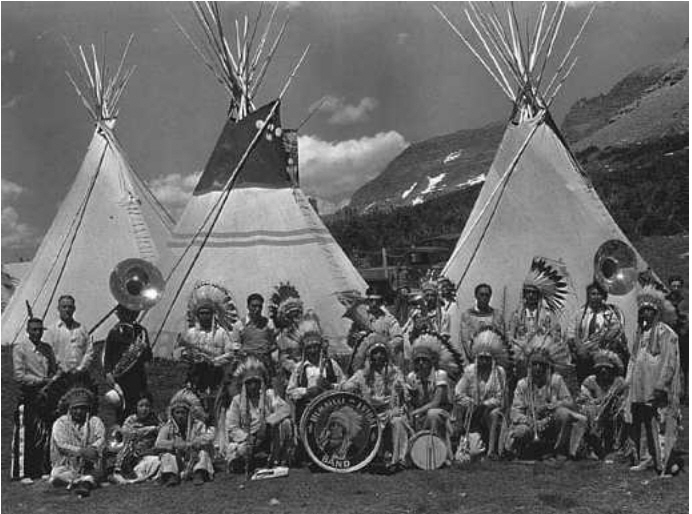
The railroad called the Blackfeet, the Glacier Park Tribe, and often took representatives to faraway cities to advertise the park. The project was much more of an expedient promotion than a true cultural exchange. The soul of the park, however, will always be Kootenai and Blackfeet (Pikunni/Piegan).
When I worked as a bellman at Many Glacier Hotel in 1963 and 1964, I was fascinated by the Blackfeet and Kootenai names for many of the mountains, rivers and creeks. Some years later, while working as an editorial assistant for the first edition of Jack Holterman’s now-classic Place Names of Glacier and Waterton National Parks, I learned that these landmarks were given Indian names by early explorers such as James Willard Schultz and George Bird Grinnell. We’ve long needed the park’s story from its original people.
Slowly, some of the official place names are being changed. Some years ago, Trick Falls (named for its odd water flow) was changed to its Blackfeet name, Running Eagle (Pitawmáhkan) Falls. Mt. Wilbur, the distinctive peak across the lake from Many Glacier Hotel, is also hearing its Blackfeet used by bellmen, tour bus drivers, boat crew personnel and others. Now people are beginning to know it as Heavy Shield. One day, perhaps the mountain will hear its name in Blackfeet: Isokwi-awótan
Montana Historical Society
Now, with the publication by the Montana Historical Society Press of People Before The Park, information that has up to now been mostly confined to books intended for scholars and students of history is now accessible to a wider audience. I hope that the park’s concessionaires are selling this book in the hotel gift shops at Many Glacier Hotel, Lake McDonald Lodge, and Glacier Park Lodge.
From the Publisher
Step out of a world governed by clocks and calendars and into the world of the Kootenai and Blackfeet peoples, whose traditional territories included the area that is now Glacier National Park. In this book, the Kootenai and Blackfeet tribes share their traditions—stories and legends, foodways and hunting techniques, games and spiritual beliefs. Readers will discover a new respect for the people who were at home in the Crown of the Continent, all around the seasons. Sally Thompson has spent over thirty years working with the tribes of the Rocky Mountain West to tell history from their points of view. Her most recent work focused on repatriating human remains and sacred objects to tribes.
A Reviewer’s Perspective
“Thompson decided to take a different approach to the book. Rather than write it all herself, she asked the Kootenai Cultural Committee and the Blackfeet’s Pikunni Traditional Association to each author their own chapter.
“The result is a book that tells a descriptive story that comes alive for the reader. Historical photos are featured throughout the book. Thompson provides introductory geographical and cultural information and provides evidence of early trails through the park.” – Erin Madison in the Great Falls Tribune
Every hiker needs several things in his/her backpack: map, matches, flashlight, water, food, bear spray and a copy of this book. As always, the place tells us about the people who live there and the people who live there enhance our knowledge of the place.
–Malcolm
 Malcolm R. Campbell is the author of two novels set partially in Glacier National Park, “The Sun Singer” and “Sarabande.”


 Malcolm's Round Table