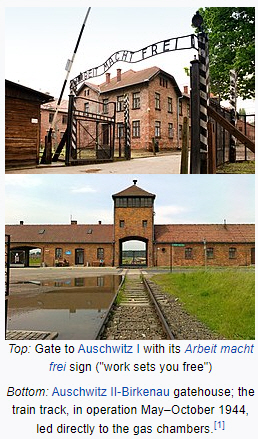
Jews in WWII: history’s defining moment

As I read Isabel Allende’s The Wind Knows My Name which begins when Samuel Adler’s father who disappears during Kristallnacht, I think that the plight of the Jews at the hands of the Germans and others is the primary event in recent history that defines the state of the world. There are, perhaps, some 70,000 books about the war. As for those directly related to Geman, Russian, and other countries’ crimes against the Jewish people, I cannot determine.

It’s hard to read such novels and nonfiction accounts without Xanax and/or Scotch to tame the horror in one’s mind and stomach at the unmitigated cruelty against one of the world’s major ethnic groups without rational purpose–unless you consider myths rational enough to justify it.

What bothers me is that the myths are illogical rationale for targeting the Jews are still with us, even within the U.S. where one would think we’ve outgrown such hatred. You can follow the fight against this evil by looking at the International Holocaust Remembrance Alliance.  According to its website, ” The IHRA identifies the practical needs of policymakers, scholars, educators, and museum professionals working in the Holocaust remembrance sector, and it produces materials to support the work of these stakeholders. Resources such as IHRA academic publications, educational guidelines, and reports are written by experts for the benefit of non-experts, helping to ensure that the IHRA’s expertise can serve a highly practical function throughout IHRA’s member countries and beyond.”

I believe we owe it to ourselves and to the Jewish people to stay informed about the ongoing problems rather than assuming that since we see nothing bad happening outside our windows, there are no issues to fight.

From the publisher, we read,  “The lives of a Jewish boy escaping Nazi-occupied Europe and a mother and daughter fleeing twenty-first-century El Salvador intersect in this ambitious, intricate novel about war and immigration” (People), from the New York Times bestselling author of A Long Petal of the Sea and Violeta. “Allende’s storytelling walks a lyrical romanticism on roads imposed by social and political turmoil.”

The danger, I think, is believing that such problems are gone with the wind. They are not. They live with more vitality than any of us would believe.

–Malcolm
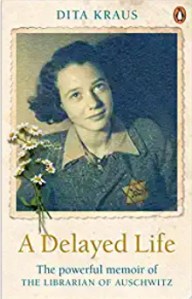
Briefly noted: ‘A Delayed Life: The true story of the Librarian of Auschwitz’ by Dita Kraus

After reading Antonio Iturbe’s The Librarian of Auschwitz, the well-researched and agonizing novel based on the true story of Dita Kraus, I was happy to discover that Dita Kraus is still with us, apparently as sharp and feisty as ever at 92.

She has her own website here where she sells her delicate paintings of flowers, a few of the books mentioned in Iturbe’s novel, and provides a link to her own memoir A Delayed Life: The true story of the Librarian of Auschwitz which was published in 2020.

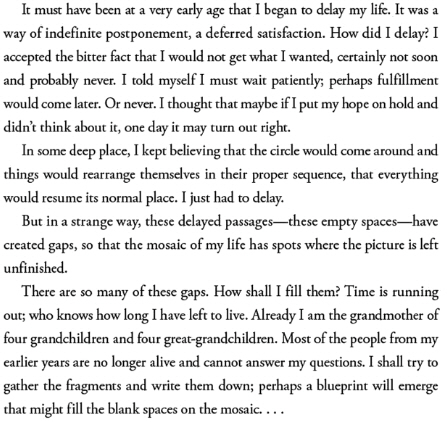
Look at the book with Amazon’s look inside feature, and you’ll find some amazing writing, pragmatic, incisive, and bluntly honest, as this excerpt shows:

From the Publisher

The powerful, heart-breaking memoir of Dita Kraus, THE LIBRARIAN OF AUSCHWITZ

Dita Kraus was born in Prague in 1929 – in her powerful new memoir she writes about her childhood before the war and then during the Nazi-occupation that saw her and her family sent to the Jewish ghetto at Terezín and from there to Auschwitz and then Bergen-Belsen.

Dita writes powerfully and unflinchingly about the harsh conditions of the camps and her role as librarian of the precious books the prisoners had managed to smuggle past the guards. She also writes about the liberation of the camps and her chance meeting with fellow survivor Otto B Kraus after the war.

Part of Dita’s story was told in fictional form in the Sunday Times bestseller THE LIBRARIAN OF AUSCHWITZ by Antonio Iturbe.

I am so impressed with this fine lady, that I ordered the book immediately. Perhaps it will fill in some of the gaps in my knowledge about her. If I had her persistence and bravery and dedication, I could move mountains–that’s pretty much what she did in the family unit school at Auschwitz-Birkenau when she was fourteen years old in this unholy place:

Malcolm

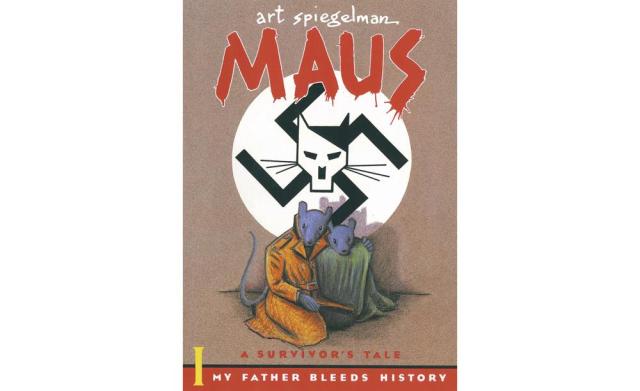
Holocaust novel ‘Maus’ banned in Tennessee school district 

ATHENS, Tenn. (AP) — A Tennessee school district has voted to ban a Pulitzer Prize-winning graphic novel about the Holocaust due to “inappropriate language” and an illustration of a nude woman, according to minutes from a board meeting.

Source: Holocaust novel ‘Maus’ banned in Tennessee school district | AP News

The Associated Press notes that “The nude woman is drawn as a mouse. In the graphic novel, Jews are drawn as mice and the Nazis are drawn as cats.”

According to a tweet by the U.S. Holocaust Museum: “Maus has played a vital role in educating about the Holocaust through sharing detailed and personal experiences of victims and survivors. On the eve of International #HolocaustRemembranceDay, it is more important than ever for students to learn this history.”

One news story, which I cannot find now, noted that it’s increasingly difficult to teach historical events to students who weren’t even born when 9/11 occurred. I can see how this would be a challenge to history teachers: making the events of the past relevant to a generation focused on texting the current moment as though there were never any earlier moments.

Maus is not a pleasant book, but then neither is the subject matter and the lessons we learn from being made uncomfortable about the world’s worst moment are, I think, vital to our understanding of how we became the people we are now.

Malcolm

Why don’t people know this stuff?

A few days ago, a reporter walked out on the street after doing a story about the Supreme Court to see how much random passersby on the street know about the court. When asked how many justices are on the court, several people thought 35 sounded about right. When asked what the court does, some thought it passed bills.

Recently, news reports of a Pew Research Center study showed that half of all Americans don’t know six million Jews were killed during the Holocaust.

Years ago, when Jay Leno was the host of the Tonight Show, he went out on a city street from time to time and asked people simple questions such as who’s the governor of your state and the kinds of questions that appear on a basic citizenship test. The studio audience laughed at the stupid answers.

My response to such things is why don’t people know this stuff?

Some say the schools are at fault. Some say we’re in the middle of the entitlement culture where folks think “it’s all about me” and don’t see any point in knowing what isn’t about them.

I don’t suppose high schools and middle schools have civics courses any more, but they must have some course that teaches students how the federal government is structured. If history is still being taught, it’s hard to see how students got through school without knowing about World War II and the Holocaust.

But when it comes down to it, it’s a shame studio audiences think ignorance about basic stuff is funny. Surprising, yes. Sad, yes. But hardly funny.

The latest incarnation of the “Weakest Link” is is currenlty airing on NBC. I’m surprised by the questions people miss. Some of the answers should be known by people in elementary or middle school. Okay, let’s stipulate that in a quiz show studio, things are a bit chaotic. But still, why don’t people know this stuff?

Some of my college professors thought it was more important to know how to find information when we needed it rather than having an encyclopedic memory of facts. Perhaps people today think they have no need to know stuff when all they have to do is go to Google or WikiPedia for the answer. Okay, that does make some sense.

Yes, I think we need a certain amount of knowedge just to function. Some basic facts and ideals. Enough stuff to make intelligent decisions about life, politics, career choices, &c.

I guess many people think “this stuff” doesn’t matter. If they think that, then I worry that one day we’ll all be governerned by the weakest link.

Malcolm