 My wife hates “High Noon” and the theme song it rode in on. John Wayne didn’t like it either. I think it’s the perfect movie, not necessarily my favorite but perfect in the way it was put together: the music, the ticking block, the fact it was shot in real-time, and the fact (which the Duke hated) that normal citizens wouldn’t help a marshal fight off a gang of bad guys that would function like a SEAL team compared to people who mainly used guns for hunting.
Wikipedia writes that “John Wayne was originally offered the lead role in the film, but refused it because he believed that Foreman’s story was an obvious allegory against blacklisting, which he actively supported.” Perhaps Wayne saw a correlation with the blacklisting nonsense, but I don’t. But then, I didn’t support blacklisting or the work of the House Un-American Activities Committee (HUAC).
From the Amazon Listing
Classic western tale of a lawman whose retirement plans go awry when a revenge-seeking gunman and his gang arrive in town – will anyone stand with the marshal? Winner of four Oscars, including Gary Cooper for Best Actor.
Glenn Frankel’s Book’s Amazon Listing
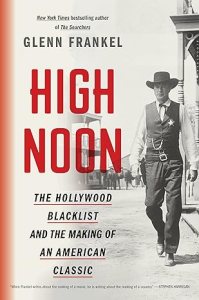 “What has been often overlooked is that High Noon was made during the height of the Hollywood blacklist, a time of political inquisition and personal betrayal. In the middle of the film shoot, screenwriter Carl Foreman was forced to testify before the House Committee on Un-American Activities about his former membership in the Communist Party. Refusing to name names, he was eventually blacklisted and fled the United States. (His co-authored screenplay for another classic, The Bridge on the River Kwai, went uncredited in 1957.) Examined in light of Foreman’s testimony, High Noon‘s emphasis on courage and loyalty takes on deeper meaning and importance.”
From Variety’s Film Review
“The Stanley Kramer production does an excellent job of presenting a picture of a small western town and its people as they wait for a gun duel between the marshal and revenge-seeking killer, an event scheduled for high noon. The mood of the citizens, of Gary Cooper the marshal, and his bride (Grace Kelly), a Quaker who is against all violence, is aptly captured by Fred Zinnemann’s direction and the graphic lensing of Floyd Crosby, which perfectly pictures the heat and dust of the sun-baked locale.”
Yes, the film still plays well today even among viewers who know nothing of the HUAC/Blacklisting drama that was part of our culture when “High Noon” was made.
 Malcolm's Round Table