Glacier Park Montana Books

Geology Along the Going-to-the-Sun-Road

I worked as an editorial assistant on the first edition (1983) of this book that uses photographs and a fold-out map to show ripple marks and fossil evidence of ancient times in the rock formations along Glacier National Park’s Going-to-the-Sun Road. I’m happy to see that the book’s new edition (2018) by Teagan Tomlin maintains the best features of the original while adding new photographs and updates.

From the Publisher

With this newly updated colorful and lively guide, Glacier National Park visitors can take a self-guided tour of the fascinating geological events that created the park’s majestic scenery.  Complete with an easy-to-read map that offers a three-dimensional perspective on the area’s geology.  Geology Along Going-to-the-Sun Road gives lay readers and geologists alike a unique opportunity to get behind-the-scenery at 21 stops along this famous highway. 

The Park’s red bus tours mention the large scale geology of the park from its cirque lakes to its glacier-carved arêtes. But they don’t usually mention the smaller evidence of the past within the rock itself. This is a wonderful guide for those traveling Sun Road in their cars or on their bicycles. Or, on foot.

The book includes information about the park’s rock formations, the Lewis thrust fault, and the actions of weathering and glaciation over time.

Malcolm

Glacier Park and Flathead Forest to Expand Visitor Use Research

from NPS Glacier National Park

WEST GLACIER, MT. – This summer, Glacier National Park and Flathead National Forest are expanding visitor use monitoring efforts to better understand use along the Middle Fork and North Fork of the Flathead Wild and Scenic River.

Flathead River – Wikipedia photo

For the past five years, Glacier National Park has been collecting data on trail, and road use along the Going-to-the-Sun Road and surrounding trails. This year, with a donation from the Glacier National Park Conservancy, monitoring will expand to the river and several other places within the park. The Flathead National Forest and Glacier National Park both manage segments of the North Fork and Middle Fork of the Flathead Wild and Scenic River. The other locations to be monitored include the North Fork, Two Medicine, Many Glacier, Goat Haunt, and Belly River.

The data, collected by the University of Montana, has been valuable to Glacier National Park as visitation has increased dramatically. With several years of data in hand, the park can now better inform visitors about how to plan their trips with crowding in mind, and also make educated decisions about where to station staff to best meet park needs.

“For the last few years, we have heard at our annual meetings with North Fork residents that river use seems to be increasing,” said Flathead National Forest Supervisor Chip Weber. “This information will allow us to better understand how much, where and when use is occurring. It will help us to better plan for proper facilities and management.”

“This is the sort of thing we could not do alone,” said Glacier National Park Superintendent Jeff Mow. “With the expertise from the University of Montana and the financial support of the Glacier National Park Conservancy, we are conducting cutting edge research about the way our public lands are used here in northwest Montana.”

Monitoring technology used in the park and now expanded to the Flathead National Forest along the Flathead Wild and Scenic River include: tube counters placed along roads and trails, and camera counters that enable the calibration of mechanical counters and estimation of river use levels.
The data collected will better help the park and forest understand visitor use outside the Going-to-the-Sun Road Corridor, including the Flathead Wild and Scenic River. This information will establish baseline visitor use numbers which in turn will inform future planning efforts such as a Backcountry/Wilderness Stewardship plan for the park, and a joint Flathead Comprehensive River Management Plan for the park and forest.

Going-to-the-Sun Road Geology

Every year thousands of people enjoy the views from Glacier National Park’s engineering marvel known as the Going-to-the-Sun Road. Whether you’re looking at the scenery from the seat of your bicycle, a red tour bus or your car, the trip from St. Mary’s to Lake McDonald provides some of the best high country ambiance in the Rocky Mountains.

Up close and personal, you will notice the rock formations. They are stunning and colorful but, unless you have a good tour guide or a handy reference book, the geology on display may remain incomprehensible.

Geology Along Going-to-the-Sun Road, Glacier National Park, Montana will meet your needs perfectly. First published by the Glacier Association in 1983, this practical, well-illustrated guidebook has met the test of time. The book is organized into twenty-one stops from east to west along Sun Road that illustrate many of the park’s geological features.

Sun Road Tour Stops

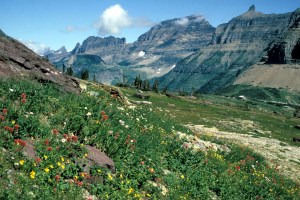
Sun Road's Logan Pass - NPS Photo
The book includes color photographs of both the far-away and the close-up features. For example, you can compare what you see when you look at Curly Bear Mountain 3.9 miles from the entrance station with a diagrammed photograph that illustrates the mountain’s visible rock formations.

Or, at Stop 5, “Grinnell Formation,” text and close-up photographs in the book help you better understand this colorful red rock. Logan Pass, Stop 10, at 6,680 offers excellent views of the horn-shaped mountains created by glaciation, including Clements Mountain (shown in the book).

In addition to the stops, the book includes a glossary, information about rock colors, a list of the park’s rock formations and a handy shaded relief map of the road. Written by geologists in a language intended for non-scientists, the guide adds to a visitor’s understanding and enjoyment of a highway that has thrilled millions of tourists since its completion in 1932.

Malcolm R. Campbell, who worked as an editorial assistant for this Glacier Association book project, is the author of two novels partially set in the park, The Sun Singer and Garden of Heaven: an Odyssey.