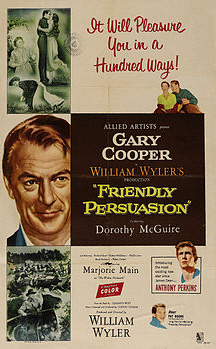
 “Friendly Persuasion is a 1956 American Civil War drama film produced and directed by William Wyler. It stars Gary Cooper, Dorothy McGuire, Anthony Perkins, Richard Eyer, Robert Middleton, Phyllis Love, Mark Richman, Walter Catlett and Marjorie Main. The screenplay by Michael Wilson was adapted from the 1945 novel The Friendly Persuasion by Jessamyn West. The movie tells the story of a Quaker family in southern Indiana during the American Civil War and the way the war tests their pacifist beliefs.” – Wikipedia
My pacifist beliefs were in their formative stages when this film was released, so I had many reasons for wanting to see it. I liked the film when I saw it in 1956 in the shadow of the Korean War and during an era when the Southern States still took a great deal of pride in their fight against the Union in the Civil War.
For those of my generation, I think “Friendly Persuasion” still holds up well, though I’m fair certain the light-hearted touch–rather a Disney-like approach–would be criticized today for its reliance on humor within the Quaker family more than its portrayal of more true-to-life battle scenes.
 The film was drawn from the 1945 novel of the same name by Jessamyn West, a Quaker who wrote a plotless novel story about Quaker life. She was drawn into the making of the film through her willingness to pull together materials from her novel about the Civil War era that would make a cohesive story for the movie.
I found it interesting that while West was working on the book, she had tuberculosis from which she wasn’t expected to recover. Family stories about growing up as a Quaker were shared with her by family members, and had a strong influence on the first edition.
There are many types of Quaker beliefs, so I did not agree with those who criticized the movie for purported inaccuracies in dogma.
Fans of Gary Cooper will like his out-of-type performance in this film.
 My wife hates “High Noon” and the theme song it rode in on. John Wayne didn’t like it either. I think it’s the perfect movie, not necessarily my favorite but perfect in the way it was put together: the music, the ticking block, the fact it was shot in real-time, and the fact (which the Duke hated) that normal citizens wouldn’t help a marshal fight off a gang of bad guys that would function like a SEAL team compared to people who mainly used guns for hunting.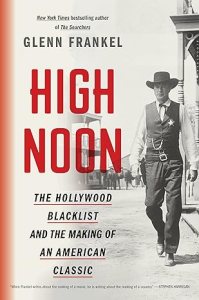
 Malcolm's Round Table