Briefly Noted: ‘Marked by Fire: Stories of the Jungian Way’

“Marked by Fire: Stories of the Jungian Way,” edited by Patricia Damery and Naomi Ruth Lowinsky, Fisher King Press; First edition (April 15, 2012), 196 pages

From the Publisher:
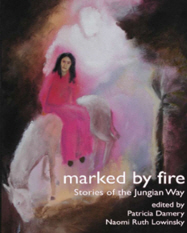
When Soul appeared to C.G. Jung and demanded he change his life, he opened himself to the powerful forces of the unconscious. He recorded his inner journey, his conversations with figures that appeared to him in vision and in dream in The Red Book. Although it would be years before The Red Book was published, much of what we now know as Jungian psychology began in those pages, when Jung allowed the irrational to assault him. That was a century ago.

How do those of us who dedicate ourselves to Jung s psychology as analysts, teachers, writers respond to Soul’s demands in our own lives?  If we believe, with Jung, in “the reality of the psyche,” how does that shape us? The articles in Marked By Fire portray direct experiences of the unconscious; they tell life stories about the fiery process of becoming ourselves.

Contributors to this edition of the Fisher King Review include: Jerome S. Bernstein, Claire Douglas, Gilda Frantz, Jacqueline Gerson, Jean Kirsch, Chie Lee, Karlyn Ward, Henry Abramovitch, Sharon Heath, Dennis Patrick Slattery, Robert Romanyshyn, Patricia Damery, and Naomi Ruth Lowinsky.

From Co-editor Patricia Damery

In a recent blog post, Patricia Damery (“Snakes,” “Goatsong”) mentioned that a guest at an event for this book asked why and how the chapters in this anthology came to be so interesting, to be more than simply personal stories.

Damery said, in part, that, “The personal stories in Marked by Fire are not journal entries but ones much further down the line, ones that have been “worked.” That is what analysis does: it takes the raw material of everyday life, the prima materia, and composts it, until it fertile ground, food for soul development. Although complexes may still be there, they do not obliterate contact with the Self or the Divine.”

These stories have a much wider application than analytical psychology, impacting everyone who appreciates the depth and scope of Carl Jung, comparative mythology, and the trials and joys of every seeker/self on the path.

You May Also Like: New York and Romance the Way We Were, my review of Mark Helprin’s “In Sunlight and In Shadow”

Malcolm

Kindle Edition

Malcolm R. Campbell is the author of contemporary fantasy novels and the recent paranormal Kindle/Nook short story “Moonlight and Ghosts.” The story draws on Campbell’s experience as a unit manager at a developmental center.


Briefly Noted: ‘Riting Myth, Mythic Writing: Plotting Your Personal Story’

“Myths are public dreams, dreams are private myths.” – Joseph Campbell

A new book by Dennis Patrick Slattery, a long-time researcher, teacher and author of mythology, depth and archetypal psychology, will help those interested in their own journeys and personal myths take a few more steps down the path.

New from Fisher King Press, Riting Myth, Mythic Writing: Plotting Your Personal Story uses 80 writing meditations to draw readers directly into the process rather than presenting facts and ideas in a lecture-style format. Those of us who write full time already know the power the writing itself has on the author during every writing moment. The book is the next best thing to a workshop in a sacred place with an experienced facilitator and other students of like mind.

In his introduction to the book, Michael Conforti writes, “Imagine sitting in an Irish pub, drinking ale and listening to the bard weave stories about so many different things, or perhaps captivated by the glow of an outdoor fire while listening to an elder telling stories about history, traditions, and ways to navigate the different life portals that each and every one of us will have to enter at some time. And then—there are stories about destiny, that illusive, mercurial something that catches hold of us at the beginning of life and never seems to want to let go. La forza di destino!! These are the experiences one has in knowing and working with Dr. Dennis Slattery. Whether sharing a pizza and beer or having the luxury of attending one of his lectures or classes, one is privileged to experience an authentic ‘elder’ who, in the tradition of all those wise ones who came before him, has the gift of bringing the world of myth and imagination to life and showing us that indeed these are as real as anything we can touch and hold in our hands.”

A pint of ale might go very well with this book.

Malcolm

The hero’s journey myth in a fantasy adventure

Review: ‘Telling the Difference’ by Paul Watsky

Telling the DifferenceTelling the Difference by Paul Watsky

My rating: 5 of 5 stars

During the 1960s, high school English teachers carefully served from the literary canon a poesy stew of skylarks, nightingales and albatrosses with a few leaves of grass for seasoning. Contemporary poems howling through the streets in their underwear were adjudged unsafe in the classroom. We were left to discover the likes of Ginsberg and Ferlinghetti after school—at which point, our imaginations became enlightened.

Paul Watky’s collected poems in Telling the Difference (il piccolo editions from Fisher King Press, 2010) are an explosion waiting to happen that today’s students will only discover in a state of reality where lesson plans and outlines are prohibited even though Watsky prohibits nothing.

When yin and yang, sacred and profane, and laughter and tears are encouraged by the poet to sit side by side—perhaps even hold hands—in his work, the result is poetry that’s unsafe at any meter. In the book’s acknowledgements, Watsky notes that he is grateful to his wife and sons “for putting up with what poetry puts people through.”

Let this acknowledgement serve as a warning to the reader that Telling the Difference has the power to unleash the imagination at the borderline of chaos and enlightenment. Bound together, uneasy laughter and joyful pain have great power whether they are borne by a pet crayfish named Cumbersome “all tarted up with dust bunnies,” diver ants who’ll chew up “the fortuitous drunk passed out in the wrong place, Granny when she falls and can’t get up,” or a girl tied to “the nearly-wiggled-out pin of a fragmentation grenade.”

Watsky’s has organized Telling the Difference into four sections, “”Temple of Kali,” “The Closest,” “What People Learn,” and Piglet Mind,” bookended neatly in between a prologue called “All Good Things” and an epilogue called “Twins Discuss Heaven.” When the prologue suggests that saying “all good things must come to an end” is mere consolation like the “dummy nipples proffered between feeds,” the book’s stage is set for multiple associations between the transitory and the infinite. In the epilogue, George says “I believe in outer space. There isn’t room for heaven” and Simon explains that if heaven were real, we “would see Grandpa Seymour flying around in his coffin.” What else is there to say?

In reality, Watsky says a lot within the illusory confines of this 81-page collection. He speaks volumes about Bluejay’s warning in “Toad Fever,” a man who smashes walnuts with his manhood in “The Magnificent Goldstein” and the danger of words in “Language Fallen into the Wrong Hands.”

Telling the Difference is a wondrous, no-boundaries delight. However, if your hands are the wrong hands for a volatile serving of unsafe words, please remember that you’ve been warned that Watsky will put you through heavens, hells and hoops you didn’t know existed.
View all my reviews

Malcolm

Book Review: ‘Adagio & Lamentation’

Adagio & LamentationAdagio & Lamentation by Naomi Ruth Lowinsky

My rating: 5 of 5 stars

A delicate writing desk stands ready for use in a sunny room on the cover of Naomi Ruth Lowinsky’s collection of poems, Adagio & Lamentation. The room is filled with light from the world outside the high arched window. The watercolor painting by the poet’s grandmother Emma Hoffman (“Oma”) displays a room Lowinsky saw many times as a teenager when she visited Oma’s house.

One can imagine Lowinsky working in such a room with a pen so sharp that it tears the paper, cutting through the desk’s polished veneer to carry ink and light deep into the primary wood. “I wish you could stop being dead,” Lowinsky writes to Oma in the opening poem, “so I could talk to you about the light.”

The nib on Lowinsky’s pen shreds the curtain of time that conceals her ancestors and allows them to speak. “The spirit of my dead grandmother came to us as we lay after love in the renovated Old Milano on the northern California coast.” The spirit’s words in “ghost gtory” cut deep. In “Adagio and Lamentation,” the poet hears her father playing the piano while “our dead came in and sat around us a ghostly variation/and my grandmother sang lieder of long ago.”

Lowinsky’s collection of poems is organized into four sections, “before the beginning and after the end,” “what broke?,” “great lake of my mother” and “what flesh does to flesh.” With strength, certainty and intuition, the poems live and breathe on their pages, and when experienced together, comprise an ever-new song about long-ago wars, colors, shadows, moments and people.

Joy and sorrow dance slowly in the light throughout Adagio & Lamentation. From the opening invocation to Oma to the closing “almost summer,” Lowinsky’s words—written with “a flicker of serpent’s tongue in her ear”—tear through the paper-thin present and drive their way deep into the underworld of the unconscious where the inspirations of her muse are fiery, erotic, earthy, transcendent and whole.
View all my reviews

–Malcolm R. Campbell is the author of “The Sun Singer,” “Garden of Heaven: an Odyssey” and “Jock Stewart and the Missing Sea of Fire.”

Review: ‘After the Jug Was Broken’

After the Jug Was BrokenAfter the Jug Was Broken by Leah Shelleda
My rating: 5 of 5 stars

Students of the ancient texts tell us that when the infinite flowed into the original vessels of the finite, the vessels shattered. Their shards, each with a spark of light, comprise all we know in a world of apparent opposites.

In the title poem in After the Jug Was Broken, Leah Shelleda writes that if the vessels were too fragile to contain the light, “Then I will be a gatherer of shards.” Shelleda organizes her shards in this luminous collection of sparks into Myth, Experience, Place and Spirit.

Some of the shards are transcendent. In Myth, her “Invocation” asks the Lamias of old to “Send sudden gusts of wild song” and Mary Magdalene asks again the old riddle, “How may a woman also enter?”

Some of the shards are sharp. In Experience, “The Memory of Light” cuts deep when it says “How rare when joy enters history/like fireworks and lasting/about as long” and “Extinct Birds” draws blood when it says “The Great Auk the Madagascar hawk/ the last ones died of indifference.”

Some of the shards are kaleidoscopic, reflecting the visions of multiple places. In Place, Shelleda writes in “Behind the Sacred Heart” that she doesn’t want to write about the Sacred Heart, preferring to tell us about a dream “of an openhearted wise man/who arrives four times a year/once in each season/but that comes later/in a language/that is not yet spoken.”

None of the shards are like the shards of broken pottery displayed dead under glass in museums. They shine with their apportioned photons of light. They live and breathe and if we take them into ourselves with our apportioned share of the infinite breath, we will be changed in ways we should not try to predict. In Spirit, the final poem “Heenayni,” whispers “I am here/here in this world as it is.”

“Heenayni,” from the Hebrew for “I am here” is, according to the students of the ancient texts, the moment where categories, worlds, photons and shards come together and the poet and the reader of the poems experience the whole as divine and as one.

View all my reviews

Coming April 29: Author Pat Bertram contributes a guest post about the light behind her new novel Light Bringer.

Malcolm