Book Review: ‘Let’s Play Ball’

Let's Play Ball Let’s Play Ball by Linda Gould

My rating: 3 of 5 stars
If author Linda Gould isn’t an avid baseball fan, she covers it well, for her descriptions of plays, players, locker rooms, owner’s suites and game-time tension in Let’s Play Ball will easily take readers out to the ball game. But the games between the Washington Filibusters and the Florida Keys feature more than pitchers’ duels and homeruns. A conspiracy is brewing during the game that will decide the National League championship. Fraternal twins Miranda and Jessica are at the stadium, Miranda as a guest in one of the owner’s suites and Jessica to cover the came for her sports magazine. Jessica’s fiancé, Manual Chavez is at the game, too. He’s the Filibusters right fielder.

The highly competitive sisters snipe at each other during the game. Perhaps Jessica is envious of Miranda’s marriage and her high-paying career as a budget analyst for a government agency. Perhaps Miranda is jealous of Jessica’s high-profile job and her engagement to a handsome baseball star with an exciting past in Cuba. After the game, while the teams are in their locker rooms, Manual is the victim of a crime. As the true scope of this crime looms larger and larger in the days that follow, logic might suggest that the sisters should work together, to support each other and help the police find out who’s behind the outrage.

Instead, Gould ramps up the tension with twins who become openly hostile. Miranda’s marriage to Tommy, an attorney with political ambitions, is less than perfect, so she has her own distractions. Yet, she thinks Jessica’s shock over what happened to Manuel is impairing her reporter’s instincts about the case. After all, how realistic is it to suggest that the owners of the Washington Filibusters and the Florida Keys, the President of the United States, the Cuban dictator and an assortment of baseball players and shooting range friends who are actively racist and/or promoting an invasion of Cuba were all in bed together plotting against Manual Chavez?

Jessica is convinced the police and the FBI aren’t handling the investigation properly and that everything will be swept under the rug if she doesn’t get personally involved. When Miranda urges caution, Jessica suggests that Miranda and Tommy, who both have agendas as well as skeletons in their closets, may even be involved in the conspiracy and the cover-up.

Gould’s inventive plot features feuding sisters who become tangled up with baseball strategies, high-profile officials and international politics. Jessica thinks criminals lurk in every shadow. She follows real and imagined leads with a vengeance. Ultimately, when she goes on bed rest because of her pregnancy, she must ask Miranda to help uncover the secrets behind the crime. This forces Miranda to risk her well-paying job and step outside her comfort zone.

However, the novel’s potentially taut pacing bogs down, in part by the insertion of back story information during the police investigation to cover the twins past history and partly because the conspiracy’s probable ringleaders are outside the sisters’ amateur investigative reach. Without the authority or resources for confronting government officials or engaging in private undercover operations, Miranda and Jessica spend a great deal of time speculating about the involvement of major suspects while trying to maneuver the more minor suspects into making inadvertent confessions.

The action leads toward a dangerous confrontation that fittingly unfolds during another tense ballgame. Most of the suspects are near at hand with a lot more than a game to lose, and Miranda is in a position to either act with courage or to pretend the FBI will eventually figure everything out. Gould handles the resulting showdown well. But it’s not closure. Most readers will expect the novel’s next chapter to show how the feisty twins will resolve the rest of the story.

Instead, the author appends a 23-page epilogue. Since the twins are interesting characters, some readers will come away from this epilogue feeling that Miranda and Jessica have successfully navigated a major crisis as well as many crucial personal issues and can now get on with their lives. No longer in the forefront of the action required to bring the conspirators to justice in the epilogue, Miranda and Jessica are suddenly—figuratively speaking—sitting on the bench as Let’s Play Ball wraps up the fortunes of the good guys and bad guys at some distance in summary fashion well after the fact. Action-oriented readers may feel cheated when Let’s Play Ball lifts its primary characters from the game before the final inning.

View all my reviews >>

Malcolm R. Campbell is the author of “The Sun Singer” and “Jock Stewart and the Missing Sea of Fire.”

Hero’s Journey – Magical Helpers

“What such a figure represents is the benign, protecting power of destiny.” –Joseph Campbell in “The Hero With a Thousand Faces”

When a mythic hero begins his or her journey into the unknown, s/he often receives help from a magical helper or mentor in the form of advice or amulets to ward off or lessen the impact of the dragons and other horrific forces and entities along the hero’s path.

Crones, wise men, elves and other faerie folk, gods and goddesses, totem animals and spirit guides are among the forms of supernatural aid that providence (or the universe) provides.

Campbell writes that no matter how dangerous the evil forces are on the far side of the threshold or portal into the unknown (dark forest, wine-red sea, unconscious), that “protective power is always and ever present within the sanctuary of the heart and even immanent within, or just behind, the unfamiliar features of the world.”

Considering the journey as a spiritual undertaking, the hero–as we learn from mythology–is wise to trust himself and his guardians. In “Harry Potter and the Sorcerer’s Stone” for example, young Harry is called to his journey via mysterious letters arriving from Hogwarts School of Wizardry and Witchcraft; however the nasty Dursley family won’t allow him to read them, much less respond.

But the journey will not be denied. Hagrid, a half giant from the school appears, and rescues Harry via supernatural means. Likewise in “Star Wars,” Obi-Wan Kenobi uses supernatural means (paranormal skills) to extract Luke Skywalker from the planet where he’s been living and then serves as Luke’s mentor as the journey begins.

Friesian Horse – Walraven on Flickr

In my novel “The Sun Singer,” young Robert Adams encounters several magical helpers including a large, black horse named Sikimí. In everyday terms, the horse is a Friesian like the one in the picture. Yet, when Robert meets the horse for the first time, he–and the reader as well–are tipped off that Sikimí is somehow more than a horse:

The horse was excessively here in the present tense as though accentuated by the angle of the light into being more now than now and more visible than normally visible.

And then David Ward–a mentor character in the novel–tells Robert that Sikimí describes himself as “night in the shape of a horse.”

The journey, though, belongs to the hero alone. In “The Sun Singer,” neither Sikimí nor David Ward remain with Robert. He says goodbye to them and is on his way. He must trust that they–or whatever he has learned from them–will serve him well when the need arises.

Each mythic hero must merge the magical powers, amulets, advice of the magical helpers or mentors with his or her own willpower and faith to carry out the quest to its conclusion. The amulets cannot be all powerful nor the mentor always present, for then the “hero” would simply be along for the ride with no risks to face nor crucial decisions to make.

Hero’s path myths–and fiction based on the steps of the hero’s journey–are intended (in addition to their storytelling value) as catalysts for readers and their own life’s journeys. The translation of the mentors concept into daily life can be rather straightforward, for there are teachers everywhere as well as books, workshops and courses everyday heroes can use to their advantage.

Most of us do not expect a wide variety of gods to help us in the manner in which they directly helped (or hindered) Odysseus in Homer’s epic poem “The Odyssey.” Depending on one’s belief system, prayer can serve as supernatural help; so, too, the messages of totem animals and spirit guides in dreams and meditation. For others, the magical helpers of myths transform into the positive synchronicity and “good luck” that seemingly appear out of nowhere as a result of one’s positive thinking, trust in himself or herself, and dedication to a course of action in harmony with the universe (or one’s spiritual views).

The prospective hero hears “the call to adventure” and makes the decision to undertake the journey without guarantees. He does not ask to see the mentor or the magical helpers in advance. He walks out the door of everyday life without a script that shows precisely what will happen and how s/he will survive the tasks ahead and make it safely home.

Writer’s Note

As Ted Andrews notes in his book “Animal-Speak: The Spiritual & Magical Powers of Creatures Great and Small,” horse symbolism is complex. His keynotes for the horse are travel, power and freedom. These fit my needs for the book since my protagonist is concerned with all of these things.

The black horse appears in my own dreams and meditations often enough to be considered a totem animal: my own magical helper, so to speak. This means that I “know” a lot more about this particular horse than I need for the book, always a plus for an author.

If horses, wise old men, or other magical helpers and guides appear in your dreams, then they are playing the same role as the supernatural powers of classic myths as well as novels and movies that are structured along the lines of Joseph Campbell’s hero’s journey theme.

–Malcolm

Malcolm R. Campbell is the author of the contemporary fantasy “The Sun Singer,” a hero’s journey novel.

Book Review: ‘Ghost Mountain’

Ghost Mountain Ghost Mountain by Nichole R Bennett

My rating: 4 of 5 stars
“Ghost Mountain” by Nichole R. Bennett features a reluctant seer who becomes the prime suspect in a murder case because she knows only what the killer could know.

When Cerri and her family move to western South Dakota, her attention is drawn to a murder at the Devils Tower across the border in Wyoming before all the moving boxes are unpacked and the family is settled into their new home. The site, also known as Bears Lodge, is sacred to many Native American nations. Because of this, Cerri’s spirit guide tells her that the murder has profaned the site and she must help the police bring the killer to justice.

Making Cerri the prime suspect in the case is a nice touch, for it’s the very thing many of us think would happen if we suddenly had a psychic impression or a visitation from a spirit guide with detailed information about a murder that hadn’t been released to the public. Cerri–named for the Celtic Goddess Cerridwen by a mother who’s made “hocus-pocus” a way of life–doesn’t want to be drawn into a spiritual, paranormal mission. But she can’t seem to extricate herself from it. Her spirit guide He Who Waits is stubborn; so is Special Agent Joseph Oliver who thinks Cerri belongs in jail.

Bennett has given Cerri a fine mystery to solve, and while she would like to avoid being a special person with a sacred mission, staying out of jail is motivation enough for clearing up the case to she can get on with her life. While the novel could have been made a little stronger if Cerri had grown more into her talents during the book’s 164 pages, the story is well told and engaging.

View all my reviews >>

Malcolm

Each purchase benefits Glacier National Park

Review: ‘Torden, Hear the Thunder’

Torden, Hear the Thunder Torden, Hear the Thunder by C. Kirkham

My rating: 5 of 5 stars
“Torden, Hear the Thunder” is a delightful story about eleven-year-old Niesje Brouwers and her powerful, high-stepping Friesian horse. Niesje, who is helping her aunt and uncle for a year on their Dutch farm, discovers a seriously wounded black stallion on the property. While her uncle is dubious about the horse’s chance of survival, Niesje is determined to save it; ultimately, a strong bond is formed. While the Brouwers don’t know where the horse came from, the reader knows it has survived an explosion on a World War I battlefield in Belgium.

While this historical novel was written for children 9-12 years old and older, it’s an interesting story for adults and young adults, especially those who love Friesian horses and/or who are attuned to the world of dressage The story focuses on Niesje, farm life, and her developing friendship with Torden. She worries about being allowed to participate in dressage–for which she must ride astride in an “unladylike manner”–and about what she will do when it’s time for her to leave the farm and go back home where there is no provision of keeping the horse.

C. Kirkham, who has written a realistic and accurate book, ends up indirectly teaching the reader a lot about a horse breed that almost became extinct. And then, in the final climatic chapters, an unexpected adventure teaches Niesje more about the world’s dangers than she expected to learn.

View all my reviews >>

Copyright (c) 2010 by Malcolm R. Campbell, author of “Jock Stewart and the Missing Sea of Fire” and “The Sun Singer” from Vanilla Heart Publishing.

Jock learns Race Ready not meant for real men

from Jock Stewart and the Missing Sea of Fire, a comedy/thriller about horses, horse thieves, girl friends and murderers. In the following excerpt, he’s on the trail of whoever stole Mayor Clark Trail’s race horse Sea of Fire.

Coral Snake Smith needed two omelets to loosen his tongue. For an informed source who made his living trading information for food, one might think Smith would have picked up some table manners along with the details of everyone else’s life. Jock drank half a cup of cold, gritty coffee and tried not to watch. Smith’s pig-in-a-trough noise was bad enough.

Jock’s dear old daddy always said, “Jock, take my word for it. Sloppy people are all going to hell.” He also said, “If a man smells like a whore house, he’s going to hell.” Smith had two strikes against him today and it wasn’t even noon yet.

“What did Lucinda Trail have to say?” asked Jock while Smith was licking his plate like an all day sucker.

Smith almost dropped the plate.

“Are your people following me around?”

Jock shrugged. “That, plus you’re wearing her perfume.”

“We were together, but not in the Biblical sense,” said Smith, and he grinned like it was something he spent a fair amount of time contemplating. “A man can do worse.”

“Word is, Clark has.”

Smith did a spit take with the remains of his coffee.

“So has your boss, but none of this is what Lucinda asked me about. She wanted to know why Monique Starnes bought two sacks of Race Ready.”

“What is that, some kind of Viagra knockoff?” asked Jock, recalling that while his Scotch tasted funny last night his performance had been better than usual.

Smith sat there with his mouth open, for once empty of anything approaching food. He looked like he’d seen a dunce.

“Race Ready is a brand of horse feed,” Smith said, with a fair amount of exasperation and condescension. “Martin and Brian Bentley over at the seed and feed stock it especially for Clark Trail. A new employee who didn’t know the feed had been set aside for Sea of Fire sold one sack to Ms. Starnes at seven AM and another sack at seven thirty-two AM. Brian called Lucinda and apologized for being out of stock.”

Since the waitress had temporarily lost interest in her job, Jock went to her station, selected a pot of coffee with the least amount of sludge in the bottom, and refilled Smith’s cup as well as his own. Doing this gave him time to collect his thoughts such as they were. Out of the universe of probabilities, one begged him to allow it to come to mind. But he wasn’t ready to think that way. So Jock temporarily dodged that line of thought by considering why Lucinda came to the Purple Platter.

“What was a woman like Lucinda doing in a place like this?”

“We keep in touch on a daily basis,” said Smith. “She facilitates that by sitting where you’re sitting now. She’s not exactly eye candy, but she trumps your sourpuss look without having to bat an eyelash or shove a shoe up a man’s trouser leg under the table.”

“Fine.”

So far, Smith had slung four sugar cubes into his cup. Now, he seemed to be studying the sugar bowl as though, what with the rain and all, Monday was turning into a five-cube day. He tasted his coffee, and then he dropped in another cube.

“Lucinda came in this morning dressed to the nines even though it was only eight thirty. Her face was blanched out more than her hair. She was disappointed when she learned that my network of quasi-ubiquitous sources knew nothing about the two sacks of Race Ready.”

“You’re not a seed and feed kind of guy,” observed Jock.

“Hardly.”

Copyright (c) 2009 by Malcolm R. Campbell

COMING SOON

An interview with Smoky Trudeau, author of “Observations of an Earth Mage.”

Review: ‘Buffaloed’ by Fairlee Winfield

Buffaloed Buffaloed by Fairlee Winfield

My rating: 5 of 5 stars
When teenager Ovidia Odegard arrives in the United States in 1904, her first duty is to find suitable work so she can begin paying back her uncle for his out-of-pocket costs in sponsoring her immigration from Norway. Her dream, though is not only to be an American, but a Westerner, and that includes wearing a fancy buckskin jacket.

Providentially, Nancy Russell–the wife of the famed Montana cowboy artist Charles M. Russell–is looking for a housemaid at the couple’s home in Great Falls. When Ovida sees a copy of Russell’s pictorial “Studies of Western Life,” she can’t wait to board the train and head for the West she’s seen at the Nickelodeon.

When she arrives in Great Falls, she finds a dirty, modern city, and once she meets Charlie Russell, she begins discovering that the idealized West as it exists in books and movies is gone–if it ever existed. While Nancy Russell wants contracts and sales for Charlie’s art, Charlie would rather spend his time spinning yarns about the old days with his “bunch” down at the saloon. Not surprisingly, the house is a mess.

“Buffaloed” is Ovidia’s story as told to her grandson just before she died at 94, and it all begins when she mentions a secret she has never shared with anyone: the famous Charles M. Russell mural “Lewis and Clark Meeting the Indians at Ross’ Hole” at the Montana State House of Representatives” wasn’t really painted by Russell. It was a con, or so Ovidia claims.

Ovidia dangles this con before her grandson’s eyes throughout her remembrances because, as she sees it, he wouldn’t understand it if he didn’t know what happened in the Russell household from the moment she reported for work. What had she gotten herself into?

This well-researched book is just the kind of yarn that the master of tall tales, one Charles Marion Russell (1862-1926), would endorse without hesitation. The dialogue, the atmosphere, and the historical period in “Buffaloed” are superb. Fans of Russell and Montana history will discover that the book includes real events and places along with a supporting cast of historical personages.

In his book “Montana Adventure,” a friend and contemporary of Russell, Frank B. Linderman, writes that “Charlie Russell was the most lovable man I have ever known.” This is the Charlie Russell who emerges in Fairlee Winfield’s wonderful novel.

Now, if you live in Montana, mostly everything having to do with Charlie Russell is sacred, and that includes a lot of living and story telling that was also delightfully profane. Ovidia does have a confession to make in regard to that mural, but this is a novel, of course.

Winfield’s disclaimer at the beginning of the book reminds us that “Buffaloed” is a work of fiction. In addition to the standard reference books about Charles and Nancy Russell, Winfield also had a more personal resource for this story: her Norwegian grandmother did work in the artist’s home and had a lot of humorous and gritty stories to tell.

View all my reviews >>

Copyright (c) by Malcolm R. Campbell, author of “The Sun Singer” and “Jock Stewart and the Missing Sea of Fire”

Book Review: ‘When Memaids Sing’

When Mermaids Sing When Mermaids Sing by Mark Zvonkovic

My rating: 4 of 5 stars
Larry Brown’s musings about life as he observes it are insightful, humorous and often jaded. Outwardly, the protagonist of Mark Zvonkovic’s gently written novel “When Mermaids Sing” is a pleasant, unassuming Medford, PA high school English teacher who tries to get along with everyone and avoid conflicts.

He often feels manipulated by the requirements of his teaching job and the endless expectations of his parents and his girl friend Millie. Brown’s parents, both college teachers, expect him to play a role in their world, while Millie–an actress who might be cheating on him–expects him to make dutiful appearances in her social and family life. At work, where he may not really be happy, he’s hoping to be granted tenure. And, his cousin Bradley has joined a cult and might have lost himself in the addictive peace it provides.

Brown can ponder the humor and the irony of such realities because he has a “cure.” He copes with the chaos of his job and his relationships by retreating into memories of the halcyon summer days of his youth at a Cape Cod vacation house with his siblings and cousins. Those were the best years of his life. The present cannot compete with them. He doesn’t want it to.

Henry David Thoreau once said of Cape Cod’s Outer Beach, “A man may stand there and put all America behind him.” Likewise, Brown retreats to the house of his youth to put all of life’s troubling challenges behind him.

While making an obligatory appearance at his father’s annual party for freshmen college students, Brown meets a personable young woman named Jenny with a strong aversion to cults. Her brother Josh has joined the charismatic Path to God, the same group to which Bradley as sworn allegiance, if not his soul.

Jenny complains that Josh has repudiated their father as Satan and “become a different person.” A psychiatrist at the party remarks that the sudden personality change exhibited by cult members is due to brainwashing, not hypnosis. This, and the lack of fences and armed guards at an ashram, make it difficult for families to intervene.

Brown vacillates about the difference between the freedom to choose a path others don’t agree with and losing one’s freedom through brainwashing and choosing the same path. Jenny’s family is no longer splitting hairs. They’ve engaged the services of a well-known deprogrammer to help them extract Josh from the Cape Cod ashram even though everyone involved might end up being charged with kidnapping.

When Jenny points out that Bradley and Josh are together at the same place and enlists Brown’s help, he can no longer ignore the issue as a mere philosophical topic for debate.

Will Brown help Jenny, Bradley and Josh? He would rather not, because if he does, he will have to admit there’s more involved here than the rescue of two impressionable young people from the brainwashing of a cult. He will finally have to take a stand on something and answer a lingering question. Is escaping life by running away to a cult different than running away to the past?

The title of Zvonkovic’s carefully written novel is suggested by a line from John Donne’s playful “Go and Catch A Falling Star.” Catching falling stars and hearing mermaids singing are, in Donne’s thinking, rather unlikely events. Readers of “When Mermaids Sing” may wonder whether substantive change in Larry Brown is also unlikely. As literary fiction, the story relies heavily on theme, interior monologue and a strong sense of place rather than non-stop action on its introspective journey to a powerful conclusion.

–Malcolm R. Campbell for POD Book Reviews & More

View all my reviews >>

Have Fun and Lose Weight

Riding in Christmas Parade
The feds won’t let me promise you anything, but let’s just say that anyone reading my comedy/thriller novel Jock Stewart and the Missing Sea of Fire might just laugh their butt off.

Now, for some people, that’s going to be a hell of a lot of weight lost in only 220 pages for only $11.86! The price is lower on Kindle.

So, it’s win/lose for everyone.

Really Brief Excerpt

Jock’s dear old daddy always said, “Jock, take my word for it. Sloppy people are all going to hell.” He also said, “If a man smells like a whore house, he’s going to hell.” Smith had two strikes against him today and it wasn’t even noon yet.

“What did Lucinda Trail have to say?” asked Jock while Smith was licking his plate like an all day sucker.

Smith almost dropped the plate.

“Are your people following me around?”

Jock shrugged. “That, plus you’re wearing her perfume.”


It was an honor being among the local authors serving as grand marshals in this year’s Christmas parade in Jefferson, Georgia. The theme was “A Storybook Christmas.” Each of the authors tossed handfuls of candy to the kids along the 40-minute route. I’m shown here in the photograph with my wife, Lesa.

Malcolm

Interview with Author Helen Osterman

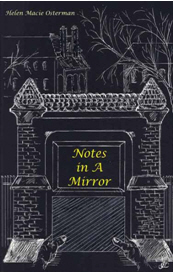
It’s a pleasure to welcome Helen Macie Osterman, author of the new novel “Notes in a Mirror.”

The year is 1950. The place is Hillside State Mental Hospital, a dark brooding place, located outside of Chicago. At the time, the treatment of the mentally ill is archaic, consisting of hydrotherapy, electroshock and Insulin coma therapies, and, in the extreme, pre-frontal lobotomy. Tranquilizers and anti-psychotic drugs have not yet appeared.

In this atmosphere of hopelessness and despair come student nurses from nearby hospitals for their three-month psychiatric rotation. Mary Lou Hammond and Kate Stephens are two of these young girls.

Malcolm: During your 45-year nursing career, you wrote articles for medical journals. What tempted you into turning to fiction?

Helen: I was always a dreamer. As a child I made up stories in my head. They were always adventurous, including jungle settings, the wild west, and, of course, Buck Rogers.

When my children were young, I wrote children’s stories for them. So, it was easy to gravitate to adult fiction.

Malcolm: Are the ambiance, descriptions and nurses’ training at the fictional institution in “Notes in a Mirror” fairly close to what you experienced in your training at the former Chicago State Mental Hospital?

Helen: Absolutely! The place was as I described it, bleak and frightening. The wards were cold and dreary, and the people were hopeless.

Malcolm: Your main character, Mary Lou, had an unpleasant upbringing with a mother who appears smothering and overly strict. If you were taking your best friend to meet Mary Lou, how would you describe her? What kind of person is she?

Helen: Mary Lou is a somewhat like myself as a young girl. Although I had a very loving family, my mother was over protective. I was afraid of everything, mostly of dying and going to hell. I was also born left handed and was forced to learn to write with mt right hand. I am able to write mirror-image with my left. That’s what gave me the idea.

Malcolm: Mary Lou’s friend Kate is an outgoing person who loves making fun of everything and generally taking a lighthearted approach to life. Mary Lou and Kate are such opposites; as you were writing “Notes in a Mirror,” did you have fun thinking of situations where they would interact?

Helen: Kate is very much like one of my classmates, named Katie. She was always in some sort of trouble, so it was easy to mimic her.

Malcolm: “Notes in a Mirror” contains frightening events. How does it differ in tone and plot from your two Emma Winberry mysteries “The Accidental Sleuth” (2007) and “The Stranger in the Opera House” (2009)

Helen: My cozy mystery series is not based on any of my experiences. It come directly from my mind. I love my characters, Emma Winberry, and her significant other, Nate Sandler. They have become part of my life. It’s fun dreaming of situations for Emma to get in trouble.

Malcolm: Did you find “Notes in a Mirror” difficult to write due to your own memories of the conditions and manner of patient care you saw at the hospital?

Helen: Actually I wrote the first draft twenty years ago and put it in a drawer. But it kept calling to me. It was not difficult to write but therapeutic to get those words on paper. I’ll never forget that experience.

Malcolm: In the early 1970s, I was a manager of one of the group homes at the Waukegan Developmental Center that was part of Illinois’ new wave of treatment for the developmentally disabled. Did your nursing career ever take you to any of the newer facilities?

Helen: I was there in 1950. The place closed in the mid-seventies. So I had no experience with any transfers. I never had an desire to work with the mentally ill.

Malcolm: I expect you saw a lot of changes in settings and treatments during your career. Did you write “Notes in a Mirror” because the setting was so perfect for a good mystery, or was it more to show how archaic the treatment of the mentally ill was in our recent history?

Helen: I wrote it because I experienced it and felt it should be told. It was very much like The Snake Pit, published in the 1940s and later made into a movie.

Malcolm: As I read your book, I couldn’t help but think of an expose reporter Nellie Bly wrote about Blackwell’s Island asylum in 1887 called “Ten Days in a Mad House.” She faked being mentally ill in order to get inside. After her experience, she, wrote: “It’s easy to get in, but once there it is impossible to get out.” While, the 1950s era Hillside State Mental Hospital in your novel isn’t as archaic as the institution Bly visited 63 years earlier, your protagonist Mary Lou could hardly force herself to stay for her training. Did your three month rotation seem like an eternity to you?

Helen: Yes it did. Someone was always threatening to go home. But we were senior students and it was out last rotation before graduation. The nice part about it was that we got to go home every weekend, if we lived in the area.

Malcolm: When Mary Lou begins dreaming about a former patient who claimed to have died at Hillside in 1911, she’s looking almost as far back in history as the “Mad House” Nellie Bly wrote about. These dreams—and the notes that show up in the mirror—lead your protagonist as well as the reader into a terrifying chain of events. How were you able to put yourself in the shoes of a character with paranormal sensitivities who was looking back to conditions worse than what she was seeing during her training?

Helen: Imagination can lead a person anywhere. I just followed the ideas that came to me.

Malcolm: Other than a great story, what else do you hope your readers discover while reading “Notes in a Mirror”?

Helen: I hope that anyone reading the book will appreciate how far the medical profession has come in treating the mentally ill. It is no longer a stigma. Mental illness is a disease like any other, and most of the patients, with the proper treatment, can lead normal lives. However, these state hospitals served a purpose. They house the people who are now living on the street because they fail to take their medications. Some are in jail when they should be hospitalized.

Malcolm: Thank you for your visit, Helen. Best of luck with “Notes in a Mirror.

For more information, visit Helen Osterman’s website or see the novel’s listing on Amazon.

In today’s Writer’s Notebook, First Look: ‘A View Inside Glacier National Park,’ the park’s new centennial book of stories.

To view my FriendFeed posts about books and publishing, click on the icon below.

Subscribe to me on FriendFeed

‘Notes in a Mirror’ author coming Dec 8

I’m looking forward to interviewing Helen Macie Osterman, author of the new thriller “Notes in a Mirror” on December 8.

This compelling book, released November 15th by Weaving Dreams Publishing, is set in a grim, 1950s mental institution where the treatments are as archaic as the dark. cold buildings.

The author worked as a nurse for 45 years. During her training, her rotation took her to such a hospital for three months where she witnessed hydrotherapy, Insulin coma therapy and electroshock. These were once accepted treatments for the mentally ill, and they are part of the world protagonist Mary Lou Hammond and Kate Stephens are plunged into at the fictional Hillside State Mental Hospital.

But there’s more. Somebody is trying to contact the sensitive Mary Lou. Is it her imagination, a former patient, or perhaps the mad house is driving her mad. This 213-page mystery will keep you guessing while making you thankful you were never committed to Hillside–or the real-life institutions on which it is based.

As the Osterman writes in her introduction, “The treatments provided were primitive and sometimes dangerous, but at the time, considered state of the art.” The author’s experience as a student nurse in such an institution gives her the knowledge to make this an accurate and chilling novel.

Malcolm, author of “Jock Stewart and the Missing Sea of Fire” and “The Sun Singer”