‘Solvable: How We Healed the Earth, and How We Can Do It Again’ by Susan Solomon

This book, from the University of Chicago Press, was released today. Solomon  “is known for pioneering work on the Antarctic ozone layer and for landmark studies of the timescales of climate change.”  Amazon Link

From the Publisher

“A compelling and pragmatic argument: solutions to yesterday’s environmental problems reveal today’s path forward.

“We solved planet-threatening problems before, Susan Solomon argues, and we can do it again. Solomon knows firsthand what those solutions entail. She first gained international fame as the leader of an expedition to Antarctica in 1986, making discoveries that were key to healing the damaged ozone layer. She saw a path–from scientific and public awareness to political engagement, international agreement, industry involvement, and effective action.

“Solomon, an atmospheric scientist and award-winning author, connects this career-defining triumph to the inside stories of other past environmental victories–against ozone depletion, smog, pesticides, and lead–to extract the essential elements of what makes change possible.

“The path to success begins when an environmental problem becomes both personal and perceptible to the general public. Lawmakers, diplomats, industries, and international agencies respond to popular momentum, and effective change takes place in tandem with consumer pressure when legislation and regulation yield practical solutions. Healing the planet is a long game won not by fear and panic but by the union of public, political, and regulatory pressure.

“Solvable is a book for anyone who has ever despaired about the climate crisis. As Solomon reminds us, doom and gloom get us nowhere, and idealism will only take us so far. The heroes in these stories range from angry mothers to gang members turned social activists, to upset Long Island birdwatchers to iconoclastic scientists (often women) to brilliant legislative craftsmen. Solomon’s authoritative point of view is an inspiration, a reality check, a road map, and a much-needed dose of realism. The problems facing our planet are Solvable. Solomon shows us how.”

–Malcolm
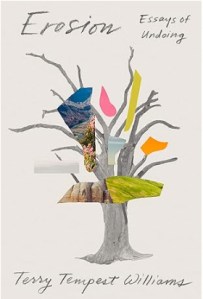
‘Erosion’ by Terry Tempest Williams

Erosion came out in 2019. My apologies for not mentioning here sooner. Perhaps my bias in favor of Williams’ activism and writing made me too cautious to talk about it as though I might inadvertently “oversell it.”

Wikipedia provides a quick overview of her life and work: “Terry Tempest Williams (born 8 September 1955), is an American writer, educator, conservationist, and activist. Williams’ writing is rooted in the American West and has been significantly influenced by the arid landscape of Utah. Her work focuses on social and environmental justice ranging from issues of ecology and the protection of public lands and wildness, to women’s health, to exploring our relationship to culture and nature. She writes in the genre of creative nonfiction and the lyrical essay.” You can learn more on her website here.

From the Publisher

“Timely and unsettling essays from an important and beloved writer and conservationist

“In Erosion, Terry Tempest Williams’s fierce, spirited, and magnificent essays are a howl in the desert. She sizes up the continuing assaults on America’s public lands and the erosion of our commitment to the open space of democracy. She asks: “How do we find the strength to not look away from all that is breaking our hearts?”

“We know the elements of erosion: wind, water, and time. They have shaped the spectacular physical landscape of our nation. Here, Williams bravely and brilliantly explores the many forms of erosion we face: of democracy, science, compassion, and trust. She examines the dire cultural and environmental implications of the gutting of Bear Ears National Monument―sacred lands to Native Peoples of the American Southwest; of the undermining of the Endangered Species Act; of the relentless press by the fossil fuel industry that has led to a panorama in which “oil rigs light up the horizon.” And she testifies that the climate crisis is not an abstraction, offering as evidence the drought outside her door and, at times, within herself.

“These essays are Williams’s call to action, blazing a way forward through difficult and dispiriting times. We will find new territory―emotional, geographical, communal. The erosion of desert lands exposes the truth of change. What has been weathered, worn, and whittled away is as powerful as what remains. Our undoing is also our becoming.

Erosion is a book for this moment, political and spiritual at once, written by one of our greatest naturalists, essayists, and defenders of the environment. She reminds us that beauty is its own form of resistance, and that water can crack stone.”

“Williams makes a poignant connection between the political and the personal . . . If Williams’s haunting, powerful and brave book can be summed up in one line of advice it would be this: try to stare down the grief of everyday life, speak out and find solace in the boundless beauty of nature.” ―Diane Ackerman, The New York Times Book Review

–Malcolm

‘They’ say the first step is always the hardest.

“Whatever we believe about how we got to be the extraordinary creatures we are today is far less important than bringing our intellect to bear on how we get together around the world and get out this mess we’ve made. That’s the key thing now. Nevermind how we got to be who we are.” – Jane Goodall

When quotations like this appear on Facebook or in news stories and articles, they get a huge number of LIKES and positive comments. I want to ask, “So, after you clicked LIKE or wrote ‘so true,’ what did you do next?”

Likewise, when people encounter charities and various crowdfunding initiatives that are collecting money for programs that will make a better world, I’m curious what people did after donating their $25 or $50. The same thought comes to mind about what people do after signing petitions that are trying to raise the public’s (or an elected official’s) awareness about a problem.
Many people appear to believe that talking about an issue is the same thing as actively working to “fix” whatever needs to be fixed. Being concerned about something, while commendable, isn’t the same thing as putting your money where your mouth is or putting your brains and brawn where your money is.

Needless to say, some people who donate $50 to one group and sign a petition in support of another group really think they’ve done their bit.

I don’t have a list of the things people ought to be doing, but joining nuts and bolts volunteer groups is one place to begin. Once you join, you’ll see an old truism governs how much gets done: 20% of the members usually do 80% of the work.

In churches, the concept of the tithe usually refers to money. Yet, we can also apply it to time, as in, giving 10% of one’s time toward fixing the mess we’re in. Even though some government officials, corporations, and lobbying groups are giving 100% of their time to make the mess worse, if enough people chipped in enough time to thwart those who are destroying nature and freedom and equality and peace, then we might have a chance of actually fixing something rather than talking about fixing something.

One way or the other, we need to take that first step toward action.

Malcolm

Malcolm R. Campbell is the author of “Special Investigative Reporter,” “Conjure Woman’s Cat,” “Eulalie and Washerwoman,” “Lena,” “Sarabande,” “Mountain Song,” “At Sea,” and “The Sun Singer.”


Environment: ship of fools or delusional idiots

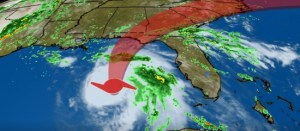
Hurricane Michael is aimed at the place where I grew up. Almost everyone from Florida has seen storms before, but the odd thing is, each time a new storm arrives I see lists of things people should do to get ready and be safe. People should know these things already as surely as they know to look both ways before crossing the street and not taking a bath with a plugged-in toaster.

If my family lived in Tallahassee now, we probably wouldn’t leave. However, we would leave if we lived in Carrabelle, St. Marks, and other coastal communities in the storm’s path. Every year, there are hurricane deniers who say they’re ready to ride out the storm as though they are bigger than the storm. We saw what happened to those people when hurricane Florence struck: they needed to be rescued and that put first-responders’ lives at risk.
I have no idea whether the timing, routes, and ferocity of Florence and Matthew have anything to do with global warming. But, inasmuch as those storms are arriving at the same time as we’re hearing another set of global warming warnings, they remind me of the fact that many people have denied the importance of the environment for years and they seem to be treating warnings about rising seas, droughts, fires, and other effects the same way they treat hurricane warnings.

Years ago, we began hearing the term “spaceship earth.” We were told that in spite of Earth’s apparent resilience to poisons, plastics, rainforest clearing, fracking, and other forms of pollution and environmental damage, that our planet was–in many ways–a spaceship traveling through space with limited resources and a failing infrastructure. Multiple environmental groups have been complaining about the damage ever since I was in grade school, and probably before that.

I was naïve in the 1960s when I joined the Sierra Club because I actually thought people were smart enough to take those warnings seriously. Now I think that spaceship earth is either a ship of fools or is carrying passengers who are delusional idiots. Apparently, restricting one’s actions to help the environment is so inconvenient that allowing Earth to fail is worth it. Most people think it will happen years after they’re gone. So they don’t worry about it. That foolish idiocy keeps them from seeing it’s happening now.

For those who love dystopian fiction, watch the news. We are living it. There’s no need to make it up. And to ramp up our feelings of danger, the current Presidential administration has appointed kamikaze pilots to every single post that can impact spaceship earth for better or worse. So far, they are choosing “worse.” We can shake our fists at the storm and say we’re going to ride it out.

Good luck with that.

Malcolm


Expanded Waterton-Glacier Watershed Protections Needed

from National Parks and Conservation Assn:

Former National Park Superintendents Call for Waterton-Glacier Expansion, Watershed Protections

Waterton Lakes - Chris Phan photo

Whitefish, MT — An international coalition of retired superintendents from Waterton Lakes National Park in Canada and Glacier National Park in the United States has voiced their concern for the future of those parks and the need for immediate actions by both countries to complete park protection measures begun earlier this year.

“Waterton-Glacier International Peace Park is a treasure that we all share as North Americans,” said former Glacier Superintendent Mick Holm.  “In joining our voice with our Canadian counterparts, we’re hoping public officials in both countries will view our communication as a call to action on behalf of this globally significant World Heritage site.”

Waterton Lakes - Lesa Campbell photo

The letter, signed by nearly all of the parks’ former superintendents, comes in the closing days of Glacier’s centennial year, as Congress considers a bi-partisan public-lands omnibus bill (America’s Great Outdoors Act of 2010) that includes several key park-protection measures. The package legislation encompasses more than 110 individual bills, aimed at protecting the country’s land, water and wildlife resources. Senate Majority Leader Harry Reid has said he would like to see passage before Congress adjourns early in the New Year.

In their letter, the former superintendents endorse a long-standing proposal for Canada to expand Waterton Lakes National Park westward, into one-third of the British Columbian Flathead.  They also call for Canada to establish a wildlife management area connecting Waterton-Glacier to other Canadian Rocky Mountain parks, including Banff.

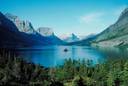
Glacier - St. Mary's Lake - NPS

The former superintendents noted the historic nature of recent steps taken by both countries to prohibit coal strip-mines, hard-rock mining, and oil and gas leases on public lands upstream from Waterton-Glacier, including action to protect 400,000 acres in Canada and the voluntary relinquishment of 200,000 acres of oil and gas leases by energy companies in the United States. They note, however, that legislation to finalize the mining and drilling ban has yet to become law in the United States, and urge prompt action on that front.

They also call for expanded environmental cooperation across the border, and a formal international agreement between both countries to protect Waterton-Glacier and the surrounding Crown of the Continent ecosystem in Montana, British Columbia, and Alberta.

“To have nearly every retired superintendent from Waterton and Glacier calling for these measures is beyond significant,” said Tim Stevens, Northern Rockies regional director of the National Parks Conservation Association.  “These individuals spent their entire careers managing protected areas.  They understand better than anyone what steps are needed to ensure the ecological integrity and clean headwaters of Waterton-Glacier.”

In 2009, proposed mining activities in the Canadian Flathead Valley gained the attention of the UNESCO World Heritage Committee, which voted unanimously to send an international team of scientists to investigate whether the negative impacts of proposed coal strip mines warranted listing Waterton-Glacier as a “World Heritage site in Danger.”  The UNESCO report concluded that the proposed strip-mine would result in environmental harm to the World Heritage site.

Only $3.99 on Kindle