“John Dee (13 July 1527 – 1608 or 1609) was an English mathematician,  astronomer, astrologer, teacher, occultist, and alchemist. He was the court astronomer for, and advisor to, Elizabeth I, and spent much of his time on alchemy, divination, and Hermetic philosophy. As an antiquarian, he had one of the largest libraries in England at the time. As a political advisor, he advocated the foundation of English colonies in the New World to form a ‘British Empire’, a term he is credited with coining. . . His goal was to help bring forth a unified world religion through the healing of the breach of the Roman Catholic and Protestant churches and the recapture of the pure theology of the ancients.” – Wikipedia
If you read about the hermetic philosophy and its impact on religion in non-fiction and fiction, or the Reign of Queen Elizabeth I, you will sooner or later come across John Dee. His influene extended into multiple areas, one being his belief in the value of communicating with angels. Louv’s book is a well-written exploration of Dee’s life.
From the Publisher
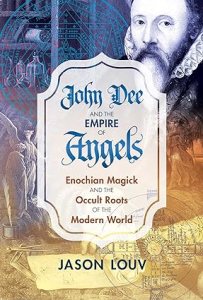 “A comprehensive look at the life and continuing influence of 16th-century scientific genius and occultist Dr. John Dee
“• Presents an overview of Dee’s scientific achievements, intelligence and spy work, imperial strategizing, and his work developing methods to communicate with angels
“• Pieces together Dee’s fragmentary Spirit Diaries and examines Enochian in precise detail and the angels’ plan to establish a New World Order
“• Explores Dee’s influence on Sir Francis Bacon, modern science, Rosicrucianism, and 20th-century occultists such as Jack Parsons, Aleister Crowley, and Anton LaVey
“Dr. John Dee (1527-1608), Queen Elizabeth I’s court advisor and astrologer, was the foremost scientific genius of the 16th century. Laying the foundation for modern science, he actively promoted mathematics and astronomy as well as made advances in navigation and optics that helped elevate England to the foremost imperial power in the world. Centuries ahead of his time, his theoretical work included the concept of light speed and prototypes for telescopes and solar panels. Dee, the original “007” (his crown-given moniker), even invented the idea of a “British Empire,” envisioning fledgling America as the new Atlantis, himself as Merlin, and Elizabeth as Arthur.
“But, as Jason Louv explains, Dee was suppressed from mainstream history because he spent the second half of his career developing a method for contacting angels. After a brilliant ascent from star student at Cambridge to scientific advisor to the Queen, Dee, with the help of a disreputable, criminal psychic named Edward Kelley, devoted ten years to communing with the angels and archangels of God. These spirit communications gave him the keys to Enochian, the language that mankind spoke before the fall from Eden. Piecing together Dee’s fragmentary Spirit Diaries and scrying sessions, the author examines Enochian in precise detail and explains how the angels used Dee and Kelley as agents to establish a New World Order that they hoped would unify all monotheistic religions and eventually dominate the entire globe.
“Presenting a comprehensive overview of Dee’s life and work, Louv examines his scientific achievements, intelligence and spy work, imperial strategizing, and Enochian magick, establishing a psychohistory of John Dee as a singular force and fundamental driver of Western history. Exploring Dee’s influence on Sir Francis Bacon, the development of modern science, 17th-century Rosicrucianism, the 19th-century occult revival, and 20th-century occultists such as Jack Parsons, Aleister Crowley, and Anton LaVey, Louv shows how John Dee continues to impact science and the occult to this day.”
Publishers Weekly Review
 “Louv (Hyperworlds, Underworlds) delivers an overwhelming amount of information in this sweeping attempt to reconcile two schools of thought about Elizabethan scientist John Dee (1527–1608). Historians concerned with Dee generally fall into two camps, writes Louv: the political historians embarrassed by Dee’s late-in-life angelic obsessions, and the occultists indifferent to Dee’s involvement in the development of British intellectualism and politics. By elucidating the “direct intersection between the forces of magic and the machinery of empire,” Louv, with moderate success, argues for the importance of Dee’s ideas throughout the last 500 years of Western history. ” (Click on PW logo for complete review.)
 Malcolm R. Campbell is the author of magical realism novels set in the Florida Panhandle.
 Of all her work, I most liked Glenda Jackson’s (9 May 1936 – 15 June 2023) portrayal of Queen Elizabeth I in the 1971 BBC TV docudrama more than any of the others in that role. Helen Mirren is a favorite of mine, and she did a good job, but I like Jackson’s work better. Jackson is probably best remembered for “Women in Love” and “A Touch of Class.” We can only guess what else she might have done as an actress had she not been gone almost three decades during her political career.
 “Elizabeth R” was the catalyst for multiple debates between my wife and me. She took English history in college and was very knowledgeable about the monarchs and issues. She could never quite understand my dislike of Elizabeth I for being as strong as it is, almost as though Elizabeth I were still on the throne causing more problems in Scotland, Ireland, and elsewhere. Few historically controversial people stir up stronger emotions in me than English monarchs, especially those constantly fighting Scotland.
 Malcolm's Round Table