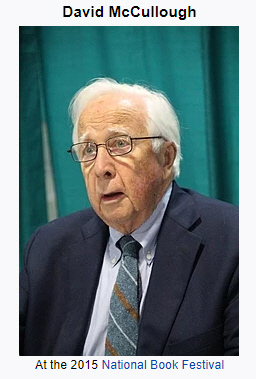
 “David McCullough, a towering force in American literature and biography, winner of the President’s Medal of Freedom, two Pulitzer Prizes and two National Book Awards, died on August 7. He was 89 years old.
“He died of natural causes at home in Hingham, the family confirmed, where he had lived for the past few years, with all five children by his side.
“Mr. McCullough devoted his writing life to telling the American story, beginning with his first book about the Johnstown Flood, published in 1968, and continuing to chronicle events, politicians and structures that made up the American experience. He followed up his debut with a book about building the Brooklyn Bridge, then headed to the creation of the Panama Canal (his first National Book Award). A book about Teddy Roosevelt followed (his second National Book Award) and then books on Harry S. Truman and John Adams, both of which won the Pulitzer Prize.” – Bill Eville in The Vineyard Gazette
In his story, Eville notes that everything McCullough wrote began on a 1940 Royal Typewriter that he bought second-hand in 1965 for $25. It works fine after all those words. In a 2011 interview, McCullough said that sometimes he thought that Royal was writing the books.
The subhead in the New York Times story said, “His research — on Adams, Truman and so much more — was deep, his writing was lively, and his narrator’s voice in documentary films was familiar to millions.”
The books found large audiences and spent weeks on the bestseller lists in part because readers who seldom read history read what McCullough and/or that old Royal typewriter wrote. My wife and I have most of his books, not because they look good on our shelves, but because we like them and respect his approach.
 It’s hard to pick a favorite, but my long-time fascination with Teddy Roosevelt prompts me to say I like Mornings on Horseback, the 1981 biography of Roosevelt, the best. Kirkus began its review, “The biographer of the Brooklyn Bridge and the Panama Canal has written a marvelous book, now, about the making of an exceptional being—and nothing that has appeared before, including Edmund Morris’ recent The Rise of Theodore Roosevelt, diminishes its interest or freshness or emotional force.”
The New York Times wrote, “Mr. McCullough tells his busy, interlocking story without ever losing track of his hero. Always at the center of things is T.R., evolving from a shrill semi-invalid into the robust warrior who would become the dominant figure of turn-of-the-century America. But though he writes with a novelist’s skill, Mr. McCullough never resorts to the novelist’s license to invent, never draws a conclusion not backed by hard facts. The result brings us as close as anyone will ever get to understanding the unique alchemy of the Roosevelt family – and its power to help and hinder Theodore in his rise.”
McCullough’s books on the Johnstown flood, the Brooklyn Bridge, Presidents Truman and Adams, and 1776 (among others) drew similar praise. McCullough’s narrations include the 2003 film “Seabiscuit” and multiple films by Ken Burns including “The Civil War” (1990).
I think it’s fair to say that McCullough’s words will be with us forever, if not longer.


 Malcolm's Round Table