After writing about Whitehead’s Harlem Shuffle yesterday, I thought I might as well focus on its sequel, Crook Manifesto, which was released today by Doubleday. The book allows Whitehead to continue his focus on Harlem and treat his readers to the characters they got to know in Harlem Shuffle. The books are part of a planned trilogy. I like the Minneapolis Star-Tribune’s comment, “A masterwork of stylish noir and social satire … Whitehead’s larger project propels us forward, probing the whipsaw of race and the ouroboros of virtue and vice.”
From the Publisher
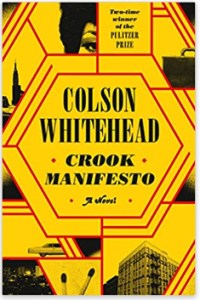 It’s 1971. Trash piles up on the streets, crime is at an all-time high, the city is careening towards bankruptcy, and a shooting war has broken out between the NYPD and the Black Liberation Army. Amidst this collective nervous breakdown furniture store owner and ex-fence Ray Carney tries to keep his head down and his business thriving. His days moving stolen goods around the city are over. It’s strictly the straight-and-narrow for him — until he needs Jackson 5 tickets for his daughter May and he decides to hit up his old police contact Munson, fixer extraordinaire. But Munson has his own favors to ask of Carney and staying out of the game gets a lot more complicated – and deadly.
1973. The counter-culture has created a new generation, the old ways are being overthrown, but there is one constant, Pepper, Carney’s endearingly violent partner in crime. It’s getting harder to put together a reliable crew for hijackings, heists, and assorted felonies, so Pepper takes on a side gig doing security on a Blaxploitation shoot in Harlem. He finds himself in a freaky world of Hollywood stars, up-and-coming comedians, and celebrity drug dealers, in addition to the usual cast of hustlers, mobsters, and hit men. These adversaries underestimate the seasoned crook – to their regret.
1976. Harlem is burning, block by block, while the whole country is gearing up for Bicentennial celebrations. Carney is trying to come up with a July 4th ad he can live with. (“Two Hundred Years of Getting Away with It!”), while his wife Elizabeth is campaigning for her childhood friend, the former assistant D.A and rising politician Alexander Oakes. When a fire severely injures one of Carney’s tenants, he enlists Pepper to look into who may be behind it. Our crooked duo have to battle their way through a crumbling metropolis run by the shady, the violent, and the utterly corrupted.
CROOK MANIFESTO is a darkly funny tale of a city under siege, but also a sneakily searching portrait of the meaning of family. Colson Whitehead’s kaleidoscopic portrait of Harlem is sure to stand as one of the all-time great evocations of a place and a time.
From the New York Times
“Returning to the world of his novel ‘Harlem Shuffle,’ Colson Whitehead’s ‘Crook Manifesto’ is a dazzling treatise, a glorious and intricate anatomy of the heist, the con, and the slow game. There’s an element of crime here, certainly, but as in Whitehead’s previous books, the genre isn’t the point. Here he uses the crime novel as a lens to investigate the mechanics of a singular neighborhood at a particular tipping point in time. He has it right: the music, the energy, the painful calculus of loss. Structured into three time periods — 1971, 1973, and finally the year of America’s bicentennial celebration, 1976 — ‘Crook Manifesto’ gleefully detonates its satire upon this world while getting to the heart of the place and its people.”
 “Arch Colson Chipp Whitehead (born November 6, 1969) is an American
  Malcolm's Round Table