I need a continuity assistant

Since I write without a plan, I seldom note down what a house (for example) looks like inside or out. I mention the things that matter as the scenes unfold, but later I have no memory of the furniture or the front porch, or the rooms. The problem here is that when people come to that house two books later in the series, I don’t know what they’re seeing–much less what they’re sitting on.

This means laboriously going through the Kindle versions of my books and taking a lot of notes about the house’s style and furnishings. The time I save by not taking notes about settings in novel one is more than used up while finding out what’s what by reading through earlier material while writing novels two, three, and four.

For some reason, I always think I’ll remember the details. I seldom do because they’re created on the fly as the action unfolds. People catch continuity problems in movies all the time. The sofa in a scene is red, then it’s suddenly blue in the next scene and not even there the next time people go into the living room.
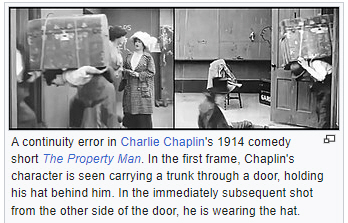
The last thing I want is readers telling me that a house–or even a sofa–keeps changing color from book to book. Or somebody’s hair or eye color. In “The Big Sleep,” Bogart said of his manners, “I don’t like them myself. They’re pretty bad. I grieve over them on long winter evenings.” I could say the same thing about my writing habits.

They help me write book one. They’re a detriment in the books that follow. That’s why I need an assistant to make a list of the houses, people, &c. in each book and send it to me as a dictionary of everything I’ve said before about everything.

But, as a poor starving author, I can’t afford a continuity supervisor, so I need to change my habits. Yeah, right, like that’s going to happen.

–Malcolm

Those old continuity blues

Readers and professional critics get a real kick out of bashing films with continuity lapses. There’s a rose in a vase at the beginning of a scene that turns into a carnation at the end of a scene. A man is wearing a red tie when he starts kissing the girl and a blue tie when the kiss ends.

Those are continuity issues. A script supervisor is supposed to maintain documentation about what’s in the scene and what’s said to ensure that in the flurry of camera takes and other changes, ties don’t change color and flowers don’t change their species.

Do those earrings change color in the middle of the kiss?

Likewise in publishing, it was traditionally the job of a line editor to catch continuity lapses. Sue had green eyes in chapter one and blue eyes in chapter eight. Joe lives in a brick house in chapter three and a house with Vinyl siding in chapter fifteen.

Publishers are reducing the sizes of their staffs and may no longer have professional line editors, smaller publishers may rely on copyeditors and proofreaders and hope the author catches his/her continuity issues, and if you’re self-publishing, the buck stops at your desk.

Some authors create a dossier on each character before they begin writing: name, hair color, eye color, physical traits, habits, place of birth, typical expressions used, etc. Every time they refer to a character, they check the file. If you don’t do this–that is, you tend to make it up as you go–you can search your MS on the character’s name to see what you said about him/her earlier in the draft.

However, this becomes harder to do when you’re writing a novel that’s part of a series and have to laboriously search (if you can find them) the final manuscripts for prior books and/or search the Kindle editions for descriptions.

When I write, characters, houses, and other locations show up as needed. I’m not bothered about continuity at that point because the scenes are transient, meaning I don’t intend to use them again. But then, what if I do? I’ve spent the morning going through the Kindle editions of my Florida Folk Magic Series looking for the description of a so-called dogtrot house. At the time, I had no idea I’d write a subsequent novel that needed to have that house in it. Hell, I couldn’t remember what it looked like, so I had to find out what I said before.

I don’t have an answer for this problem. If you stop writing to record a bunch of info about a character/location/house, you can find it later. If you don’t stop, you’ll probably end up with a better scene because you won’t have interrupted it for “record-keeping.” While I’m writing a novel, I keep all kinds of notes on scraps of paper: but these get lost. I guess I need a better filing system.

Malcolm

The Kindle editions of “Special Investigative Reporter” and “Conjure Woman’s Cat” are on sale at Amazon for 99₵ until the end of March.