‘Darkening of the Light,’ by Robert Hays

Disclaimer: I am a colleague of Robert Hays at Florida’s Thomas-Jacob Publishing.
Darkening of the Light was published on June 4 by Robert Hays, Prof. Emeritus (journalism) at the University of Illinois Urbana-Champaign, and the author of  Blood on the Roses, A Shallow River of Mercy, and other fiction and nonfiction titles.

From the Publisher

“Although he misses Melinda, the girl he left behind, after his time as a homeless orphan on the streets of Paducah, Jeter thinks being a groom in the White House stables, and life in general in the nation’s capital is all he’ll ever want. His friend and mentor, Shakespeare-quoting Union Army Captain Joseph Emerson, is an advisor to President Lincoln. With the President just re-elected and the war with the Confederacy won, they all see bright days ahead.

Hays

“But an assassin’s bullet brings their world crashing down, and Jeter and the Captain see their own grief reflected in the mourning of millions of citizens as the captain commands an Honor Guard on the funeral train that bears Lincoln’s remains on the long cross-country trip home to Illinois.

“As Jeter explores the cities where the train stops en route, he adds his own real-life stories and comes to appreciate the cultural mix that makes America one great nation.”

Malcolm

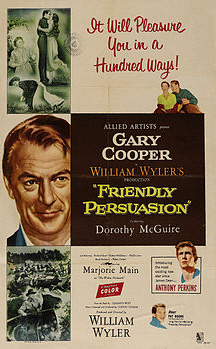
Watching ‘Friendly Persuasion’ Again and Still Enjoying the Story and Performances

“Friendly Persuasion is a 1956 American Civil War drama film produced and directed by William Wyler. It stars Gary Cooper, Dorothy McGuire, Anthony Perkins, Richard Eyer, Robert Middleton, Phyllis Love, Mark Richman, Walter Catlett and Marjorie Main. The screenplay by Michael Wilson was adapted from the 1945 novel The Friendly Persuasion by Jessamyn West. The movie tells the story of a Quaker family in southern Indiana during the American Civil War and the way the war tests their pacifist beliefs.” – Wikipedia

My pacifist beliefs were in their formative stages when this film was released, so I had many reasons for wanting to see it. I liked the film when I saw it in 1956 in the shadow of the Korean War and during an era when the Southern States still took a great deal of pride in their fight against the Union in the Civil War.

For those of my generation, I think “Friendly Persuasion” still holds up well, though I’m fair certain the light-hearted touch–rather a Disney-like approach–would be criticized today for its reliance on humor within the Quaker family more than its portrayal of more true-to-life battle scenes.

The film was drawn from the 1945 novel of the same name by Jessamyn West, a Quaker who wrote a plotless novel story about Quaker life. She was drawn into the making of the film through her willingness to pull together materials from her novel about the Civil War era that would make a cohesive story for the movie.
I found it interesting that while West was working on the book, she had tuberculosis from which she wasn’t expected to recover. Family stories about growing up as a Quaker were shared with her by family members, and had a strong influence on the first edition.

There are many types of Quaker beliefs, so I did not agree with those who criticized the movie for purported inaccuracies in dogma.

Fans of Gary Cooper will like his out-of-type performance in this film.

Malcolm

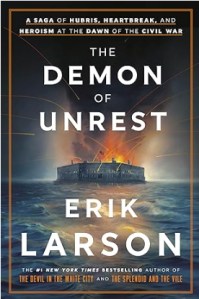
‘The Demon of Unrest’ by Erik Larson

Larson

The Bibliography of the American Civil War says there are over 60,000 books about the war in print. If I were an editor at Crown Publishing  Group and received a proposal via an author’s agent for yet another book, my primary thought would be “What will this book add to the discussion.” No doubt I would be influenced by a proposal from the author of The Devil in the White City which made a big splash in 2003.

Larson writes on his website, “At the heart of the story is a mystery that still confounds: How on earth did South Carolina, a primitive, scantily populated state in economic decline, become the fulcrum for America’s greatest tragedy? And even more bewildering, what malignant magic brought Americans on both sides of the Mason-Dixon Line to the point where they could actually imagine the wholesale killing of one another?”

If these thoughts were part of Larson’s agent’s proposal on my desk, I would want to read more. When Larson’s readers see the listing for this book, due to be released at the end of May, they’ll also want to read more, according to, well, me.

From The Publisher

“The #1 New York Times bestselling author of The Splendid and the Vile brings to life the pivotal five months between the election of Abraham Lincoln and the start of the Civil War—a simmering crisis that finally tore a deeply divided nation in two.

“A MOST ANTICIPATED BOOK OF THE YEAR:
The New York Times, People, Time, Los Angeles Times, Men’s Health, New York Post, Lit Hub, Book Riot, Screenrant

“On November 6, 1860, Abraham Lincoln became the fluky victor in a tight race for president. The country was bitterly at odds; Southern extremists were moving ever closer to destroying the Union, with one state after another seceding and Lincoln powerless to stop them. Slavery fueled the conflict, but somehow the passions of North and South came to focus on a lonely federal fortress in Charleston Harbor: Fort Sumter.

“Master storyteller Erik Larson offers a gripping account of the chaotic months between Lincoln’s election and the Confederacy’s shelling of Sumter—a period marked by tragic errors and miscommunications, enflamed egos and craven ambitions, personal tragedies and betrayals. Lincoln himself wrote that the trials of these five months were “so great that, could I have anticipated them, I would not have believed it possible to survive them.”

“At the heart of this suspense-filled narrative are Major Robert Anderson, Sumter’s commander and a former slave owner sympathetic to the South but loyal to the Union; Edmund Ruffin, a vain and bloodthirsty radical who stirs secessionist ardor at every opportunity; and Mary Boykin Chesnut, wife of a prominent planter, conflicted over both marriage and slavery and seeing parallels between them. In the middle of it all is the overwhelmed Lincoln, battling with his duplicitous secretary of state, William Seward, as he tries desperately to avert a war that he fears is inevitable—one that will eventually kill 750,000 Americans.

“Drawing on diaries, secret communiques, slave ledgers, and plantation records, Larson gives us a political horror story that captures the forces that led America to the brink—a dark reminder that we often don’t see a cataclysm coming until it’s too late.”

From Publishers Weekly

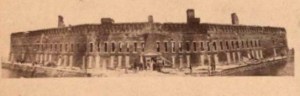
Sumter – 1861 Photo

“In this twisty and cinematic account, bestseller Larson (The Splendid and the Vile) recreates the five-month period between Abraham Lincoln’s 1861 election and the outbreak of the Civil War, focusing on the intensifying showdown over Fort Sumter in Charleston, S.C., where Maj. Robert Anderson, the U.S. Army commander, faced a swelling Confederate force with his outgunned garrison of 75 soldiers. Larson mirrors Anderson’s struggle to hold his post while avoiding provocations that might lead to war with Lincoln’s tightrope-walk attempt to stand firm against secession without goading the South into it. As he traveled to Washington, D.C., to take office—arriving in disguise after dodging a rumored assassination plot in Baltimore—Lincoln vacillated over whether to resupply Fort Sumter or surrender it.” – Publishers Weekly

Malcolm

Malcolm R. Campbell, author of magical realism and contemporary fantasy novels, previously served as a book reviewer for a Georgia regional magazine.
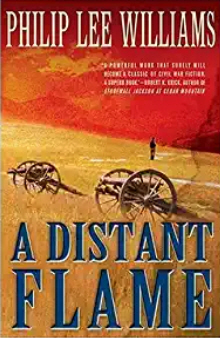
‘A Distant Flame’ – the second time through

I purchased my copy of this novel about the battle of Atlanta in 2005 when author Philip Lee Williams gave a reading in my small NE Georgia town. He signed the copy, but since the novel had won the Michael Shaara Award for Excellence in Civil War Fiction, he was more interested in my memories of Shaara as my creative writing teacher than talking about the book. I see that I gave the book a positive review on Amazon.

The book is somewhat haunting for a Georgia resident to read simply because the battles happened in the small towns between where I live now and Atlanta–and I’ve visited some of the battle locations.  I-75 carries motorists past sites where thousands were killed. It’s more haunting now because there is so much violence and unrest in the country in addition to the ills of the pandemic.

From the Publisher

In the spring of 1864, the Confederate Army in Georgia is faced with the onrushing storm of General William T. Sherman’s troops. A young sharpshooter for the South, Charlie Merrill, who has suffered many losses in his life already, must find a way to endure—and grow—if he is to survive the battles that will culminate in July at the gates of Atlanta.

From the opening salvos on Rocky Face Ridge near Dalton, through the trials of Resaca and Kennesaw Mountain, Charlie must face the overwhelming force of the Federal army and a growing uncertainty about his place in the war.

Never before has the Atlanta Campaign been rendered—in all its swift and terrible action—with such attention to history or with writing that reaches the level of art. This crucial episode in the Civil War’s western theater comes alive with unexcelled power and drama as it unfolds in soldiers’ hands and hearts.

Throughout the course of the novel, Charlie’s life is laid out in powerful detail. The experiences from his childhood, through the war, and into his twilight years are to a great extent on his mind half a century later when he is to give a major speech in the park of his small Georgia town

A Distant Flame is a book about the cost of war and the running conflict that led Sherman’s Army to the Battle of Atlanta—and the March to the Sea. It stands as a testament to love, dedication, and growth, from the Civil War’s fields of fire to the slow steps of old age.

What impressed me as an author is the fact that Williams made a chart (for research, not to include in the novel) showing where every general and brigade were 24/7 as Sherman moved through North Georgia. I mention this to everyone who says I spend too much time with research.

The novel reads well the second time through, and since it’s been a while since I read it, I don’t remember things just before they happen.

Malcolm


The dead do not whisper at historic battlefields

Jackson Shrine near Fredericksburg

Stonewall Jackson died of pneumonia May 10, 1863, at Guinea Station, Virginia, VA. eight days after being wounded at the Battle of Chancellorsville. He probably would have survived the wounds–ironically from “friendly fire”–had the pneumonia not stricken him as he lay in a bed in this house which Lesa and I visited near Fredericksburg several days ago. The house was an outbuilding on the former Chandler Plantation and is preserved today at the Fredericksburg & Spotsylvania National Military Park.

His bed is there now, and it is not a quiet one.

We didn’t have time to visit the Chancellorsville battlefield, but did tour the battlefields at Fredericksburg and Spotsylvania. There was a light drizzle most of the day. A fitting day, I supposed, to visit hallowed ground where so many were killed in 1862 and 1864. Lesa was a history major with an emphasis on the Civil War. We have both read fiction and nonfiction about the war as well as viewing documentaries such as the very memorable one produced by Ken Burns.

Spotsylvania

Battlefield Sign

As we walked the site of a nasty engagement at Spotsylvania called The Bloody Angle, we acknowledged that in spite of what we knew before we went there, standing there and reading the signs brought home a host of emotions about the death, fear, horror, resignation, bravery, determination and hope that were felt by the men who died and survived on that patch of ground a century and a half ago.

I don’t see how a writer of either fiction or nonfiction can write about an even without visit these historic sites. To varying degrees, we can sense the dead, hear their voices where they died. Like everyone, writers mourn the dead, the lives stopped in midstream often in moments of terror and pain. But we also mourn the living. The dead are here no more, resting in peace, we hope, but the living carry their memories of the dead and continue to suffer greatly for years and lifetimes. Better to die in the war, I’ve always thought, than to be the child or the spouse of the soldier who died in the war.

Stonewall Jackson’s wife Mary Anna visited him on his death bed in this house and subsequently lived until 1915. She suffered, I think, longer than he did. If I were to write a Civil War novel that included Stonewall Jackson, I would be listening for Mary Anna’s voice, too.


Malcolm

Crawford W. Long Museum Included in Civil War Sites Guidebook

The Crawford W. Long Museum in Jefferson is among the 350 historic sites included in Crossroads of Conflict: Guide to Civil War Sites in Georgia from the University of Georgia Press.

The entry, which includes a photograph of the museum’s historic 1858 Pendergrass Store, notes that the facility “honors the physician Crawford W. Long, who attended the University of Georgia where he roomed with Alexander H. Stephens, the future vice president of the Confederacy. Long is credited as the first physician to use ether for surgical purposes.” Long served in the Athens, Georgia Home Guard and as a surgeon for the Confederacy.

Written by Barry L. Brown and Gordon R. Elwell, the Georgia Civil War Commission publication is an expanded update of the 1994 edition of the guidebook. The 304-page new edition, which arranges Georgia sites into nine regions beginning with the Chickamauga Battlefield in the northwest, includes 65 black and white photographs, 190 color photographs and images, and twenty maps.

According to the University of Georgia Press, “The impact of the Civil War on Georgia was greater than any other event in the state’s history. Approximately eleven thousand Georgians were killed and the state suffered more than one hundred thousand in total casualties. Georgia was extremely influential in this nation’s most tragic conflict, and the war touched every corner of the state.”

Born in Danielsville, Georgia, Crawford W. Long (1815-1878) first used ether for surgical anesthesia on March 30, 1842.

“Do a Georgia resident, friend planning a cultural tourism vacation to the South, or student of the Civil War might enjoy this guidebook? If so, click the Share This button below to send a link by email or recommend this post on your favorite social site.”

Coming Attractions on Malcolm’s Round Table

November 17 – An interview with author Vila Spiderhawk
November 21 – Second Annual Blog Jog Day
December 17 – Virtual VHP Dine-a-Round

Malcolm

Fine storytelling: ‘Above the Fray, Part II’

Above the Fray Part Two Above the Fray Part Two by Kris Jackson

My rating: 5 of 5 stars
Part I of “Above the Fray” (CraigsPress, May 2009) follows the exploits of protagonist Nathaniel Curry, a fifteen-year-old telegraph operator from Richmond, with the Union Army Balloon Corps from the Peninsula Campaign during the spring and summer of 1862 through the Battle of Antietam that September.

Part II begins as General Ambrose Burnside, who was placed in command of the Army of the Potomac in November 1862, is pushing into Virginia with the objective of capturing the Confederate capital at Richmond. En route, the Union Army will suffer a costly defeat at Fredericksburg in December with a battle plan that Nathaniel sees as “simple to the point of folly.”

Richmond will not fall until the spring of 1865, two years after Chief Aeronaut Thaddeus Lowe has resigned from the balloon corps due to pay and logistics disputes. The Union Army Balloon Corps, a civilian contract organization, disbands in August 1863.

Curry, however, is not out of the war. There’s no precise way to say just how he stays in the war without giving away the inventive plot. Both the Union and the Confederacy want him to spy for them, for he is either an exceptionally streetwise chameleon or a man protected by the gods. He is equally at home with generals and prostitutes, with Southern slaves and northern infantrymen, and with soaring above the fray of a battlefield and with slogging it out under fire on both sides of the lines.

Taken together, parts I and II of “Above the Fray” give the reader a balloonist’s view of the Civil War from Atlanta to Richmond to Washington, D.C. Jackson’s research is broad and impeccable, his ear for dialogue is well-tuned, and his rendering of the war from multiple theaters and perspectives is stunning.

One evening Curry and his friend Vogler are sitting in camp with several of the many historical characters, Thaddeus Lowe, James Allen and Ezra Allen reading mail.

“‘Solly,’ Nathaniel Curry said, ‘you get more mail than the rest of us together.’

“‘Vogler looked over his glasses at him and smiled.

“‘What are you reading now? What language is that?’

“‘It’s German. This is the journal of the Royal Society of Prussia.’

“‘Wouldn’t they speak Prussian?’

“‘No. You’re thinking of Russia where they speak Russian.’
“‘Oh. The letters aren’t the same as ours.’”

Vogler then tells his fellow aeronauts he’s reading an account of several record-setting balloon ascents by aerialists Henry Coxwell and James Glaisher in England who reached a height of over 37,000 feet. The second flight occurred about the same time the balloon corps was at Antietam. The aeronauts are excited about the record, and they discuss the impact of the cold temperatures and thinner atmosphere on both the aerialists and their balloon.

Such accounts expand the reach of the novel to events far from the field of battle, greatly adding to the perspective of both the characters and the reader. Similarly, events Nathaniel observes at the Second Battle of Bull Run in “Above the Fray, Part I,” bring him to the attention of those conducting the controversial court-martial of Union General Fitz-John Porter in Part II where the issues of politics, command competency and scapegoats intertwine.

Is it likely that a young telegraph operator from Richmond would be on speaking terms with President Abraham Lincoln, Confederate President Jefferson Davis, General Robert E. Lee, and multiple officers in both the northern and southern chains of command? Perhaps not.

But Kris Jackson makes it credible and entertaining. “Above the Fray, Part II” is fine storytelling by an author who knows the territory. When Nathaniel Curry approaches Appomattox Court House in the spring of 1865, he has come a very long way from that long ago day when he inadvertently rode a balloon into the sky with Professor Thaddeus Lowe, that day when Lowe said, “The sun’ll not rise today, Nathaniel. You and I shall have to rise to meet it.”

View all my reviews >>

Note: The trade paperback cover of Part II looks slightly different than the one displayed here by GoodReads.

Copyright (c) 2010 by Malcolm R. Campbell, author of “The Sun Singer” and “Jock Stewart and the Missing Sea of Fire.”