Not long after we were married, my wife and I discovered that both of us love reading reference books, primarily dictionaries and enclopedias and–in my case–Brewer’s Dictionary of Phrase and Fable. Contrary to what our critics say, we don’t walk to the book shelf, pull out a reference book, and start reading. No, it starts innocently enough. We’re there to look something up but, en route, we see other interesting entries and find ourselves engrossed in them.
 My family started out with Compon’s Encyclopedia when my brothers and I were in grade school and junior high, and then moved on to the Encyclopædia Britannica which thereafter became my favourite. It was published as a physical book from 1768 to 2010, and there after as an online publication. My wife’s family had World Book. My Scot’s ancesters would approve of the thistle.

My dictionary of choice is Webster’s New Collegiate Dicitionary which is listed with a publication date of 1977, though I think my copy came out before that. I use it now because the spellings in it are those I grew up with and refuse to change. You’ll never find me using the words “donut” or “plow” because they look flat wrong. The versions of words I use are, in current dictionaries, listed as “British Spellings” even though I learnt them in the Florida school system. If I can’t find a word here, it’s not a word. Needless to say, this view has caused problems with teachers and editors, but I always tell them to suck it up and let the old guy have his way.
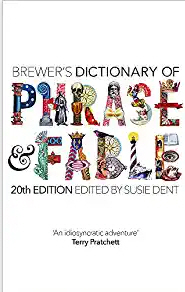
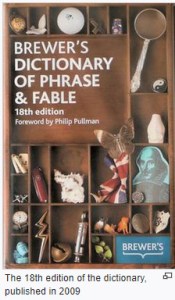 My favourite reference book, which I see I mentioned on this blog about twenty years ago, is Brewer’s Dicitionary of Phrase and Fable. It’s very easy to get lost for hours in this one. Brewer’s, which has been around since 1870, is described by Wikipedia “is a reference work containing definitions and explanations of many famous phrases, allusions, and figures, whether historical or mythical. The “New Edition revised, corrected, and enlarged” from 1895 is now in the public domain, and Web-based versions are available online. The most recent version is the 20th edition, published in November 2018 by Chambers Harrap Publishers.”
I think I last mentioned it on this blog about twenty years go. None the less, it sits close at hand on my bookshelf and has been responsible for many hours of reading what I really didn’t need to read. I have noticed, however, that when reading reference books, one comes across a lot of things he didn’t know but needed to know. Now that’s synchronicity.
–Malcolm
Malcolm R. Campbell is the author of contemporary fantasy, magical realism, and paranormal stories and novels.


 Malcolm's Round Table