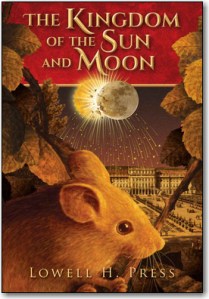
The Kingdom of the Sun and Moon, by Lowell H. Press, Parkers Mill Publishing (September 10, 2014), Ages 10 and up, 316 pages.
Starting with the cover, this is a beautifully crafted book.
Lowell H. Press has written an inventive novel about a hierarchy of mice living in the gardens and secret interior spaces of a castle inspired by the Schönbrunn Palace in Vienna, Austria.
The colony’s king cares little for his subjects and is mostly interested in taking the food they save throughout the year for his own use during the winter months.Two brothers, Sommer and Nesbit, discover that all is not what it seems, including the king’s purported fear of a pending invasion of the colony by a massive army of woodland mice.
Sommer, who is drafted by the king’s minions for a suicide mission on the colony’s behalf and Nesbit, who insults the king and flees into the dangerous forest, take different approaches to survival and justice. Sommer becomes a cadet commander, while Nesbit becomes known as either a worker of magic of an exceptionally lucky mouse.
Set in a 1700s world, The Kingdom of the Sun and Moon is a delightful story with well-drawn characters and an underlying culture and myth that will charm young readers while keeping their parents engaged whenever this derring-do yarn is shared around the dinner table or at at bedtime.
Press used his visit to the Schönbrunn Palace to great advantage in developing a setting for his story that is well suited to the mice colony’s culture and history as well as to the people and cats who appear throughout the tale for better or worse.
Sommer and Nesbit of the Long Meadow Colony are tiny, as mice go, but they make up for it in bravery and guile.
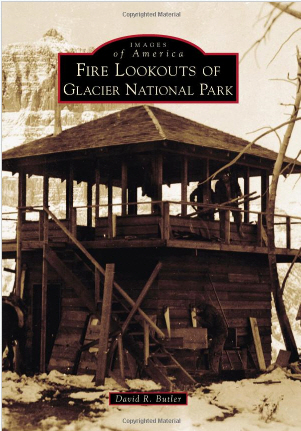
Fire Lookouts of Glacier National Park (Images of America), by David R. Butler, Arcadia Publishing (June 9, 2014), 128pp, photographs.
I’m happy to see the release of David R. Butler’s new book about Glacier National Park’s fire lookouts. Several years ago, in Heavens Peak Fire Lookout Assessment Open For Comments, I mentioned the developing plans to refurbish the historic fire lookout on Heaven’s Peak. David told me that most of that work was completed in 2012 and that his book includes before and after pictures. This is good news.
From the Publisher: The first fire lookouts in the Glacier National Park region were simply high points atop mountain peaks with unimpeded views of the surrounding terrain. Widespread fires in the 1910s and 1920s led to the construction of more permanent lookouts, first as wooden pole structures and subsequently as a variety of one- and two-story cabin designs. Cooperating lookouts in Glacier Park, the Flathead National Forest, and the Blackfeet Indian Reservation provided coverage of forests throughout Glacier National Park. Beginning in the 1950s, many of the lookouts were decommissioned and eventually destroyed. This volume tells the story of the rise and fall of the extensive fire lookout network that protected Glacier National Park during times of high fire danger, including lookouts still operating today.
From the Book: “Fire lookouts are described by many writers as magical places, and are well-known as inspirational sites for writers and poets such as Jack Kerouac, Normal Maclean, and Gary Snyder, as well as environmental writers and naturalists such as Edward Abbey and Doug Peacock. They also serve as nostalgic, historical reminders of a simpler time before the Internet, wireless communication, and the widespread use of advanced technology for spotting and monitoring fire boundaries.”
A small percentage of hikers and climbers see the nine remaining lookouts (a few of which are still in use) in Glacier, sticking to the more well-known trails, saddle trips and launch trips. For those who have never seen the lookouts, the photographs in this book open new worlds. For those who know, or who would like to more, Butler brings us another chapter in Glacier’s colorful history.
Update: Arcadia is offering the book at 20% off through Father’s Day 2014. Here’s the link.
Malcolm R. Campbell is the author of three contemporary fantasy novels (“The Seeker,” “The Sun Singer,” “Sarabande” set in Glacier National Park as well as his non-fiction “Bears; Where They Fought,” a historical look at Glacier’s Swiftcurrent Valley.
I’m a disorganized writer. My den, and especially my book shelves, is a mess. When my publisher sends me free author’s copies of my books and/or I order books for gifts, reviewers and book signings, I often order more copies without checking to see how many I already have. Extra copies are everywhere.
Here’s my solution. The following is a list of extra copies of some of the books I’ve written. All of them are available on Amazon, Smashwords and OmniLit so you can check them out. If you decide you would like a copy mailed to you (continental U.S.), you can have one at no charge. Limit is one per person on a first-come, first served basis.
With the exception of the last item on the list, all of these are from Vanilla Heart Publishing.
If you would like a copy, send me an e-mail with the title of the book you want, your mailing address and whether or not you want the copy signed. If you have a second or third choice, include those titles in case somebody else gets to your first choice before you do.
Send the e-mails to me at malcolmrcampbell [at] yahoo [dot] com.
Offer expires May 30, 2014
Titles and Copies Available
Emily’s Stories (three short stories set in north Florida) – 1 copy
The Seeker (magical realism with fantasy elements) – 4 copies
The Sailor (magical realism with fantasy elements) – 3 copies
Jock Stewart and the Missing Sea of Fire (comedy/mystery, original cover) – 2 copies
The Sun Singer (fantasy) – 3 copies
The Sun Singer (fantasy, iUniverse edition; same as VHP edition except that it blurs the real locations used in the story) – 2 copies
If you find anything that sounds like your cup of tea, e-mail me and I’ll send it to you. There’s no obligation, but if you love it, an Amazon review would be nice.
Years ago, as a park ranger in Yellowstone, Alan Leftridge loved sharing his passion for the outdoors with other people.
“Seeing the excitement and enthusiasm on a visitor’s face is its own reward,” Leftridge says. “They come to a park asking ‘what is there to see and do?’ and you can see the anticipation build as you describe the natural wonders awaiting them. It’s the best part of the job.”
Now Leftridge has channeled that passion into Farcountry Press’ newest release, The Best of Yellowstone National Park ($19.95, Farcountry Press, 2014).
“As the world’s first national park, Yellowstone is a land of superlatives,” he says. “The park is home to the world’s largest collection of geothermal features, including geysers, mudpots, hot springs, and fumaroles. There are stunning wildflower displays, grizzly bears, wolves, bison, and elk, and wonderful hiking trails. It’s easy to share my excitement for such a spectacular place.”
From his home in Montana’s Swan Valley, Leftridge regularly ventures onto Yellowstone’s trails, photographing wildflowers, watching wildlife, and easing into the serenity of the mountains.
Leftridge says, “Over the years, I’ve spent many hours exploring Yellowstone. I wanted this book to read like an insider’s guide, as though a trusted friend was divulging all the best things to see and do in the park.”
The book describes the best day hikes, nature trails, backpack trips, boat tours, flora and fauna, historic sites, and more. There are sections on the best activities for kids and the best ways to spend a rainy (or snowy) day. Also included are the best cross-country ski trails and other activities for winter visitors.
In addition to his contemporary fantasy set in Glacier National Park, Malcolm R. Campbell is the author of the collection of humorous stores “Jock Stewart Strikes Back.”
This book fits into the “clever” and “hoot” genres and/or categories. It rocks and rolls from beginning to end with characters, events and language usage that are off-the-scale nuts.
In many ways, the plot–which is deliciously tangled–doesn’t matter because we’re all along for the ride and where we end up doesn’t matter. . .it’s one of those “the journey is more important than the destination” kind of books, er, in a wry way.
My only cautionary words are these: reading this book is rather like eating a cake that’s 99% frosting. You feel guilty but you keep doing it anyway.
If you’re a regular GoodReads visitor, you probably got an e-mail in the last could of days called See Your Year in Books. Mine began: “Congratulations! You read 21 books this year!”
This told me one thing: I haven’t been very diligent entering the names of the books I’m reading at GoodReads, for that is a fraction of the real number. Nonetheless, it was fun to look back:
We tend to sum up our yearly joys and sorrows, don’t we, from major news events and all those “best books of the year” lists to our own career and family milestones. I look at all these book covers and realize that authors pulled my imagination in many different ways in 2013. I also see that I forgot to buy some of the books I couldn’t wait to read when I first heard about them.
If you’re an avid reader, perhaps you’re also surprised at some of the books you read and some of the books you forgot about. Perhaps I need to get more organized. Hmm, sounds like a New Year’s resolution, doesn’t it?
Three folk tales set in the swamps and flatwoods of the Florida Panhandle at the dawn of time. Why doesn’t the Florida Panther roar? Why does the Snake Bird need to dry its wings. And what unlikely food is the black bear’s favorite?
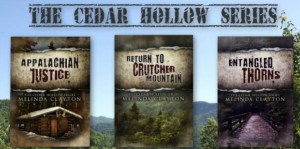
Today’s guest is author Melinda Clayton (“The Cedar Hollow Series”). Her new novel, a stunning tale about a family in the midst of self-destruction Blessed Are the Wholly Broken, was released October 16. Clayton, who has published numerous articles and short stories in print and online magazines, is a licensed psychotherapist in the states of Florida and Colorado. She holds an Ed.D. in Special Education Administration. She recently founded Thomas-Jacob Publishing described as a “unique family-owned publishing company.”
Clayton previously visited Malcolm’s Round Table in July of 2012 when her novel Entangled Thorns was released as the third book in “The Cedar Hollow Series.”
Malcolm: Welcome back! In your new novel Blessed Are the Wholly Broken, you move away from the Appalachian Mountain families in “The Cedar Hollow Series” to Phillip and Anna Lewinsky, a modern-day urban couple, living in Memphis. As an author, how difficult was it to shift away from the prospective “comfort zone” of an on-going series with known characters and established settings to a new environment featuring students graduating from college who are ready for careers and family life?
Melinda: Thanks for having me back, Malcolm. It was difficult, but I also felt it was time. There may be other Cedar Hollow stories, but the story of Phillip and Anna Lewinsky had been rattling around in my head for some time. I had also wanted to write a story set in the area of Tennessee in which I grew up, so that was fun. It was also fun to revisit the University of Memphis on Memphis’ rainiest day of 1989. I remember that day well. I was really tired of the rain, of being cold, and of getting soaked on my walks to both class and work.
Malcolm: At the beginning of the book, you quote a line from “In Place of a Curse,” a signature poem by John Ciardi: “They who are wholly broken, and they in whom mercy is understanding, I shall embrace at once and lead to pillows in heaven.” In addition to suggesting a unique title for your novel, how does this sentiment set the stage for the story to come?
Melinda: I think of Phillip as being “wholly broken.” This is a man who in his early twenties felt he had everything he needed to be happy. In his words, “I felt like the luckiest guy in the world. First job, first apartment, first girlfriend, best friend. What more could I have possibly wanted?” But by his mid-forties, when we first meet him in the Prologue, he feels he has nothing at all. “Life imprisonment or death; that is the question. And while the outcome matters immensely to the other players in this drama of my life, it matters not at all to me. I am dead either way.”
I wanted to explore that dynamic, the path one might travel that could lead from euphoria to despair, from hopeful to hopeless.
Malcolm: Asking a therapist why s/he writes about characters with deeply rooted psychological problems probably makes as much sense as asking a composer why s/he writes about characters who are struggling with a symphony. Yet, as I think about both “The Cedar Hollow Series” and Blessed Are the Wholly Broken, I can’t help but see the books’ characters as almost being—as we say in the South—“too broke to fix.” In addition to the page-turning read we all look for, do you think these novels will also help provide closure for readers who know people who seem wholly broken and/or who often feel they might be wholly broken?
Melinda: Wow, I might have to think about that for a minute! I think the “broken” characters in the Cedar Hollow Series have within them some spark of hope, enough, at least, to compel them to continue moving forward. One reviewer remarked that she loved it that those books all ended on a hopeful note, a type of new beginning for the characters. If there’s a message to those books, it might be something along the lines of each cloud having a silver lining, or there being a light at the end of the tunnel. Never give up; this too shall pass, etc.
I think Blessed Are the Wholly Broken is different in that within the first page, we know Phillip Lewinsky has been found guilty of the murder of his wife. One of the beta-readers called me midway through reading and said, “But he’s going to get out, right?” She found him to be a sympathetic, likable character and wanted a happy ending for him. I suppose a philosophical argument could be made that in a paradoxical sort of way, he was happy with the ending and he did find the closure he was looking for, but the writing of Wholly Broken was more about an examination of the unraveling of a life than it was about reaching closure.
Malcolm: How do prospective wholly broken people/characters impact the therapist/novelist?
Melinda: In some ways, the impact is the same for both the therapist and the novelist, in that I’ve always been fascinated by trying to discover what makes us all tick. Behavioral theory would say we don’t engage in a behavior unless we’re getting something out of that behavior. Maybe we’re being positively reinforced in some way, or maybe we’re trying to avoid something uncomfortable. That’s overly simplistic, but I think for the most part, it’s true.
As a therapist, part of finding the solution lies in finding the why of the behavior. Once a person recognizes and understands the purpose behind their behavior, they can choose whether or not they want to change it.
As a novelist, it’s fun to work to tie together a character’s motivations, choices, and decisions with their ultimate outcome.
Malcolm: After readers learn on the first page of Blessed Are the Wholly Broken that a crime has been committed, the novel moves about quickly from one time to another and from one place to another rather like a “whodunit.” I felt like I was reading a detective story. How did you approach your research for this, especially that involving medical, police, prison and courtroom procedures?
The dorms at Memphis State University (now U of M) where Phillip and Anna meet.
Melinda: This novel, by far, required more research than all three of my previous novels put together. I spent time both talking with and emailing medical and legal experts as well as making several phone calls to the Lauderdale County Jail to make sure I accurately portrayed not only procedures, but physical components of the building.
I sent hardcopies of the chapters dealing with medical issues to an expert in the field of microbiology, and chapters dealing with legal and courtroom procedures to the founder of a law firm in New York.
I wanted the book to be as true to the regions as possible, so I also researched weather patterns in that area during that time to make sure if it was raining in the novel, it really had rained on that particular day. I pulled up calendars from that time to make sure if court was held on a specific day in the novel, it would have really been held on that day in Ripley, Tennessee.
I think I probably spent more time on research than I did on writing. Everyone was incredibly helpful; if there are mistakes, they’re completely my own.
Malcolm: While Blessed Are the Wholly Broken was still a work in progress, you formed your own publishing company. How did the becoming a publisher change your perspective about what it takes to prepare and format manuscripts, and to publish and market a book? How did it change your viewpoint as a writer? Did becoming a publisher change your writing habits or approach or were you able to keep your publisher’s hat in the closet until the manuscript was done?
Melinda: Becoming a publisher in the middle of the writing process taught me that publishing is a lot of work! In some ways it stifled me as a writer because as I typed, I couldn’t help thinking, “Ugh, once I get done with this manuscript, I have to reformat it three different ways….” On the flip side, I loved having the ability to review and proof the finalized manuscripts before hitting “publish.” It was nice to have one last chance to check for any typos or formatting errors before going “live.”
Malcolm: Best of luck with Thomas-Jacob Publishing and Blessed Are the Wholly Broken. Where can prospective readers find you your novels on the Internet?
Melinda: Thanks, Malcolm! And thanks for the wonderful interview.
All of my books can be found through major retailers such as Amazon and Barnes & Noble. They’re also available through Smashwords, Apple, Sony, and Kobo.
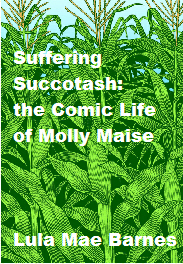
Suffering Succotash: The Comic Life of Molly Maise,” by Lula Mae Barnes (Corn Fritter Press, September 2012), 4,837pp with illustrations, index, maps, and bibliography.
As time goes by, fewer and fewer people remain on this Earth who suffered through depression-era and Thanksgiving meals constructed substantially of succotash.
“As far back as the Revolutionary War,” writes Lula Mae Barnes in her new and overly definitive biography of the 1770s Rhode Island innkeeper, dancer and lady of the evening Molly Maise, “people were thankful to live off succotash when times were hard and just as thankful to get rid of the vile mixture when good fortune smiled upon them again.”
Barnes, who spent the last fifty years uncovering the obscure details of the inventor of succotash, claims that the mixture of corn, various forms of beans and minced oaths is far too improbable a concoction to have occurred by accident.
Young Molly Maise, an innkeeper on Aquidneck Island who supported the “divine cause of everything that wasn’t British,” devised succotash as a “devious treat” for British sailors enjoying her favors in the days leading up to the 1778 Battle of Rhode Island. Ever after, she claimed her succotash made the sailors so ill, they scuttled their own fleet to kill the pain. While historians agree that the fleet was scuttled, they do not cite succotash as a cause.
According to Barnes, Maise spent a lifetime giving humorous talks, some bawdy, about the ills of succotash and the role it had in the war. While her speeches and dance routines, including “The Succotash Rag” (which pre-dated the American Ragtime boom by one hundred years) were well attended, she failed to gain the validation as a soldier and inventor she was seeking.
In fact, the biography’s references clearly indict most, if not all, of the United States’ founding fathers, soldiers, newspapermen and historians of a “treasonous level of guilt” for their roles in covering up the role of Molly Maise and succotash in “the cause of freedom.”
Barnes’ epic work clearly shows that every human’s recipe for defeat is based on the foods they eat, how they mix them together, and what they name the resulting entree. Had Maise called her corn and beans a Corn & Bean Medley, history might have duly honored her for the suffering her invention caused herself and all the generations that followed.
The epitaph on Maise’s tombstone reads: “Loose corn and beans sink ships faster than loose lips.”
“There was a time when a learned fellow (literally, a Renaissance man) could read all the major extant works published in the western world. Information overload soon put paid to that. Since there is “no end” to “making many books” – as the Old Testament book Ecclesiastes prophesied, anticipating our digital age – the realm of the unread has spread like a spilt bottle of correction fluid.” – The Guardian in “In theory: the unread and the unreadable”
Carlos Ruiz Zafón writes about a “cemetery of forgotten books” in his novel The Shadow of the Wind. This cemetery is a library maintained by the secret few who know about it and who may lend you a volume if you will protect it for life. After reading the article in “The Guardian” which led me to The Neglected Books Page which led me author Jo Walton’s lengthy 2010 Neglected Books: The List (with a science fiction and fantasy focus), I wondered if we should build a cemetery, that is, a library, of forgotten AND neglected books.
You probably have some favorite authors and books that never seem to catch on with the general public. With my Georgia focus, I can usually name several Georgia authors who seem to be lost in the shuffle even though they have won awards and/or had a book or two made into a movie. While I’ll probably read the upcoming Dan Brown book Inferno, I don’t usually follow fads. Reading outside the latest fad, I’m usually able to think of wonderful books that are being overlooked.
“The Guardian” article mentions information overload. That’s certainly a factor. Adults aren’t known for reading a lot of novels per year. Perhaps high school and college literature classes made fiction seem boring. Perhaps the latest reality show, movie, or trending Internet story gets in the way. There are plenty of reasons.
One can also say that small press authors, not including those published by old-line prestigious small presses, are likely to feel neglected. For the most part, small press books do not get reviews from Kirkus, Booklist, Publishers Weekly and major newspapers. There usually are no noteworthy interviews with small press authors or off-book-page stories about their work. With few exceptions, their books are not entered into awards competitions, included on the media’s best-books-of-the-year lists, optioned for movies, or remotely on the radar of most prospective readers.
If you ask a major critic, book reviewer, literary magazine, or publishing magazine what a neglected or a forgotten book is, it is normally considered one from a major publisher that was well reviewed, but had lower than expected sales and was allowed to go out of print. Books by popular authors that don’t catch on like the authors’ other works are also in the “neglected” category.
The cemetery/library in The Shadow of the Wind resonated with me in part because of the novel’s notion that “Every time a book changes hands, every time someone runs his eyes down its pages, its spirit grows and strengthens.” In “real life,” a secret library that almost nobody knows about won’t serve our need. Perhaps books need patrons or people who love them and talk about them or people who share them with their friends. Perhaps we need more adventurous readers who will commit to buying five books a year that are not on the bestseller list. We need more reviewers: writers often wonder why people say, “hey, I loved your book” but then don’t follow that up with a reader review on GoodReads or Amazon.
I think I’m only talking about band-aids here unless more people find more reasons to read. According to ParaPublishing, 27% of adults in the U.S. don’t read books for pleasure (based on figures from a few years ago). What books are the remaining adults going to pick from: an old and forgotten book, a book from a small press author, or the book sitting in the bookstore window and at the top of the national bestseller lists? No wonder so many books are forgotten and/or neglected and/or passed over—depending on your definition of those terms.
Years ago when literature and other liberal arts courses were more valued in high schools and college than they are now, most of the students in my classes came from families where their parents read almost no books. The students learned from home that reading wasn’t valued. Our town’s public library has reading classes for kids, and I love seeing the kids there. But I wonder, is the excitement of the reading program reinforced by parents at home or are the kids just dropped off at the library by parents who need time to run some errands elsewhere?
Reading is an investment in time more than an investment of money. I get offers via e-mail, Facebook and GoodReads for free downloads and sample chapters. I read a lot, but I can’t keep up with the deluge. I try to promote new authors on my blogs and on Twitter, but sooner or later, I want to read the books I hear about rather than free books I’ve never heard about. It’s book overload even for those of us who read a lot.
Perhaps reading just isn’t a modern-day avocation and perhaps it’s too late to change that. Can reading-oriented groups help or did we let lack of reading get so far out of hand that the problem is too broken to fix? More and more people are writing and publishing, but their viable readership seems to be getting smaller no matter how much time we all spend arguing about whether e-books should be almost free or should sell for enough to support the authors who wrote them?
So, what books and authors do you like that have fallen into the neglected or forgotten categories?
What happens when you tell your friends about these books? Do they yawn and then spend another evening watching reality TV shows or reading only the top ten book on their genre’s bestseller list?
Can you squeeze both feet onto a 2″ x 6″ piece of rock? What if that rock is 3,000 feet above a cold mountain lake?
Mountain goats, the iconic symbol of Glacier National Park, can place all four feet on a rocky pinnacle or ledge that small, and they can leap from rock to rock. The design of the mountain goats’ legs and feet makes them very good climbers.
Donna Love (“The Wild Life of Elk” and “Henry The Impatient Heron”) filled “The Totally Out There Guide to Glacier National Park” (Mountain Press, 2010) and the free Arts and Activities Guide (PDF download) with facts like these. Illustrated by Joyce Mihran Turley, the book’s visually exciting art work will delight the younger members of the family. The text is written for both teens and adults.
From the Publisher:
Glacier National Park remains a unique ecosystem, one of the most unspoiled in the world, full of wonders to discover. Triple Divide Peak is the only place in the United States where water flows to three oceans west to the Pacific Ocean, east to the Atlantic, and north to the Arctic. The Big Drift, the snowdrift that forms on Logan Pass each winter, can grow to over eighty feet high and takes road crews months to clear each spring. Come discover the Crown of the Continent with The Totally Out There Guide to Glacier National Park, the first in a new book series that encourages kids and their grownups to get off the couch and get totally out there experiencing the wonders of our national parks.
Join acclaimed author Donna Love as she examines the park s twenty-five remaining active glaciers, explains the formation of the park s towering mountains, vibrant valleys, and pristine lakes, and looks at living things from beargrass to grizzly bears. You ll learn about the park s human history as well, from the arrival of the first ancient peoples to the establishment of the park in 1910 to plans for the twenty-first century and beyond. Whether you re taking a real trip or an imaginary adventure, you ll definitely enjoy the journey!
Coming Soon
Donna is working on a similar book for fans of Yellowstone National Park. Donna says on her website that “When our children were young, I found I had the ability to explain nature to them. I believe that the more you know about something, the better care you can give it, so I enjoy learning about new subjects. To learn about the subjects for each of my books, I study it until I understand it. Then I explain it. I think that’s why children, as well as adults, love my writing.”












 Malcolm's Round Table