If you send a reviewer a screwy book, please call it back

If you’re like me, and for the sake of the world I hope you’re not, you occasionally accept a book to review and then before you’ve finished reading the first five hundred words, thoughts like these come to mind:

  1. bookreviewMy doctor won’t prescribe enough meds for me to finish this book.
  2. Burning toast would make a more compelling plot.
  3. If I shut my eyes, maybe the book will go away.
  4. Can a reviewer go into the witness protection program if s/he (a) stops reading the book and acts like it got lost in the mail, or, (b) gives it a negative review in hopes the truth will keep him/her safe and then discovers that it won’t?

Why can’t the authors who have books like this send me an honest e-mail in advance that warms me that the book has put a hex on every reviewer who tried to read it up to now?

Where was the author when the memo went around reminding people that Italics isn’t an easy type font to read, meaning don’t use it for 90% of the book. (Reminds me of some of my classmates who highlighted everything in every textbook which had the effect of highlighting nothing.)

Goodness knows, I don’t want to send you an e-mail that hurts your feelings–much less that makes you go buy a gun–that tells you this thing (or baby/pride and joy/life’s work/last thing between you and the poor house) isn’t cutting it.

If you were a real mensch, you would realize that I’m stuck: (a) ending up in an asylum after “doing the right thing” and reading your entire book and/or (b) lying about the book in a glowing review, and/or (c) going into the hiding in Two Egg, Florida until the whole thing blows up or blows over.

Frankly, I just want my life back and don’t think that’s too much to ask.

–Malcolm

SOF2014lowresMalcolm R. Campbell is the author of the comedy/satire Jock Stewart and the Missing Sea of Fire.

Review: ‘The Improbable Wonders of Moojie Littleman’ by Robin Gregory

The Improbable Wonders of Moojie Littleman, by Robin Gregory ( Mad Mystical Journey Press, December 14, 2015), 294 pp.

Moojie has so many strikes against him that survival of any kind seems improbable. He’s born with physical disabilities; is slow to talk and when he finally does, he stutters; he loses his mother and his father won’t have him; almost everyone taunts him; and he’s sent to live with a cantankerous grandfather at a place called St. Isidore’s Fainting Goat Dairy. If being named “Moojie” was the first curse, being sent to the dairy was just about the last straw.

MoojieBut were more last straws to come.

His grandfather drinks, curses, works Moojie hard in spite of the young man’s weak legs and weak arms, constantly threatens to send him to an orphanage, and passionately has it out for the so-called “hostiles” who live in the surrounding forests.

While the hostiles first appear to have come from the land of faerie, Moojie discovers they’re a magical race tasked with demonstrating harmony in our world. He hopes their clan will accept him because, among other things, he has no true family to call his own. But will they trust him? He can scarcely trust himself. But he’s learning, and the realism of this process is well handled by the author.

Moojie, his grandfather, his meddlesome aunt, the clan members, and the townspeople are defined in spot-on detail. They have depth, though Moojie believes he’s shallow and inept at the beginning of this well-crafted and beautifully told tale. The book’s magical realism accentuates the abilities of the off-world clan family as well as the dormant gifts Moojie has been blessed (or possibly cursed) with.

Many will call this a coming-of-age novel. Yes it is. But that assessment is much too stale for such a fresh, rich story. The story is about making choices and the probable transformations that follow them. Other than a bit of sentimentality at the end, Robin Gregory’s novel is a wonder about wonders and highly recommended.

–Malcolm

Malcolm R. Campbell is the author of magical realism and contemporary fantasy novels and short stories.

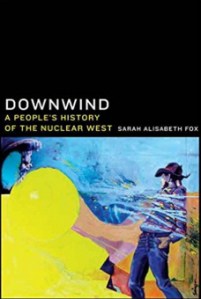
Briefly Noted: ‘Downwind: a People’s History of the Nuclear West’

Downwind: a People’s History of the Nuclear West, by  Sarah Alisabeth Fox (Bison Books: November 2014), 304 pp.

downwindThe opening lines of this book begin a frightening story: “By the time five-year-old Claudia returned to her swing set, a strangely colored cloud was all that remained of her flying saucer. Years later, she leaned the apparition she had seen in the sky was not a UFO but the mushroom cloud of a nuclear explosion. Her childhood home in southern Utah was about a hundred miles east of the Nevada Test Site.”

Author Sarah Fox goes on to say that the site which was operational between 1951 and 1992 was one of the world’s most heavily used nuclear weapons testing areas.

From the Publisher

Downwind is an unflinching tale of the atomic West that reveals the intentional disregard for human and animal life through nuclear testing by the federal government and uranium extraction by mining corporations during and after the Cold War.

In chilling detail Downwind brings to light the stories and concerns of these groups whose voices have been silenced and marginalized for decades in the name of “patriotism” and “national security.”

With the renewed boom in mining in the American West, Fox’s look at this hidden history, unearthed from years of field interviews, archival research, and epidemiological studies, is a must-read for every American concerned about the fate of our western lands and communities.

From the Reviewers

  • “Comprehensive and incisive, Downwind also adds heart and soul to an epic story of resilience in the aftermath of reckless arrogance. Sarah Fox gives the history of the nuclear age back to the people who had it written in their bones. The testimony she captured is both shocking and inspiring.” – Chip Ward, author of Canaries on the Rim: Living Downwind in the West
  • “Fox’s narrative forces the reader to choose whether to accept the official version of events or to believe the people who lived downwind of the nuclear tests and who worked in the uranium industry. There is no middle ground in her argument. According to Fox, repeated nuclear tests led to cancers and other diseases and to the deaths of innumerable people.” – David Mills in “Montana: The Magazine of Western History,” Winter 2015.

downwindwindpatternsIn her January 27, 2016 blog post, Day of Remembrance for Downwinders: the 65th Anniversary of the Inception of Nuclear Testing in Nevada, Fox says that there were over 900 nuclear tests at the site. Her accompanying graphic illustrates where wind patterns carried the resulting pollution.

In both the blog and the book’s introduction, she says that the proceeds from the sale of the book are being donated Heal Utah, “an environmental non-profit that promotes renewable energy and protects Utah’s public health and environment from nuclear, toxic, and dirty energy threats.”

In an era when the United States’ nuclear weapons program is supposedly a relic of the past, Downwind reminds us that the sins of the past are very much still with us even if we never again use a nuclear weapon. The book has a 4.3 review rating on Amazon with five five-star reviews and one one-star review. The one-star reviewer states that Fox’s stories are not only not new, but that her information about reported illnesses and deaths isn’t accurate. If the author has refuted this claim, I haven’t found it. It’s worth noting that a commenter believes this review is based a less-than-accurate, self-published book.

On balance, the book has stories we should know about if we haven’t heard them already. If readers follow this up by looking at the Heal Utah site, they’ll see that the past is a warning to those currently mining uranium in close proximity to the Grand Canyon.

–Malcolm

‘Willing Spirits’ – Look, it’s free for three days

What a better way to kick off 2016: a free ghost story. My Kindle short story “Willing Spirits” is free on Amazon January 2-4, 2016.

willingspiritskindlecoverPicture this: you’re a high school student living in a drafty old house in St. Louis during a winter snow story. The power goes out. You light a candle in hopes that its feeble, flickering light will be enough. You have a book report to finish and it’s due tomorrow.

The author of the book is dead. She used to be famous, a spirit from another time and place who came to St. Louis years ago to be contacted by Ouija board and trance to give readings and write a few critically acclaimed books that swept the country by storm.

Now there’s a ghostly presence in your cold bedroom. It doesn’t take you long to figure out why she is or that her help may be a mixed blessing.

I hope you enjoy the book.

–Malcolm

ouijabboardP.S. The St. Louis ghost in this short story is real. To learn more about Patience Worth, click here. If you know where to look, you can drive by the house where she appeared to medium Pearl Curran. Now, perhaps, she has returned–if you believe ghost stories.


Briefly Noted: ‘People Before The Park’

People Before The Park, by Sally Thompson, Kootenai Culture Committee & Pikunni Traditional Association (MHS Press, July 2015), 256 pages with photographs.

peoplebeforeparkThe Great Northern Railway, one of the predecessor roads of today’s Burlington Northern Santa Fe, developed Glacier National Park’s roads, telephone system, power lines and famous hotels as a tourist destination for passengers on its Empire Builder and Western Star trains. The railroad’s influence on the park was immense.

The railroad called the Blackfeet, the Glacier Park Tribe, and often took representatives to faraway cities to advertise the park. The project was much more of an expedient promotion than a true cultural exchange. The soul of the park, however, will always be Kootenai and Blackfeet (Pikunni/Piegan).

When I worked as a bellman at Many Glacier Hotel in 1963 and 1964, I was fascinated by the Blackfeet and Kootenai names for many of the mountains, rivers and creeks. Some years later, while working as an editorial assistant for the first edition of Jack Holterman’s now-classic Place Names of Glacier and Waterton National Parks, I learned that these landmarks were given Indian names by early explorers such as James Willard Schultz and George Bird Grinnell. We’ve long needed the park’s story from its original people.

Slowly, some of the official place names are being changed. Some years ago, Trick Falls (named for its odd water flow) was changed to its Blackfeet name, Running Eagle (Pitawmáhkan) Falls. Mt. Wilbur, the distinctive peak across the lake from Many Glacier Hotel, is also hearing its Blackfeet used by bellmen, tour bus drivers, boat crew personnel and others. Now people are beginning to know it as Heavy Shield. One day, perhaps the mountain will hear its name in Blackfeet: Isokwi-awótan

Montana Historical Society

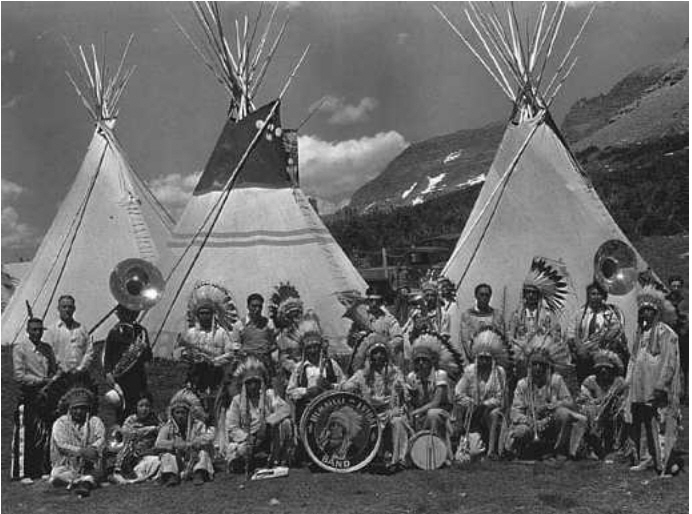
Blackfeet at the July 15, 1933 dedication of Going to the Sun Road, photo by George A. Grant, NPS photo archives.

Now, with the publication by the Montana Historical Society Press of People Before The Park, information that has up to now been mostly confined to books intended for scholars and students of history is now accessible to a wider audience. I hope that the park’s concessionaires are selling this book in the hotel gift shops at Many Glacier Hotel, Lake McDonald Lodge, and Glacier Park Lodge.

From the Publisher

Step out of a world governed by clocks and calendars and into the world of the Kootenai and Blackfeet peoples, whose traditional territories included the area that is now Glacier National Park. In this book, the Kootenai and Blackfeet tribes share their traditions—stories and legends, foodways and hunting techniques, games and spiritual beliefs. Readers will discover a new respect for the people who were at home in the Crown of the Continent, all around the seasons. Sally Thompson has spent over thirty years working with the tribes of the Rocky Mountain West to tell history from their points of view. Her most recent work focused on repatriating human remains and sacred objects to tribes.

A Reviewer’s Perspective

“Thompson decided to take a different approach to the book. Rather than write it all herself, she asked the Kootenai Cultural Committee and the Blackfeet’s Pikunni Traditional Association to each author their own chapter.

“The result is a book that tells a descriptive story that comes alive for the reader. Historical photos are featured throughout the book. Thompson provides introductory geographical and cultural information and provides evidence of early trails through the park.” – Erin Madison in the Great Falls Tribune

Every hiker needs several things in his/her backpack: map, matches, flashlight, water, food, bear spray and a copy of this book. As always, the place tells us about the people who live there and the people who live there enhance our knowledge of the place.

–Malcolm

SunSinger4coverMalcolm R. Campbell is the author of two novels set partially in Glacier National Park, “The Sun Singer” and “Sarabande.”


Thank you to my 26,250 visitors

83grandThis blog has been staggering along for awhile like a sailor trying to find his way back to the ship after a night on the town in a foreign port. (Been there, done that.)

When I started Malcolm’s Round Table, I was thinking of King Arthur (indirectly in my family tree) and the Knights of the Round Table. Not that I would admit that I was looking for the Holy Grail. I had no idea what I was going to say or that I’d end up saying it for some 1,050 posts about everything from writing to Glacier National Park, to the USS Ranger to the Florida locations for some of my recent stories.

Somehow along the road, 26,250 of you stopped by for some 83,252 visits. And, according to the WordPress gurus, the busiest time has been Thursday at 2 p.m. This tells me you guys are logging on at work after drinking your lunch.

Thursday2pm

Seriously, were you trying to stay awake or were you looking for the Holy Grail? (And, were you successful in either quest?) Truth be told, I bring to this blog and to most of my fiction the premise that every one of us is on a hero’s journey in search of that moment and/or that insight that transforms us into the individual we were destined to become if we allowed it to happen.

In my novel The Sun Singer, I explore the hero’s journey from a masculine perspective. In Sarabande, I look at the journey from a feminine perspective. A recent article on Brain Pickings called “If Librarians Were Honest” caught my attention because it’s based on the premise that “If librarians were honest, they would say, No one spends time here without being changed…”

Vision of the Holy Grail at the Round Table.

Hero’s and Heroine’s journeys change us, often in spectacular ways under dangerous circumstances. Libraries can also change us. Potentially, every book, article, and post we read will change us a little or a lot. We never quite know at the beginning of a journey or a book, just who we will be at the end of it.

So, it’s a glorious risk, right?

Perhaps I should have posted this yesterday on my birthday because each of your visits is a gift. It’s a gift of your time, just as reading The Sun Singer, Sarabande, and Conjure Woman’s Cat is a gift of your time. Perhaps you felt different when you finished some of the posts and some of my stories.

Or, perhaps you were changed in imperceptible ways. If you’re also a writer, you will know that you not only change as you read but also as you write. I’m slightly different than I was when I wrote, “This blog has been staggering along for awhile like a sailor trying to find his way back to the ship after a nigh on the town” at the beginning of this post.

We don’t often notice the smallest changes in ourselves because movies and books lead us to believe that when we find the Holy Grail, we’ll find it all at once rather than little by little. Perhaps we need a magic mirror that shows us, not how we’ve aged over time, but how we’ve changed.

If we did, I think we’d not only be surprised by the results, but we’d all feel a lot better about ourselves. At any rate, that’s why I write and that’s why I’m happy that 26,250 of you have stopped by to read.

–Malcolm

KIndle cover 200x300(1)Malcolm R. Campbell is the author of the 1950s-era novella “Conjure Woman’s Cat” about a conjure woman who fights back against the KKK with folk magic.

Visit my website to learn more.


Reviews for ratings or to explore something new?

The reviews on this blog have been a mix of new or unknown authors and books by recognizable names. Since this blog isn’t Beatrice or Bookslut, I don’t kid myself into thinking that my opinions about authors and their books will have an earthshaking impact in the scheme of things.

Since I’m not Beatrice or Bookslut, much less The New York Times or the Washington Post, I worry less about the impact of ratings. If I work for a widely known media outlet, I’lll be handed most of the books I review and most of those will be books that are probably doing well enough not to need a review.

On the other side of the coin, new authors need the exposure that reviews give them whether they come from readers on Amazon or bloggers like myself. I know how authors feel when they ask me to review their books and the next thing they see here is a review of a bestselling author.

I know because I’ve been there. My books have also gone to review sites that chose instead to review, in some cases, books that were several years old and already famous and already reviewed by everyone and their brother. I know, I know, that famous book is better for ratings, especially if you have advertisers that watch our market influence like hawks.

I’m not oblivious to ratings here. I don’t suppose this is a secret, but I do hope some of those who stop by this blog will like what they see and buy one of my books.

The BIG BOOKS I review here are books I bought, read, likely and felt like talking about. The authors won’t know I reviewed their book 99% of the time. But, like others who enjoy talking with their friends about the latest books “everybody’s reading,” it’s fun to toss in my two cents about J. K. Rowling or Dan Brown from time to time.

But I feel guilty when I do it. I see a lot of visitors with those posts, but I wasn’t bringing them anything new–just more talk about a book or an author that’s been reviewed everywhere else. I feel better, I think, when I can tell you about a book you haven’t heard of, but might like. Those posts get fewer visits and that’s discouraging.

I wasn’t born yesterday, so I know that people tend to read books everyone else is reading rather than experimenting with books none of their online and off-line friends have heard of.

A new author is always a risk. But there could be gold there even though The New York Times and Book Page and Publishers Weekly will never give that author a chance. But what an adventure it is to read something wonderful from a debut author. That’s part of the fun of reviewing books and deciding to go with something nobody’s ever heard of instead of the BIG BOOK has already sold 100000000000 copies.

So, how experimental in your reading are you?

Do you wait to see which books grab the mainstream reviewers’ and public’s attention and create your reading list from that group? Or, do you read descriptions of self-published and small press books and give them a try from time to time?

Curiously,

Malcolm

Readers, do disparate books fracture your dreams?

A friend of mine on Facebook whose been watching H. G. Wells movies said that her dreams have turned into H. G. Wells movies.

thecityMy dreams never turn into the exact movies: more like some fractured mess of the movie where everyone’s crazy and all hope is lost.

The same thing happens to me with books. I read books most often before falling asleep. I’ve been cursed with “the ability” to see scenes of my own invention out of the book I’m reading if I ever doze off–or even rest my eyes.

My scenes seem real to me as though I’m propped up in bed still reading the book. Then the cat bothers me or I fluff up the pillow and realize I’ve been making it up “reading” something that’s not in the book, but that could be in the book. This happens every time without fail. When my wife finds me dozing, she thinks I’m asleep rather than writing new scenes for another author’s book.

There doesn’t seem to be a cure for this.

Dreams and reality get fractured when I’m reading more than one book at a time, say, Dean Koontz’ “The City” and Sue Monk Kidd’s “The Invention of Wings.”

So, there I am holding Kidd’s book about life on a plantation and suddenly Sarah and Hetty are walking down Fifth Avenue. That’s rather jarring since the plantation is in Charleston.

wingskiddThe nonsensical scenes that arise out of this jolt me awake faster than cats and twisted pillows.

The plot further thickens (AKA, gets messed up) when I’m working on multiple writing projects, say, one set in a swamp and one set in the mountains. Sometimes I open up the file and find myself planning to write a scene that belongs in the other book.

Fortunately, sentences like “the grizzly bear stood next to the Ponderosa Pine forest” tip me off that I’m not currently in the Florida swamp manuscript. If I see a cottonmouth moccasin, I assume I’m not in the Montana mountains.

I don’t know if readers have this trouble or if it’s just writers. I feel like I’m juggling realities like on of those old-time performers juggle bowling pinson the Johnny Carson show.

There are says when it’s best not to step outside because I don’t know if my front yard will be there or something our of a Stephen King book.

Malcolm

SunSinger4coverMalcolm R. Campbell is the author of contemporary fantasy and magical realism which explains a lot. His fantasy, coming-of-age novel The Sun Singer is currently on sale on Amazon for 99 cents.

What might have been; what might still be

“Everyone who gives up a serious childhood dream — of becoming an artist, a doctor, an engineer, an athlete — lives the rest of their life with a sense of loss, with nagging what ifs.”

– Glenn Kurtz in “Practicing: A Musician’s Return to Music,” quoted in “The Pleasure of Practicing: A Musician’s Assuring Account of Creative Homecoming and Overcoming Impostor Syndrome” by Maria Popova

writergraphicIf I were to give up writing, I would, to borrow an idea from Kurtz, feel the loss more strongly than the greatest lovers I have lost.

Childhood dreams of becoming something–a poet, a novelist, a playwright–often nurtured by well-meaning parents who tell their sons and daughters they have what it takes to be great, often fade as interlocking realities about earning a living with creative writing as part of the equation.

Even before Amazon and e-books and free books and cheap books turned publishing upside down, few writers stepped out of college with a manuscript in their briefcases that was ready to become a critical and/or a commercial success on Broadway, in Hollywood or in a major publisher’s newly released book list.

Life as they say, got in the way. And it still does.

It’s easy to find oneself suddenly middle aged with a drawer filled with rejection slips for manuscripts actually submitted and another drawer filled with manuscripts that stalled somewhere between once upon a time and happily ever after.

How easy it is to stop trying, perhaps to ponder on dark and stormy nights what might have been if one hadn’t gotten married too soon, if the baby hadn’t forced one to take a second job, if aged parents hadn’t needed time-consuming care, if somebody somewhere had provided an ounce more of encouragement and support and/or a way for the amateur to get his or her foot inside the golden door to professional status.

It’s also easy to wonder what kind of youthful vanity or arrogance led one to believe s/he would be one of the appallingly small percentage of writers who earns all or a substantial percentage of his/her yearly income as a poet, novelist or playwright/screenwriter.

The dream seemed so right, how could it be wrong?

Quitting the dream makes sense because, with the list of failures in mind between then and now, it has injured a lot of people: spouses and lovers led from hope to hope and from pillar to post while the writer promised year after year that “this” was “the” book, while schedules and expenses and work spaces were arranged to accommodate the writer’s holy mission, while books and manuscripts turned the house into a warehouse of faded paper and faded hopes.

It’s hard to quit and easy to quit. It’s hard because, like the lottery player who thinks this week’s number will win the jackpot, the writer thinks “this time my work in progress will find an agent and then a publisher who believes in it.”

It’s easy to quit because writing, after a long while, becomes not only an expensive and time-consuming hobby, but a rather sad thing like the habits of inventors who think they’re on the verge of creating  something the world needs or aging models who think “I still have it” or various other delusions that verge (at best) on hobbies and avocations when the stars and planets align.

When you quit, you stop growing and you feel the way you felt when the person you wanted to marry somehow slipped away. When you quit, you stop growing because you’re not practicing the craft your childhood or young adult self said it loved, said was a mission, said was like breathing, said was more important than sex, said was a life’s purpose, said was destiny.

If you’re lucky, so you don’t quit because practicing your craft is who you are and you realize when you’re not writing, you’re somebody you don’t recognize in the mirror.

Maybe Hollywood and Random House will never call, though you still dream that they might, and you understand that as some people like creating lists of all the birds they’ve spotted or the places they’ve been or the languages they’ve learnt, that you’re writing because it’s you and you love it and you cannot abide the death of part of yourself if you didn’t keep typing one word after another.

Loving it is where we need to be for those of us who aren’t Hillary Mantel and Stephen King or Nora Roberts, and so we keep writing for what might still be, the satisfaction of reading what we’ve written whether anyone else reads what we’ve written and finds any satisfaction from it, much less pays for the opportunity.

Perhaps we will one day be discovered. Meanwhile, we’re continually discovering ourselves through the words we put on the page.

–Malcolm

thesailorcoverMalcolm R. Campbell is the author of “Emily’s Stories” and “The Sailor.”

Briefly Noted: Two spiritual books from Mare Cromwell

  • Messages from Mother…. Earth Mother, by Mare Cromwell, Pamoon Press (December 6, 2012), 112pp.
  • The Great Mother Bible: or, I’d rather be gardening, by Mare Cromwell, Pamoon Press (December 26, 2014), 314pp.

On this, the second day of Christmas, Mother Nature might well have given me two turtle doves but, in fact, she gave me (and you, as well) The Great Mother Bible just released by Pamoon Press.

In her author’s note for Messages from Mother, Mare Cromwell says:

messagesfrommother“Where this information comes from is part of the Great Mystery to me. This book was written in only five weeks. I was focused on a completely different book and Spirit broadsided me in late June, 2012, and told me this was the book that I was meant to write. I was fighting lymphoma and essentially surrendered to Spirit to write this. I healed from cancer during the same time period.

“At times Spirit will just do that.”

I have been stalking spirit–as Annie Dillard has called it–for most of my life, and the fleeting glimpses I catch find their way into my novels as contemporary fantasy. As Jane Yolen has said of truths disguised, I tell it slant.

In Messages from Mother, Cromwell gives us more than a fleeting glimpse. We see spirit standing before us with no need for an oblique lens. Cromwell extends this vision in The Great Mother Bible.

From the Publisher:

greatmotherbibleMare Cromwell was awakened at 5 AM in November of 2013, and given specific instructions from the Great Mother to set aside that winter to listen and write The Great Mother Bible. Out of that spiritual call has come this revolutionary and humorous book of spiritual wisdom that speaks to the wondrous sacred realms in which we live. With teachings ranging from the role of aliens on Earth, the Christ Consciousness, and the need for balance between the Sacred Feminine and Divine Masculine, the Great Mother offers essential guidance to help bring our beleaguered world back into divine harmony.

These are wondrous books for seekers who wish to establish a closer relationship with the natural world. And they come at a time when more and more people are seeing that threats to wild places–in fact to Earth itself–are more dire than they knew.

Psychologist Stanley Krippner writes that the Great Mother Bible will  “inspire some readers but will infuriate others. Mare Cromwell’s profound relationship with the Great Mother offers a dialogue that is witty, wise and comical. Mare writes about ‘unseen forces’ but her luminous accounts bring a lucidity and reality to their insights that are uplifting, intriguing, and wondrous.”

If you discover one book this winter, pick one of these. If, however, you prefer two figurative turtle doves, discover both of these.

–Malcolm

Malcolm R. Campbell is the author of “Emily’s Stories”