When Did the Realization “I Am an Author” Hit?

Author Pat Bertram (“More Deaths Than One” and “A Spark of Heavenly Fire”) wrote a post with this same title today. She’s been assisting her publisher, Second Wind, with projects while working on pre-publication publicity for “Daughter Am I” and on edits for “Light Bringer.” So today, the realization it: She feels like an author.

I left a comment on her post, saying that I felt more like a writer when I worked as a corporate communications director and a technical writer than I do now. Partly, that was because my work produced an income that made a difference to my family’s financial well being. Now, I can’t say that. On some days, I feel like writing is a very expensive hobby and I look at Pat Conroy who’s two years younger than I with another bestselling novel and I think, “there’s an author.” Most authors, though, remain obscure.

Many traditionally published books sell a thousand copies or less; most self-published books sell a hundred copies or less. The income produced is less than publicity costs. Hence, it becomes easy to say writing is a hobby–like having aquariums all over the house, a dozen stamp albums in the den, or a huge model train layout in the basement–because it uses up income while producing many interesting hours rather than paying the rent.

Yes, I am an author. Yes, I enjoy writing, planning novels, doing reviews, posting here on this web log, researching new project ideas, and keeping up with the profession. Yet, the reality of being an author is so much different than I expected when I looked ahead to my career when I was in high school. And, I think it’s probably a lot different than the public believes as well. For the public, if they’ve heard of you, you’re and author. If they haven’t, you’re not. The public is very blunt about whether one is or isn’t what he claims to be.

It comes down to self-satisfaction, then, being happy with what one is doing and feeling that the output, however obscure, is also what he is supposed to be doing. We all hope our books reach readers who will enjoy them and who might also derive value from them. But we’re seldom omniscient enough to know when and where that happens.

But we keep writing because–in our warped imagination–there’s no better way for us to spend our lives.

Malcolm

To view my “Wonderful Books” FriendFeed posts, click on the icon below.

Subscribe to me on FriendFeed

Why I Write

It’s been quite obvious to me over the years that most people think writers are screwed up people.

While I’ve served on an aircraft carrier, run a locomotive, used a backhoe, driven spikes on a new RR roadbed, delivered papers, and been the voice you hear when you want computer phone support, this doesn’t cover up the fact that I’m a writer. Like Jack Palance in the movie “Shane,” I stop conversation when I come into a room. It’s not because everyone’s waiting for me to say something quotable, it’s because “regular people” see writers as different.

Variously, we are cursed, crazy, bookish, studious, libertine, bohemian, licentious, and ultra-left wing. Storytellers, like magicians, circus people, actors and patent medicine salesmen have always been seen as part of a con or a scam or the occult.

I see myself as none of these things, but it’s hard to shed the images in other people’s mind’s eye.

I see writing as a career like any other. While some writers become rich and famous, that’s not the norm. Most authors cannot earn a living from their novels. Like the rancher, insurance salesman, school principal, truck driver and computer programmer, I’m a working to support my family and maybe take a vacation once in a while.

My father was a writer, so that was an influence, just as the sons of ranchers and salesmen and teachers often step into their parents’ professions. It’s what they know and it’s what I know.

After people work a job for a while, they get better at it, and they learn tips and tricks for making it more meaningful to them in the context of their lives. Some people hang out in shops and break rooms; I hang out in libraries.

People in all professions believe that–even though they need to earn a living–the work they do is beneficial to the world, probably not the entire world, but to those they meet day to day. A friendly truck driver will stop when s/he sees your broken down car on the shoulder of an Interstate. A writer disseminates information and ideas s/he hopes will be of value, practically and/or spiritually.

My novel The Sun Singer is a case in point. First, I was writing what I know: mountains, hiking, climbing and a touch of mysticism. Such things can be entertaining and give readers a few hours of fun. But I also saw a deeper message in The Sun Singer, a path toward personal transformation that readers could either accept or reject without losing track of the entertainment value of the adventure story. I’m not a guru and wouldn’t want to be one. I don’t have the cosmic scheme of things figured out. But maybe I can say a few things that will help others to figure it out and get as close to the truth as they can. That’s everyone’s calling, isn’t it?

We’re all trying to make the world better while keeping food on the table.  The work is practical and spiritual. I try to live that in my life as a writer because it’s what I fell into, or possibly what I was led into. My best friend from high school fell into being a captain of tall ships that sail  around the world. What a unique profession that is, yet he sees me as the crazy one. Go figure. He sails and I write. It pays the bills and makes for a wonderful life.

Coming February 19th

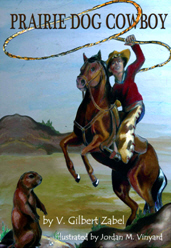
cowboycoverI‘m pleased to announce that Vivian Zabel, author of “Prairie Dog Cowboy,” will be here on February 19th to discuss her new book. What a wonderful story it is!

Four of the people  (within the U.S. and Canada) who stop by and ask a question or make a comment on my blog and/or the other blogs she is visiting will receive a canvas tote bag with Zabel’s 4RV Publishing logo.

While she’s here, please don’t act like writers are screwed up. Play like we’re a couple of ranchers.

Copyright (c) 2009 by Malcolm R. Campbell