 Timothy Egan’s new book A Fever in the Heartland, which came out in April, is chilling because of the vile group it describes, the fact that most people associate the KKK with the South, and the recent upsurge of hate groups. From the publisher’s description: “The Ku Klux Klan’s Plot to Take Over America, and the Woman Who Stopped ThemThe Roaring Twenties–the Jazz Age–has been characterized as a time of Gatsby frivolity. But it was also the height of the uniquely American hate group, the Ku Klux Klan. Their domain was not the old Confederacy, but the Heartland and the West. They hated Blacks, Jews, Catholics and immigrants in equal measure, and took radical steps to keep these people from the American promise. And the man who set in motion their takeover of great swaths of America was a charismatic charlatan named D.C. Stephenson.”
While nobody I know has ever had a median nerve in his/her arm knicked by a needle during a standard blood draw for a doctor’s test, this happened to my wife a month ago and now it appears she will be stuck with the cost of seeing a neurologist and with the weekly physical therapy visits. Her right hand is pretty much out of service, causing–you might guess–hardship when trying to handwrite, type something, or pick up just about anything. There’s a lot of information online about this; from that, “the best” I can see is that her PT will go on forever. I will get all of my blood draws done in my left arm from now on out!
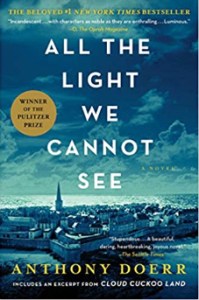
 I’m finally reading Anthony Doerr’s 3033 novel Cloud Cuckoo Land. At 93 pages in, I can see that the story is just as crazy as the title suggests. It has a 4.3 rating on Amazon, so others figured out how to soldier through the chaos. The New York Times review is headlined, “From Anthony Doerr, an Ode to Storytelling That Shows How It’s Done.” The review includes this comment: “Cloud Cuckoo Land,” a follow-up to Doerr’s best-selling novel “All the Light We Cannot See,” is, among other things, a paean to the nameless people who have played a role in the transmission of ancient texts and preserved the tales they tell. But it’s also about the consolations of stories and the balm they have provided for millenniums. It’s a wildly inventive novel that teems with life, straddles an enormous range of experience and learning, and embodies the storytelling gifts that it celebrates.
  My guilty TV fun includes watching “Swamp People: Serpent Invasion.” Supposing this has any reality to it, the show follows men and women catching Burmese pythons (and sometimes gators in the Everglades. I love the Everglades, a park that has survived almost every human attempt to destroy it. I saw an article somewhere that said we may never get rid of the pythons.
–Malcolm
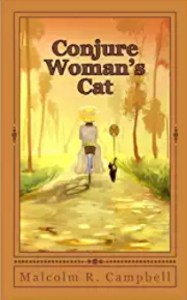 Malcolm R. Campbell does not include any pythons in his Florida Folk Magic Series because, at the time it is set, there were no known pythons in the Florida Panhandle. We had panthers then, however.
The four-book series begins with Conjure Woman’s Cat.

 Malcolm's Round Table