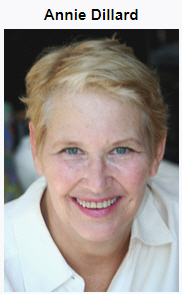
Annie, that Pilgrim, whose words I go back to again and again

“I can no longer travel, can’t meet with strangers, can’t sign books but will sign labels with SASE, can’t write by request, and can’t answer letters. I’ve got to read and concentrate. Why? Beats me.” – Annie Dillard, from her website

I was browsing through the Poets & Writers website today when I saw that a profile of Annie Dillard, by John Freeman, “Such Great Heights”  from 2016 was displayed from the magazine’s archives.  Freeman writes, “You can almost hear the pops and fizzes of combustion as the flue clears and Dillard’s mind gulps down the oxygen it has been feeding on for years—books. It’s something to behold. Here is the sensibility that emerged from a white-glove Pittsburgh background because she read a novel about Rimbaud and wanted her mind to be on fire too. Here is the writer who pulled it off, chiseling out Pilgrim at Tinker Creek (Harper’s Magazine Press, 1974), the Walden of our time, in nine months because she read a book on nature and felt she could do better. And thus Dillard wrote that great, elegant prayer to the seasons, largely at night, in the Hollins College library in Roanoke, Virginia, powered by chocolate milk, Vantage cigarettes, and Hasidic theology.”
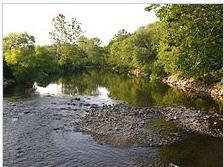
Tinker Creek in Virginia

If there were a website where readers who love a writer’s words and philosophy could sign up to become an official kindred spirit, I would have gone there in 1974 when the Pulitzer-Prize-winning Pilgrim at Tinker Creek emerged to sign my name on Dillard’s kindred spirit page. He work has influenced by thinking .

In Tinker Creek, she writes, “It is so self-conscious, so apparently moral, simply to step aside from the gaps where the creeks and winds pour down, saying, I never merited this grace, quite rightly, and then to sulk along the rest of your days on the edge of rage.
I won’t have it. The world is wilder than that in all directions, more dangerous and bitter, more extravagant and bright. We are making hay when we should be making whoopee; we are raising tomatoes when we should be raising Cain, or Lazarus. Go up into the gaps. If you can find them; they shift and vanish too. Stalk the gaps. Squeak into a gap in the soil, turn, and unlock-more than a maple- a universe. This is how you spend this afternoon, and tomorrow morning, and tomorrow afternoon. Spend the afternoon. You can’t take it with you.”

Yes to all that. And to her words in such books as Holy the Firm, Teaching a Stone to Talk, and Tickets for a Prayer Wheel. She taught for 21 years at Wesleyan University where I wish I’d been a student to audit her classes. If you read a lot, you will most likely find your Annie Dillard, the friendly author you wish lived next door with the porch light on..

We’re about the same age, she and I,  and there’s much we could have talked about.

Malcolm

A note to the Nobel committee

“I would like to learn, or remember, how to live. I come to Hollins Pond not so much to learn how to live as, frankly, to forget about it. That is, I don’t think I can learn from a wild animal how to live in particular…but I might learn something of mindlessness, something of the purity of living in the physical senses and the dignity of living without bias or motive.” — Annie Dillard

Perhaps it as escaped your notice, but all “who shall have produced in the field of literature the most outstanding work in an ideal direction” are not European, and neither is their focus restricted to fiction.

That said, Annie Dillard’s literature invites your consideration.

Much has been written about the lack of precision in the passages in Alfred Nobel’s 1895 will outlining the scope and intent of the Nobel Prizes. Yet, within the world of fiction, nonfiction and poetry, outstanding work seeks (and finds) its own angle of repose, and there it sits like a beating heart within the body of all literature as that which best sustains the art within its time and place. Its pulse beat is unmistakable. Had Nobel been more precise, our definition of great literature might have had the clarity of a very small pond.

Much has been written about the great precision author Annie Dillard brings to her fiction and narrative nonfiction, including her Pulitzer Prize winning Pilgrim at Tinker Creek (1974) and her metaphysical exploration of God, pain and suffering, Holy the Firm.

In spite of Dillard’s well-developed powers of observation and the precision with which she describes that she sees, critics and other readers have not been able to pigeon-hole the author’s intentions and stance. Henry David Thoreau’s influence on her work is obvious; her work also calls to mind such nature writers as Aldo Leopold and Edward Abbey as well as the transcendent quality of anthropologist Loren Eiseley.

Yet, in an age where knowledge and respect for the natural world tend to go hand in hand with advocacy, Dillard’s focus is nonjudgemental. She observes and writes without bias and without prescription.

As Pamela A. Smith wrote in her essay The Ecotheology of Annie Dillard: A Study in Ambivalence, Dillard is hard to pin down in the realms of theology, ecology and ethics.

“Dillard dazzlingly and fearsomely expresses what most people never pause to notice. That facility with language and capacity for sitting still and remaining awake to detail constitute her great gift. Her central contribution to ecotheology is that she displays, in minutiae, what has been and what still exists in a number of significant bioregions. She also exhibits for the ecological thinker that familiar twentieth-century phenomenon: an inability to move from observation to ethic, a sense of personal insignificance and alienation, a tendency to let things alone,” writes Smith.

Dillard’s work returns again and again to the natural world and to man’s place within it. While critics and other readers might be more comfortable if her writings could be defined with a short, crisp, unambiguous statement, such a thing would greatly limit the scope of Dillard’s most outstanding work in an ideal direction.

In her New York Times review of Dillard’s 2007 novel The Maytrees, Michelle Green aptly sums up the author to the extent that that’s possible: “In the three decades since Pilgrim at Tinker Creek, the nonfiction debut in which she introduced a prose style so gorgeously precise that every sentence sang, this poet, essayist and journalist has written nine original volumes powered by spare but brilliant language.”

An ideal direction, to be sure.

A recent suggestion by critic Janice Harayda that I consider what nature writer might be worthy of the Nobel Prize was the welcome catalyst for this post.

Malcolm

COMING SOON

A discussion with author Pat Bertram

Spoken word poetry – a slam poet’s new book

Glacier National Park’s Centennial volume of stories