Domestic house cats are like often water, opting for slow and silent pressure rather than overt fire and brimstone approach of other pets when food time is approaching (and possibly forgotten by the two-leggeds in the house).
Our three house cats noticeably become more friendly as regular mealtimes approach. They lean against our legs when we walk through the house. They make little murping noises and rub against doorjambs and table legs in our presence.
But mostly, I can tell how close it is to their next meal by how close they are to my desk. When mealtime is 45 minutes away, they’re in the hallways. When it’s 20 minutes away, they’re outside my den door–or just inside it. When mealtime is imminent (or late) they’re right next to my desk. Sometimes I say, “Why are y’all going around in a pack” and they look at me with a variety of expressions of pity and disdain–their way of saying, “the old duffer doesn’t know how to tell time any more” and “Sure, when he wants something to eat, he just goes out to the refrigerator and gets it, but we have to wait because the Creator screwed up and didn’t give us the thumbs we need to open stuff.”
If cats could speak English, I’m sure they’d say, “Raccoons got thumbs and we didn’t. What kind of sense does that make?”
My answer would be, “They wash their food and you don’t. You don’t need thumbs.”
“If we had thumbs, we’d wash our food.”
Far be it from me to question why cats don’t have thumbs. If they did, food time for them would probably be 24/7 because (unlike what some cat books say), cats do overeat if the food is available.
But since it isn’t, I can set my watch by how close they are to my desk. Since they just got fed 25 minutes ago, they’re nowhere to be seen. Once they have their food, they have no use for me any more until 11 p.m. approaches. Then, I’m suddenly their best friend, the best thing since slice bread, or even a minor god (though not a smart god due to their lack of thumbs).
The cats who–as we know–move around on little cat feet like fog know how to use silence to exert pressure. Like the water that slowly erodes rock over time, they erode my concentration over time. I could be in the middle of writing the last line of the great American novel. But I can’t, because I can’t come up with the right words due to the sound of silence all around my desk.
Malcolm R. Campbell is the author of contemporary fantasy, paranormal short stories, and the three folktales about animals in “The Land Between the Rivers.”
“The Twa Corbies”, Illustration by Arthur Rackham to Some British Ballads – Wikipedia
In Part 1, I suggested that magical animals in fantasy, magical realism and folktales should start out on your imaginary drawing board as factually accurate as possible. Real-world facts make your animal believable.
Whether your animal can perform overt acts of magic, such as my flying horse Sikimi in The Sun Singer and Sarabande, or mysteriously appears on the scene when important things happen to the characters, such as the crows in Verlyn Flieger’s The Inn at Corbies’ Caw, you can add great depth by linking it to traditional myths and superstitions, American Indian creation myths and real or imaginary local stories and beliefs. When you do this, you are building either on what the reader already believes (ravens hang out in grave yards and bring bad luck) or you are layering the story with information that, while probably new to the reader, helps make your magical animal three dimensional.
In a recent short story about the rare Florida panther, I noted that according to Seminole myth, the creator placed all the animals into a birthing shell from which they emerged when the time was right. The first animal to come into the world was the panther, and she had certain qualities that made her special. Since my story is set in a long-ago time period before humans arrived, the animals view the birthing shell as real. They mention it in an off hand way because my short story is not retelling the myth; the mythic backstory gives my panther a larger than life ambiance.
Many writers turn to Nature-Speak and/or to Animal-Speak: The Spiritual and Magical Powers of Creatures Great and Small by Ted Andrews for a comprehensive introduction to a large number of animals as they are seen in myth and folklore. The books are especially valid for stories set in the United States since they have an American Indian flavor. I prefer to find out about my prospective magical animals before I start writing so I can build their characterizations and actions around the myths and superstitions rather than pasting a “surface-level” set of qualities on top of an otherwise realistic creature.
The Internet is an amazing resource as long as one double checks everything from multiple sources to: (a) insure the myth or legend is widely known rather than being one writer’s imaginary story or religious belief, (b) locate enough detail to keep your account (including the adjectives and phrases you use) from sounding too much like the one source you located. When setting a story in a real location, a you can start with such online searches as creation myths of the Seminoles (insert appropriate tribe for the region) , panther (insert appropriate animal) myths and legends, and Florida (insert state, city, park, forest or resort) animal legends.
How Magic Do You Want Your Animal to Be?
Magic has to be used carefully, for if you make your main character (human or animal) all powerful, then you won’t have a way to build an exciting story. When your animal is all powerful, then you can build in understood “rules” that keep it from solving all the challenges in the story the minute it arrives. My flying horse, for example, is on the scene to transport my human characters from place to place. But he allows them to decide where they’re going and what they’re going to do when they get there. While he occasionally takes strong action, he generally doesn’t interfere in the fate, destiny or logical plan of the humans.
You can, of course, make all of the magic indirect. That is, if an character’s totem animal is the raven, the raven need not have Superman-like powers to play a role. He can appear in dreams and visions with cryptic messages, can be seen flying in a certain direction as a hint to the characters to go that way, and can be placed in trees or in flight overhead when things are beginning to get frightening. This approach works well in contemporary fantasy and magical realism where your magical animals generally don’t have the capabilities of science fiction and fantasy animals in other worlds where the rules are different.
In “real life,” an overtly magical animal would attract attention. Of course, if that attention and how the human and animal deal with it, is important to your story, then hiding the animal’s abilities wouldn’t be an issue. Otherwise, magical animals tend to be more overt when they appear in parallel worlds, spooky uncertain regions, and deserted places. You can also blur the level of reality by opening up the possibility that the magical things a character saw and/or took part in, might have been the stuff of his imagination and dreams. You will see when you do your research into animal superstitions and tales, that magic tends to happen in places where the whole world cannot see it. This not only makes the magic potentially more frightening (it happens at midnight where two roads cross, for example), but keeps it from getting out of control in your story.
If your protagonist is a human, the rules of storytelling (depending on the genre) generally call for him or her to have more control over the direction of the plot than the animal. When placed within a dangerous situation, you character—knowing or not knowing the magic that’s “available”— will make choices to run, to hide, to fight, to be heroic, to find hidden strengths, or perhaps to fail. The magical animal cannot run in out of nowhere and “fix” all of the character’s problems. If so, the story become very anticlimactic.
In most fantasy, there are various “rules in place” in the parallel universe and in adjoining or overlay worlds that contain or restrict all the magic. This also makes stories more suspenseful and mysterious and keeps them from ending on the first page. Even Superman can’t do everything and be everywhere at once: the fact that he can’t, is what makes the story a story. The same is true for your magical animals.
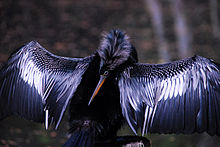
I grew up seeing Anhingas in Florida swamps. A bit of Internet research told me why they dry their wings before flying.
Animals in fantasy, folktales, faerie, and magical realism often have the ability to perform magic, change shapes, influence human events, know the future, or serve as guides between realms or worlds. While the needs of these genres are not the same, it helps to start off with as much knowledge as you can about real animals in their natural habitats. Once you know what an animal eats, how and where it sleeps, what its habits are, and what it looks like, you can branch off from there.
While most readers cannot recite the same specifics as a wildlife biologist, they do have a sense about how animals move around in their environments, and what kinds of animal habits in a work of fiction come across as true or apparently true, and what is blatantly impossible. If you’re writing faerie tales or folktales or creating animals “from scratch” like those we saw in the Harry Potter books, you have more latitude than you do in contemporary fantasy or magical realism.
My feelings about this are somewhat based on my own manner of writing, insisting on accuracy to a fault. For example, in a recent story my two main characters were driving between two real-life towns while listening to a real-life CD. My accuracy thing while writing this is to see how many miles the people will travel at normal speed and then look at the playing times of the cuts on the CD. It doesn’t have to be exact: but personally, I don’t want my characters to purportedly listen to 30 minutes of music during a ten-minute drive.
Likewise, even in fantasy and folktale, I don’t want my animals eating or sleeping in places they never eat or sleep in real life. Sure, magical powers can account for a lot of differences between real animals and fantasy or folktale animals. But the wider the gap you have between the animal in your story and the animal in real life, the less viable your story is and the greater the odds the readers won’t go along with it.
If I had the time and money, I would go into the field with a wildlife biologist and listen while s/he describes the animal behaviors and habitats we’re looking at. Like most writers, I can’t invest in $100 worth of highly specific books from Amazon just for a short story. This means relying on dozens of websites to find the foundation facts for my story.
I was trained as a journalist, yet as a novelist I believe in magic. That means I dislike and have trouble following stories or novels where everything is totally fabricated. If nothing in the story is real, it will probably not attract an audience.
I anchor my stories with verifiable facts about the animals and the settings. Perhaps you will anchor your stories in some other way. But when it comes to creating magical animals in fiction, it won’t hurt to know what your animals do and don’t do, eat and don’t eat, and are capable of and not capable of in “real life” before you start adding the fantasy elements, animal totem qualities, traditional myths and legends involving the animal, superstitions and the stuff you imagine as you put yourself in the animal’s self and walk around a bit.
If you place magical powers on top of a totally unrealistic animal, your story is going to be very difficult to write, much less keep a reader’s attention. A little careful research into your animal in nature will improve the magical animal in your story.

 Malcolm R. Campbell is the author of contemporary fantasy, paranormal short stories, and the three folktales about animals in “The Land Between the Rivers.”



 Malcolm's Round Table