Don’t let the old salts send you topside on mail buoy watch

The carrier's island - goodhugh photo on flickr
The carrier’s island – goodhugh photo on flickr

As I work through the final edits for my upcoming novel The Sailor, I find myself smiling at all the weird, strange, and often crude navy slang and acronyms that were a part of daily life when I served aboard the four acres of sovereign soil better known as an aircraft carrier or a bird farm.

Since this is a family blog (don’t ya think?), I won’t mention the profane slang other than to say you can find it quickly enough in a Google search.

One of the first things you learn on an aircraft carrier is that the navy does not fly choppers. If you call a helicopter a chopper, you’ll probably be placed on mail buoy watch (more on that later) or sent off in search of various kinds of equipment and supplies that don’t exist. The helicopter is a Helo (hee-low).

A liberty port
A liberty port

Going ashore is going on the beach whether it’s a beach, a pier, or liberty (free time) in a foreign port where you might get screwed, blued, and tattooed. (Oops, I forgot this is a family blog.)  Now hear this, if you get back late from liberty you are not AWOL, you are UA. UA = authorized absence, as in, “I was UA” or “Mr. A.J. Squared Away (a sailor with a perfect shave, perfect uniform, etc.) went UA.”

Once you become a member of Uncle Sam’s Canoe Club, called the Gulf of Tonkin Yacht Club during the WESTPAC (western Pacific) Vietnam War days, your first duties involve listening up, taking a good set of notes, and otherwise learning the rocks and shoals (regulations).  If the chief (chief petty officer) thinks you’re slacking off, otherwise known as skating, and aren’t learning, he’ll either write you up (put you on report) or send you off to the galley to wash the flavor extractors.

If you get written up, you’ll end up shooting pool with the captain, that is, brought before a captain’s mast hearing after which you might variously be sent to the brig, demoted, or served a big chicken dinner (bad conduct discharge).
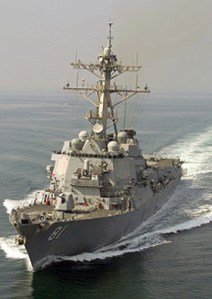
A Tin Can is a destroyer, like the one escorting your carrier, not a metal outhouse.

If you’re serving on an aircraft carrier, you’ll soon learn to stay off the flight deck during flight ops unless you are authorized to be there. If you work on the flight deck, the color of your shirt (yellow, green, white, red, blue, purple, brown or black) identifies the job you’re supposed to be doing. Red is, of course, for crash and smash (firefighters). If you want to watch launch and recovery operations, head up to the windows called vulture’s row in the island (AKA superstructure) where the view is perfect.

Old salts will try to fill your head (brain, not the rest room) full of crap (lies, yarns, and obviously erroneous scuttlebutt) that will only result in your being considered as gear adrift or a good candidate for mail buoy watch. “Mail buoy watch” is mandated by lifers (old salts) when the weather is poor.

During bad weather, somebody (you) is dressed up in foul weather gear and sent topside (AKA, a weather deck) with a hook. Your job will be to watch for the mail buoy, that is to say, the place where the ship’s mail will be waiting because either the COD (the mail plane) or some mythical mail ship can’t deliver the mail in a storm.

Before you head out to snag the mail, your uniform of the day (helmet, life jacket, etc.) will be critiqued by those in the know. Pictures will be taken and then you’ll be on your own in the rain until you realize you’re a victim of the kind of good-natured hazing that will give a guy a lot of grief, a bad cold, and a trip to sickbay for some Corpsman Candy (an ineffective cough drop).

It’s always best to at least look like you know what you’re doing, that is to say staying 4.0 (pronounced four-oh) and squared away during your tour of duty on the big gray ship (BGS). Who knows you might stop saying FTN (you can figure out what that means) and ship over (reenlist). On the other hand, if you’re a bent shitcan, then you’re too hopeless to even be in the navy.

You May Also Like: Heave Out and Trice Up

–Malcolm
Navy to Scrap Historic Aircraft Carrier – 2015 UPDATES (now in Port of Brownsville)

Ranger - Wikipedia Photo
Ranger – Wikipedia Photo

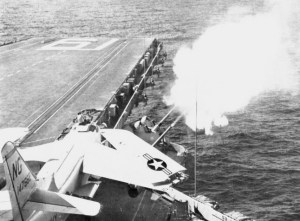
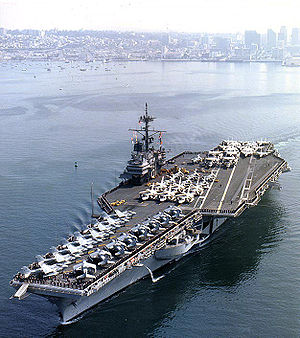
“The seventh USS Ranger (CV/CVA-61) is one of four Forrestal-class supercarriers built for the US Navy in the 1950s. Although all four ships of the class were completed with angled decks,Ranger had the distinction of being the first US carrier built from the very beginning as an angled deck ship.” – Wikipedia (See continuing updates at the end of this post.)

In matters of war, I am a pacifist.

That said, I believe our troops merit our support whether or not the war they’re fighting in is popular or not.

I also think history and historical artifacts, objects and memorabilia are important, for they help communicate the stories of other eras. It’s been a pleasure working with museums as a grant writer and as a collections manager and seeing first hand how excited people can get when shown historic equipment, documents and photographs.

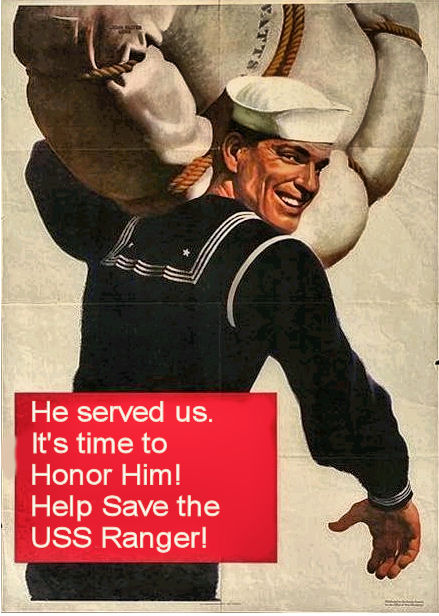
RangerPosterI served aboard the USS Ranger (CVA-61) during the Vietnam War. The war was probably the country’s most unpopular war. When I appeared in public wearing my uniform, I was intentionally bumped into on the street, spat on, and called a baby killer. Yet our history and memories of that time must be preserved.

So, in matters of history, especially those that focus on museums and other educational experiences, I am an activist. In Charleston, I have seen the displays on the USS Yorktown and I have seen the reactions of tourists and school groups as they toured the flight deck, the hangar deck, the mess decks, bridge and ready rooms of the old ship.

When the USS Ranger Foundation was formed in Oregon with the hope of following the examples of those who saved the USS Yorktown in Charleston and the USS Midway in San Diego as museums, I was happy to join up even though I don’t have the financial means to donate money nor the proximity to the ship and selected museum site to volunteer.

Ranger in 1961 - Kemon01 photo on Flickr
Ranger in 1961 – Kemon01 photo on Flickr

First, the educational opportunities here are immense. It’s one thing to read about military history. It’s quite another to walk through a fort, battlefield or restored ship. Aircraft carriers have evolved since the Vietnam War—I can hardly even recognize the modern navy uniform. As I write this, there have been tests of flying drones off of carriers rather than expensive manned aircraft. As a museum, Ranger could have been a piece of history on the Columbia River at the donated site in Fairview for many years to come.

Second, museums and other cultural tourism sites bring dollars and jobs into communities. Many studies have been done showing that a tourist destination such as the USS Ranger can bring in a higher percentage of every tourist dollar than other attractions.

Apparently this is not to be

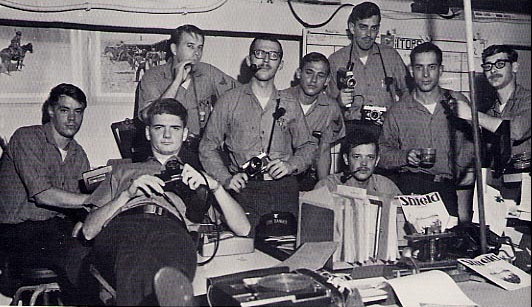
USS Ranger Public Affairs Office on the 03 level. I am second from the right.
USS Ranger Public Affairs Office on the 03 level. I am second from the right here in 1968.

I salute the long hours and dedicated efforts of the volunteers and directors of the USS Ranger Foundation. But I think I missed a memo.

The application process for the acquisition of a decommissioned navy ship is difficult, expensive and lengthy. Unfortunately, the Foundation’s application was rejected by the Navy last October. (See Foundation to Fight NAVSEA Decision to Scrap Ranger) At that time, the Foundation was looking for ways to have that decision reversed.

Over the Christmas holidays, the Foundation said that constraints were keeping them from having more time to develop their application. Here’s where I missed the memo, I think.

I never heard what those constraints were, what (if anything) was missing or incomplete in the Foundation’s original application, or whether or not the support of influential people in and out of government could influence the Navy to provide more time, reconsider, or otherwise work with the Foundation to save the ship rather than scrapping the ship.

rangerlogoNow, the Foundation is looking for another ship. That’s probably a reasonable backup approach. Nonetheless, I think we need to know:

  • Why the application was rejected.
  • What, if anything, could be done to make the application acceptable.
  • Who, if anyone, could be enlisted to garner political and public attention to urge the Navy to delay the scrapping schedule and,
  • Who, if anyone, could raise additional funds and increased public support within the State of Oregon to save the ship and bring it to the Portland area.

We don’t know any of these things. Perhaps, in knowing them, we would see that placing a historic aircraft carrier in a Columbia River museum site had too many insurmountable obstacles in it to ever succeed even if the navy waited five more years or ten more years.

A-4 Skyhawk landing in 1980 - Kookaburra2011 photo on flickr
A-4 Skyhawk landing in 1980 – Kookaburra2011 photo on flickr

I have worked with museums and I have seen the impossible done before. Those in the know said “It will never happen.” But it did happen, with money left over and with the partnering help of those who had been thought, by those afraid to ask, to be the least likely to assist a museum.

So it is, that I do not like seeing this project fade away without a ramped up, viral PR campaign and without the help of high-level thought leaders and influencers who might be able to make a USS Ranger museum a reality. A successful aircraft carrier museum helps everyone, including the Navy. A scrapped ship frees up space at a pier and brings in a few dollars, but otherwise helps no one.

Worse yet, our history is lost in the bureaucratic shuffle. Rather than fading away, I would have preferred seeing this project end, if it had to end, with nothing less than a noisy, failure-is-not-an-option, Hail Mary, damn-the-torpedoes effort.

As always, I wish the Foundation fair winds and following seas.

Malcolm R. Campbell, Journalist
USS Ranger Public Affairs Office and Naval Station Great Lakes  1968 – 1970

Update – January 9, 2014

Those of you who live in the Bremmerton area may have a better means of finding out whether the ship has been scrapped already than I do. However, I have checked with the Navy about the rationale for disposing of the ship (in addition to the costs of maintaining mothballed ships).

From the Navy’s perspective, the USS Ranger Foundation’s progress throughout the entire application process was slow and it finally appeared that little or no progress was being made on some fairly large obstacles:

  • En route to the ship’s proposed mooring site, the BNSF bridge at river mile 80.9 had not been solved. Basically, the ship couldn’t clear the bridge without a major effort on the railroad’s part.
  • The foundation’s cost estimates for the project were incomplete. They gave an overall figure to the Navy about projected costs, but only documented a fraction of those costs.
  • The USS Ranger was placed on a donation hold in 2004. Even though the foundation had expressed an interest in the ship in 2003, the application wasn’t filed until 2009. With the ship available for an eight-year period and with major obstacles not being resolved, it seemed unlikely that the foundation would ever present a complete and viable application. Unfortunately, the Navy’s assessment about this is probably correct.

Update – February 3, 2014

More Updates:

–Malcolm

Malcolm R. Campbell, who  served on the USS Ranger during the Vietnam War, is the author of the Jim Crow era novella “Conjure Woman’s Cat.”

Heave Out and Trice Up

When a sailor reports aboard Navy ship right out of boot camp, s/he will have four immediate concerns: (1) Not being fooled by old salts into searching the boat from stem to stern for pieces of equipment that don’t exist, (2) Getting lost, (3) Following the proper General Quarters “traffic pattern,” and (4) learning Navy phraseology.

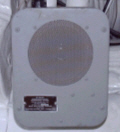
1MC Speaker

The Navy insists upon standard phraseology in its deck logs, phone talker communications, reports and 1-MC (ship-wide public address system) announcements. 1-MC announcements are accompanied by boatswain’s pipe calls which all sound the same at first.

While I was working on a novel about the sea, I remembered what it was like being transferred to the aircraft carrier USS Ranger (CVA-61) right out of boot camp. Compared to boot camp, the ship was much better duty, but there was still a lot to learn.

When I reported aboard, I was informed that I had been assigned to a floating city with an airport where the residents spoke a foreign language. Soon, I would have to learn what was supposed to happen when we “set condition zebra” (a readiness condition with certain hatches and fittings closed); and that a “shot line” didn’t refer glassware on a bar but to a small-diameter line fired over an alongside ship prior to an underway replenishment (UNREP).

Reveille throughout the city came a lot earlier than one expected even though the chief petty officers in charge of our boot camp companies at Great Lakes had brainwashed us that squared-away sailors loved getting up early. But they didn’t tell us that aboard ship a BMOW (Boatswain’s Mate of the Watch) would announce over the 1-MC to “Heave out and Trice Up.”

My first thought was that everyone aboard ship was being asked to vomit on command in the head. I was wrong. The phrase means get up. If you’re sleeping in a hammock, tie it up. If you’re sleeping in a rack (bunk) tilt it up against the bulkhead (wall). This makes it possible for the sweepers or compartment cleaners to sweep the deck (floor) underneath it. In the old days, a trice hook held the rack/hammock to the bulkhead.

The Public Affairs Officer as the Lone Ranger

Planning to join the Navy and–as we always said–let the world see you? Be ready to learn fast. When it’s time to get up, you won’t have time to study your Bluejacket’s Manual for instructions. But one way or the other, you’ll need to know the difference between heave, heave in, heave around, heave out, heave to, and heaving line.

Scuttlebutt (gossip) isn’t always “the straight skinny” (accurate facts) especially when it comes from the fabled all-knowing (and mythical) “port butter cutter.” With luck, the old salts will soon tire of sending you off to find fictional left-handed crescent wrenches, cans of relative bearing grease, buckets of prop wash, or of asking you stand “mail buoy” (huh?) watch on the bow. Then they’ll remind you (if you need reminding) that all stairs on ships are called ladders and doors are called hatches and dogs are what keep them closed.

Maybe they’ll tell you the handy general quarters acronym FUSDAP so that in the three-minute rush to get to your duty station you’re moving with traffic rather than against it. Forward and up on the starboard side, down and aft on the port side is very handy to know.I hope they don’t have to tell you not to head for the flight deck looking for a Quidditch game when the BMOW comes on the 1MC and says “sweepers sweepers man your brooms.”

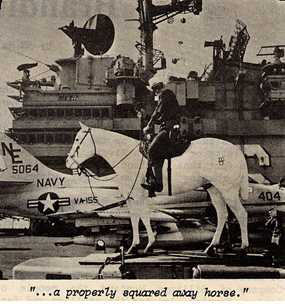
On the other hand, our ship really did have a horse, fiberglass, that is, so if the chief sent you to give it a bucket of oats, it was best to disappear for a while until everyone else in the compartment was done laughing at the joke.

Update: Since this post was written, the USS Ranger was sold for scrap because in all the years it was available to be purchased by a group willing to turn it into a museum, no viable plan was submitted to the navy. Movie stars spend more on their houses than was needed to preserve this ship and all the history it contained. Screwed up priorities, I guess.

Malcolm


AtSeaBookCoverMalcolm R. Campbell is the author of the Vietnam War-era novel set on board an aircraft carrier, “At Sea.” For David Ward, going in harm’s way seems to apply more toward the people back home than life in the sailor towns and the ship.