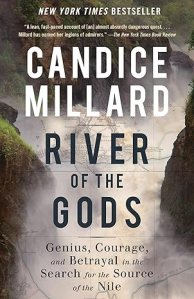
 One benefit of exchanging pen-pal-style emails with an old friend who reads as many books as I do is hearing about new books I might have overlooked. In the 1960s, we were hiking partners in the Rocky Mountains; neither of us suspected then that we’d be writing to each other this many years later. Her latest recommendation is River of Gods, and it’s a good one. It reminds me of my high school history classes that include a lot of material about explorers in Africa.
I definitely agree with the New York Times Book Review comment that “River of the Gods is a lean, fast-paced account of the almost absurdly dangerous quest by [Richard Burton and John Speke] to solve the geographic riddle of their era. . . Candice Millard has earned her legions of admirers. She is a graceful writer and a careful researcher, and she knows how to navigate a tangled tale.”
From the Publisher
“For millennia the location of the Nile River’s headwaters was shrouded in mystery. In the 19th century, there was a frenzy of interest in ancient Egypt. At the same time, European powers sent off waves of explorations intended to map the unknown corners of the globe – and extend their colonial empires.
“Richard Burton and John Hanning Speke were sent by the Royal Geographical Society to claim the prize for England. Burton spoke twenty-nine languages, and was a decorated soldier. He was also mercurial, subtle, and an iconoclastic atheist. Speke was a young aristocrat and Army officer determined to make his mark, passionate about hunting, Burton’s opposite in temperament and beliefs.
“From the start, the two men clashed. They would endure tremendous hardships, illness, and constant setbacks. Two years in, deep in the African interior, Burton became too sick to press on, but Speke did and claimed he found the source in a great lake that he christened Lake Victoria. When they returned to England, Speke rushed to take credit, disparaging Burton. Burton disputed his claim, and Speke launched another expedition to Africa to prove it. The two became venomous enemies, with the public siding with the more charismatic Burton, to Speke’s great envy. The day before they were to publicly debate, Speke shot himself.
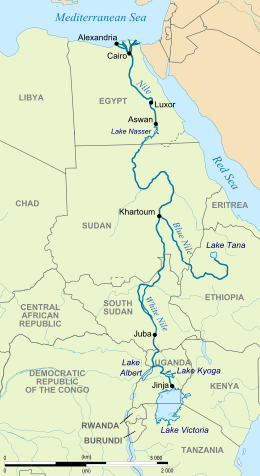 “Yet there was a third man on both expeditions, his name obscured by imperial annals, whose exploits were even more extraordinary. This was Sidi Mubarak Bombay, who was enslaved and shipped from his home village in East Africa to India. When the man who purchased him died, he made his way into the local Sultan’s army and eventually traveled back to Africa, where he used his resourcefulness, linguistic prowess, and raw courage to forge a living as a guide. Without Bombay and men like him, who led, carried, and protected the expedition, neither Englishman would have come close to the headwaters of the Nile, or perhaps even survived.
“In River of the Gods, Candice Millard has written another peerless story of courage and adventure, set against the backdrop of the race to exploit Africa by the colonial powers.”
Book Page Review
The Nile’s mythic reputation as the longest river in Africa, and arguably the world, once inspired generations of European explorers to seek its source—and exploit Africa’s vast resources in the process. Now, thanks to this richly detailed story well told by historian Candice Millard, a colorful and controversial chapter in world history resurfaces. In River of the Gods: Genius, Courage, and Betrayal in the Search for the Source of the Nile, 19th-century explorers’ egos loom godlike over expeditions, their abused local guides save lives and prompt discoveries, and the second largest continent on Earth finally gets mapped.
–Malcolm
 Malcolm R. Campbell is the author of the contemporary fantasy “The Sun Singer.”


 Malcolm's Round Table