 Quite likely, most readers know Alice Hoffman through her “Practical Magic” series as well as The Dove Keepers. There’s such a variety in her work, that one might wonder if there are multiple Alice Hoffmans out there crafting her thirty novels. If so, her latest book The Invisible Hour, released on August 15th, which may or may not come from yet “another” Hoffman is a tempting treat.
From the Publisher
“From the beloved New York Times bestselling author of The Marriage of Opposites and the Practical Magic series comes an enchanting novel about love, heartbreak, self-discovery, and the enduring magic of books.
“One brilliant June day when Mia Jacob can no longer see a way to survive, the power of words saves her. The Scarlet Letter was written almost two hundred years earlier, but it seems to tell the story of Mia’s mother, Ivy, and their life inside the Community—an oppressive cult in western Massachusetts where contact with the outside world is forbidden, and books are considered evil. But how could this be? How could Nathaniel Hawthorne have so perfectly captured the pain and loss that Mia carries inside her?
“Through a journey of heartbreak, love, and time, Mia must abandon the rules she was raised with at the Community. As she does, she realizes that reading can transport you to other worlds or bring them to you, and that readers and writers affect one another in mysterious ways. She learns that time is more fluid than she can imagine, and that love is stronger than any chains that bind you.
“As a girl Mia fell in love with a book. Now as a young woman she falls in love with a brilliant writer as she makes her way back in time. But what if Nathaniel Hawthorne never wrote The Scarlet Letter? And what if Mia Jacob never found it on the day she planned to die?
“Nathaniel Hawthorne wrote: “A single dream is more powerful than a thousand realities.”
“This is the story of one woman’s dream. For a little while it came true.”
Reviews
Kirkus says that it’s “Not one of Hoffman’s best, but it may spark a desire to reread Hawthorne.” The Washington Post writes, “Alice Hoffman’s ‘The Invisible Hour’ is the latest fervent tribute to the power of literature and libraries.” The New York Journal of Books says, “With a truly imaginative structure, Alice Hoffman delves into what has become her trademark theme of magic. The Invisible Hour asks a grand ‘What if?’ Not so much the question posed on the book’s jacket: What if Mia Jacob never found the library or The Scarlet Letter by Nathaniel Hawthorne? The larger question the novel contemplates is whether a young woman can escape so deeply into a book, and fall so deeply in love with its author that she time travels to 1837 to be with him? “
Even though the reviews are a bit mixed, Hoffman fans care what they think, not what the critics think. Having read most of her work, that’s my approach to The Invisible Hour.
–Malcolm
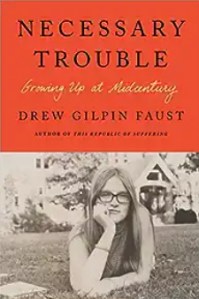
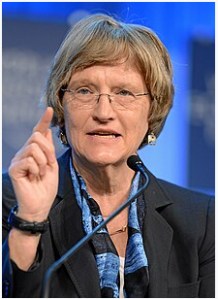 Drew Gilpin Faust
  While the rest of the USA was listening to “Chances Are,” “Don’t Be Cruel,” and “All I Have to Do is Dream” in the 1950s, I was learning about jazz and the blues from my father’s large collection of 78 rpm records. My musical “philosophy” (haha, like I had one) came from a 1931 song by Duke Ellington, “It Don’t Mean a Thing if it Ain’t got that. . .” Well, you know.
 So naturally, I liked “I’ve Got It Bad and That Ain’t Good” by Duke Ellington and Paul Francis Webster released in 1941. A lot of other people liked it, too, since everybody who was anybody sang it, including Cannonball Adderley, Ivie Anderson, and Louis Armstrong. Cher, who–like me–wasn’t born when the song came out, sang the version I liked the best on her 1973 album “Bittersweet White Light.” Many think this album contains some of her best work, though it didn’t do well.

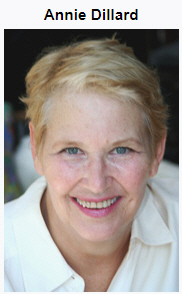 “I can no longer travel, can’t meet with strangers, can’t sign books but will sign labels with SASE, can’t write by request, and can’t answer letters. I’ve got to read and concentrate. Why? Beats me.” – Annie Dillard,
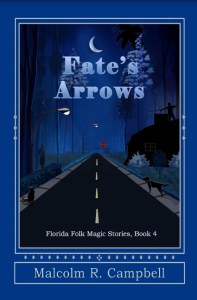 This time, it’s the novel in progress which, if I don’t get my teeth sharpened up, could turn into a real turkey and that would tick off my understanding publisher. So, my apologies for the length of time that’s passing by since the release of my last book, Fate’s Arrows in 2020. Like a turkey drumstick to a guy used to fried chicken, Cornish game hens, and squabs, this book was supposed to be essentially a short novel or a long novella. But once I got into it, I realized that–as a continuation of the story in Fate’s Arrows–it was a lot longer and more complex than I expected.
 If Ostrich really tastes sort of like venison, I would like it. So I hope that when I finally get enough spare room inside my mouth to chew what I ended up with, I’ll make better progress with this book. And, when it comes out, I hope you’ll like it even thought it will probably be darker and grittier than Fate’s Arrows. Let’s face it, there’s no good way to write a light-hearted book about the KKK because it’s members in Florida where my novels are set were more cruel than Shortfin Mako Sharks and quite likely lived next door. Your friendly sheriff was probably a member.
 Well, there are lots of ways, actually, but I’m thinking of “1883′ which ran initially in 2021 with great work by actors Tim McGraw, Faith Hill, Sam Elliott, and Isabel May. The series about a wagon train heading west was very gritty, but the dialogue and plot were exceptional. Okay, I’ll warn you that there are spoilers here.
 I just finished entering online comments into a Glacier National Park survey about how to do things better in managing the park. If you’ve visited Glacier recently, you know that all roads in the park are controlled by a reservation system that dictates when you can drive from one place to another. I can understand why the plan was tried, but I think it made everything worse.
 Asking about the western-most state gets you a lot of answers. A lot of peole will blurt out “California” and then sheepishly say, “oh yeah, it’s Hawai’i.” Both answers are wrong. Alaska’s islands stretch out farther west than Hawai’i. If you compare the location of the Aleutian Islands on a map–better yet, a globe–you’ll see they’re farther west than Hawai’i. Once you see the map, it’s obvious that Alaska is farther west than Hawai’i.
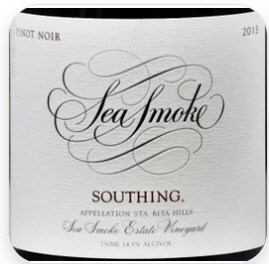 “Swill,” by the way, is a magnum (1.5-liter) bottle of grocery store wine that sells for around ten bucks. I refuse to buy the so-called standard 750ml bottle because it’s a bad value in terms of price. Bring me a bottle of Pinot Noir and I’ll be happy. Sea Smoke Southing Pinot Noir will do nicely because it tastes great and is way outside my budget.
 My favorite Scotch is single malt Talisker, heavy on the peat and the smoke with a great slogan on their website: “On the shores of the Isle of Skye, where rugged coastlines meet the raging sea, you find adventure in a bottle. Talisker single malt scotch whisky captures the elemental wildness and unadulterated beauty of its birthplace to give you a taste of Skye in every sip.” That’s heaven in a bottle of, say, Talisker Storm.
 Malcolm's Round Table