‘Other Birds’ by Sarah Addison Allen

Southern author Sarah Addison Allen (Garden Spells) writes books that blend magic, magical realism, and well-drawn characters into delightful stories that seem as real as the world outside my window. I haven’t mentioned her work here since Lost Lake was released in 2014. So, let’s get up to date with Other Birds which came out in the summer of 2022 from St. Martin’s Press. As Readers Digest aptly notes, “Allen’s gift for whimsical, poetic language, makes Other Birds one of our most-anticipated books for 2022. You’re going to want to read this one with your book club.”

From the Publisher

“From the acclaimed author of Garden Spells comes a tale of lost souls, secrets that shape us, and how the right flock can guide you home.

“Down a narrow alley in the small coastal town of Mallow Island, South Carolina, lies a stunning cobblestone building comprised of five apartments. It’s called The Dellawisp and it’s named after the tiny turquoise birds who, alongside its human tenants, inhabit an air of magical secrecy.

“When Zoey Hennessey comes to claim her deceased mother’s apartment at The Dellawisp, she meets her quirky, enigmatic neighbors including a girl on the run, a grieving chef whose comfort food does not comfort him, two estranged middle-aged sisters, and three ghosts. Each with their own story. Each with their own longings. Each whose ending isn’t yet written.

“When one of her new neighbors dies under odd circumstances the night Zoey arrives, she’s thrust into the mystery of The Dellawisp, which involves missing pages from a legendary writer whose work might be hidden there. She soon discovers that many unfinished stories permeate the place, and the people around her are in as much need of healing from wrongs of the past as she is. To find their way they have to learn how to trust each other, confront their deepest fears, and let go of what haunts them.

“Delightful and atmospheric, Other Birds is filled with magical realism and moments of pure love that won’t let you go. Sarah Addison Allen shows us that between the real and the imaginary, there are stories that take flight in the most extraordinary ways.”

From Book Page

“What does it mean for a story’s setting to really act as an additional character? It can’t just be a well-defined place where players act out their roles. Rather, it must feel like an extra layer where secrets might be kept—and possibly revealed. An apartment building on Mallow Island, South Carolina, beautifully illustrates this principle in Sarah Addison Allen’s sixth novel, Other Birds.”

–Malcolm

Malcolm R. Campbell is the author of magical realism and contemporary fantasy novels and short stories available via at books stores and online sellers from from Thomas-Jacob Publishing.

OMG, I’m drinking green tea again

Green tea is a type of tea that is made from Camellia sinensis leaves and buds that have not undergone the same withering and oxidation process which is used to make oolong teas and black teas. Green tea originated in China, and since then its production and manufacture has spread to other countries in East Asia.” – Wikipedia

If you were around in 1969 (you probably weren’t) “we” (lots of people) jumped in the Celestial Seasonings band wagon swilling down “Sleepy Time,” “Red Zinger,” and others. After all, there was a war on.

Years went by and, due to bad spirits, my stomach started rebelling against tea, even Earl Grey. But now those spirits have gone away, due to high-quality conjuring work on my part, and now I’m drinking green tea and honey to settle my stomach.

Wikipedia photo

Even sites like WebMD say that there are numerous health benefits to drinking green tea: “As a drink or supplement, green tea is sometimes used for high cholesterol, high blood pressure, to prevent heart disease, and to prevent ovarian cancer. It is also used for many other conditions, but there is no good scientific evidence to support most of these uses.”

Jeanine at Love & Lemons–a great food site–writes, “Regular green tea is already touted as an antioxidant powerhouse, but Matcha has even more benefits. Here’s why: when you make other forms of green tea, you steep the leaves in hot water and then discard them. When you make Matcha, you whisk the powder into hot water or milk. As a result, you actually consume the entire tea leaf when you drink it! The antioxidants it contains may lower blood pressure, reduce your risk of heart disease, and even boost your metabolism.”

I started drinking this brew as a medicine. Now I’ve come to like it.

Malcolm

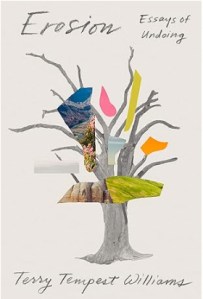
‘Erosion’ by Terry Tempest Williams

Erosion came out in 2019. My apologies for not mentioning here sooner. Perhaps my bias in favor of Williams’ activism and writing made me too cautious to talk about it as though I might inadvertently “oversell it.”

Wikipedia provides a quick overview of her life and work: “Terry Tempest Williams (born 8 September 1955), is an American writer, educator, conservationist, and activist. Williams’ writing is rooted in the American West and has been significantly influenced by the arid landscape of Utah. Her work focuses on social and environmental justice ranging from issues of ecology and the protection of public lands and wildness, to women’s health, to exploring our relationship to culture and nature. She writes in the genre of creative nonfiction and the lyrical essay.” You can learn more on her website here.

From the Publisher

“Timely and unsettling essays from an important and beloved writer and conservationist

“In Erosion, Terry Tempest Williams’s fierce, spirited, and magnificent essays are a howl in the desert. She sizes up the continuing assaults on America’s public lands and the erosion of our commitment to the open space of democracy. She asks: “How do we find the strength to not look away from all that is breaking our hearts?”

“We know the elements of erosion: wind, water, and time. They have shaped the spectacular physical landscape of our nation. Here, Williams bravely and brilliantly explores the many forms of erosion we face: of democracy, science, compassion, and trust. She examines the dire cultural and environmental implications of the gutting of Bear Ears National Monument―sacred lands to Native Peoples of the American Southwest; of the undermining of the Endangered Species Act; of the relentless press by the fossil fuel industry that has led to a panorama in which “oil rigs light up the horizon.” And she testifies that the climate crisis is not an abstraction, offering as evidence the drought outside her door and, at times, within herself.

“These essays are Williams’s call to action, blazing a way forward through difficult and dispiriting times. We will find new territory―emotional, geographical, communal. The erosion of desert lands exposes the truth of change. What has been weathered, worn, and whittled away is as powerful as what remains. Our undoing is also our becoming.

Erosion is a book for this moment, political and spiritual at once, written by one of our greatest naturalists, essayists, and defenders of the environment. She reminds us that beauty is its own form of resistance, and that water can crack stone.”

“Williams makes a poignant connection between the political and the personal . . . If Williams’s haunting, powerful and brave book can be summed up in one line of advice it would be this: try to stare down the grief of everyday life, speak out and find solace in the boundless beauty of nature.” ―Diane Ackerman, The New York Times Book Review

–Malcolm

Banned Books Week

I suspect that a lot of us feel a great distance between our reading habits and banned books because we don’t go to the library or have children who are impacted by what’s suddenly not available in the classroom or the school library.  We live busy lives. So if a book is banned in Peoria, we have little or no reason to notice it because nobody is stopping us from buying and reading the book.

This year, Banned Books Week runs between October 1-7.  According to one of the sponsors, the American Library Association (ALA), “This year’s theme is ‘Let Freedom Read.’ When we ban books, we’re closing off readers to people, places, and perspectives.”

According to Deborah Caldwell-Stone, director of the ALA’s Office for Intellectual Freedom, “This is a dangerous time for readers and the public servants who provide access to reading materials. Readers, particularly students, are losing access to critical information, and librarians and teachers are under attack for doing their jobs.” The number of challenged books and attempted bans is increasing.

You can find a list of Banned Books Week events here, along with book ban data.

We need to be aware of all this,  I think, to protect our freedom to read what we want even if the issues appear to be far away.

Malcolm

Tomorrow, a visit to a demigod

There’s a game show on TV called “Snake Oil” in which contestants try to figure out which of the products they’re shown are real and which are snake oil. Goodness knows, that before the FDA was created, a lot of people made a lot of money selling patent medicine, otherwise known as snake oil.

In general, the Pure Foods and Drugs Act was a good thing except for the part which led to medicines being labeled as “prescription only.” As a Libertarian, I resent this and believe that after reading the pros and cons and contraindications of a medication, I should be allowed to buy it over the counter even if I have to sign an acceptance of liability statement.

Kavevala a demigod from Finish folklore

Doctors have saved my life twice from cancer and have been instrumental in curring other ailments. I’m in awe of their knowledge and skill. Nonetheless, I don’t think they should have the right to prevent me from buying a medication that has been working. This control casts them in the role of demigods and I don’t like that.

I was taking a medicine this summer that was working to get rid of a summer-long infection. However, due to a miscommunication between doctors, it wasn’t renewed when another round was needed. Now I’m stuck without it because it got rid of enough of the infection to keep new  tests from showing I still have it. The fact that I can feel the difference between being on the the medicine and not being in the medicine isn’t considered relevant.

What this comes down to is a four-month infection for which I received two weeks of treatment that was effective but I’m barred from continuing the cure because I cannot buy the medicine with a prescription. I’m going to be talking to the “demigod” tomorrow, though I think it will come to nothing.

So, more green tea and honey. I don’t think the FDA controls that yet.

Malcolm

Writing is the Lifeblood of a Writer

Didion in 1970

“When she was a teenager, [Joan] Didion taught herself to type and to write by pecking out stories by Ernest Hemingway and Joseph Conrad on an Olivetti Lettera 22. Her goal: ‘To learn how the sentences worked,’ she told the Paris Review. Thus began her immersion in the physical act as well as the craft of writing. Call it a form of machine learning. ‘I’m only myself in front of my typewriter,’ Didion once told an editor at Ms. magazine.” –from “’To Be A Writer, You Must Write:’ How Joan Didion Became Joan Didion” by Evelyn McDonnell.

“I’m only myself in front of my typewriter,” updated to include “computer keyboard” explains a lot about those of us who write. That might include hints about why many of us are awkward when we have to talk to people–or think.

I like Didion (1934-2021) because she came on the scene during the exciting and controversial days of “new journalism” in which reporters in many ways became part of the story they were reporting. Tom Wolfe, Gay Talese, and Norman Mailer were leaders in this genre. The style purportedly communicated what the “just the facts” of standard reporting couldn’t address.

While Didion was, in large part, an essayist who could be found in major publications, it’s likely that those who remember her are probably more familiar with her fiction, including Play It as it Lays and A Book of Common Prayer. Others remember her from her nonfiction book  The Year of Magical Thinking about her daughter’s illness and the death of her husband, author John Gregory Dunne (Crooning, Playland) in 2003.

If you want to know more about Joan Didion, McDonnell’s book is a worthy starting point that, according to Booklist is “Shaped by intellectual rigor and artistic grace … McDonnell’s portrait is vibrant, fluent, sensitive, and clarifying.”

Malcolm

Dang, Dumbledore is dead

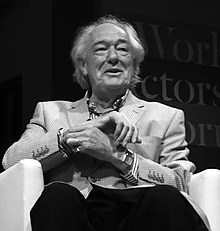
Gambon

When he’s not Dumbledore he is (was) 82-year-old Michael Gambon. Natural causes, was it? Maybe that’s the cover story to obscure Snape’s role in the matter. After all, if you’ve seen the Harry Potter movies, you know that Snape has done it before. But Snape is twice dead. Once in the series and purportedly once in “real life” as Alan Rickman in 2016.

There’s a long list of denizens we can look at: Bellatrix Lestrange, Draco Malfoy, Lord Voldemort, Dolores Jane Umbridge, Lucius Malfoy, &c., &c. Like Snape, any of these characters could have escaped the “fiction” of the series and manifested in “real life.” That’s probably why Richard Harris (the first actor to play Dumbledore) died after the first two movies in the series in 2002 of Hodgkin’s lymphoma–according to the cover story.

I’m biased in favor of Harris’ portrayal because I saw him once on the stage as well as in many movies and was used to his style (and his off-camera hijinks). He played a more ethereal Dumbledore than Gambon. Both were Irish and both were good in the role.

According to Variety, “While it is easier for a character actor, often working in supporting roles, to rack up a large number of credits than it is for lead actors, Gambon was enormously prolific, with over 150 TV or film credits in an era when half that number would be impressive and unusual — and this for a man whose body of stage work was also prodigious.”

Most readers and viewers don’t know that there’s a fine line between the fiction of novels and feature films and life as we think we know it. People tend to think they’re “safe” when the movie ends and when they reach the last page of the novel. Ha! I think not.

Malcolm

Last Oil and Gas Lease in the Montana’s Badger-Two Medicine Retired

National Parks Conservation Association

News Release – September 1, 2023

Washington, D.C. – Blackfeet leaders and conservationists celebrated today that they, along with the federal government, have reached a negotiated agreement with Solenex, LLC to permanently retire the last remaining federal oil and gas lease in the 130,000-acre Badger-Two Medicine area of the Helena-Lewis and Clark National Forest.

The settlement agreement marks the culmination of a 40-year effort by tribal leaders, conservationists, hunters and anglers, and other Montanans to prevent oil and gas drilling in the Badger-Two Medicine. Located adjacent to Glacier National Park and the Blackfeet Indian Reservation, the area is considered sacred ground by the Blackfeet Nation due to its deep cultural and historical significance to Blackfeet people as well as vital habit and a migration corridor for some of Montana’s most treasured wildlife species including elk, wolverines, grizzly bears, and westslope cutthroat trout.

The 6,247-acre lease held by Solenex was one of 47 oil and gas leases originally issued by the Reagan Administration in the Badger-Two Medicine in the early 1980s. With today’s settlement agreement, all of these leases in the area have now been permanently eliminated without any development having occurred, ending the threat of drilling in this wild, roadless area once and for all. Read more here.

The existence of these leases was bad in multiple ways, two of them being that they threatened Blackfeet land and Glacier National Park as well the Bob Marshall Wilderness and Great Bear Wilderness.

Some years ago, when I was part of a group fighting a mine in British Columbia that released polluted water into the Flathead River on Glacier’s western boundary, we successfully used the US/Canada Boundary Waters Treaty to argue that the outflow from this mine would negatively impact lands and waters within the U.S. It took a while, but we got the mine closed.

The lesson of this is that activities outside protected lands can bring pollution and other negative impacts to the flora and fauna inside those protected lands. Like the mine, the Solenex leases had that potential. Water and air pollution can be ubiquitous in that protected land boundaries don’t magically stop the inflow of pollution. At the time, I pushed an idea forward that would place concentric “circles” around protected areas in which nothing “dangerous” could be constructed. Naturally, this wasn’t passed.  Development, such as that impacting Manassas National Battlefield Park aren’t always mines and oil pipes lines, but are commercial and neighborhood encroachments that that not only spoil views from with a park, but bring dust, traffic, and noise to areas that aren’t equipped to handle them.

The proposed Everglades Jetport was another example of this: development near a protected area that negatively impacts a protected area. It’s hard to protect that which we want to protect when nearby construction, commercial and residential projects, and superhighways threaten what we have set aside as “sacred.”

When we protect land, we think, “there, that’s taken care of” as we move on to other issues. No, it’s never taken care of. Developers are always on the porch trying to get a foot in the door.

–Malcolm

Thistle Farms helps ‘women survivors overcome and heal from systems of prostitution and exploitation.’

I discovered Thistle Farms in Nashville while looking at the list of grantees of the Isabell Allende Foundation. According to Thistle Farms’ website:

Your support helps create sanctuary and healing for women survivors.

  • 2 Years of Free Housing
  • Healthcare and Trauma Therapy
  • Meaningful Employment
  • Advocacy and Public Policy Initiatives

It’s horrifying to discover just how many women, including those in the United States, need this kind of sanctuary. In addition to donations, Thistle Farms supports its programs through the sale of candles, essential oils, soaps, and similar products that you can find here.

The organization houses “up to 36 residents at a time in a therapeutic setting that offers healing and transformation through housing, healthcare, counseling, employment, and community building. Housing and clinical services are free of charge and provided without Federal assistance.  Five years after program completion, 75% of our graduates are living healthy, independent lives. Broken relationships have been restored. Hopelessness has been replaced with hope.”

In an on-site article called “The Many Faces of Human Trafficking,” Tasha Kennard writes, “90-percent of sex trafficking victims in the US are female, of which women and girls of color make up a disproportionate number of trafficked individuals. Meanwhile, the overwhelming majority of those purchasing sex – creating the demand that drives even more bodies into the sex trade – are men.

“Most of the women Thistle Farms serves report having first experienced sexual abuse between the ages of 7-11, began using alcohol or drugs by the age of 13 as a means of coping with trauma, and are first on the streets between the ages of 14 and 16.”

The problem is worse than most of us know. According to Child USA, “1 in 5 girls and 1 in 13 boys are sexually abused before the age of 18.” Empower The Fight states, “Human trafficking is the fastest-growing organized crime activity in the United States. Estimating 250,000 children per year are victims of sex trafficking. Most older children are trafficked while still going to school and living at home!”

I celebrate the organizations such as Thistle Farms that help fight the results of this evil and, like many, am surprised that it’s so pervasive in the U.S., especially within indigenous groups.

–Malcolm

‘Buffalo Dreamers’ by John Newman

This novel was published by Sweetgrass Books (Farcountry Press) on October 4, 2022, and is set in Montana, my favorite state.

From the Publisher

“A YOUNG MARINE PROTECTS WHAT IS MOST SACRED

“For Sam Comstock, a young Iraq war vet with PTSD, the need to find a way to heal his wounded soul is a matter of life or death. His Marine sniper skills lead him to Montana on a mission to help manage an infamous wildlife challenge: killing migratory buffalo outside Yellowstone Park that are presumed to carry an infectious disease for cattle. This places Sam seriously at odds with a renegade band of Indian warrior-dreamers who are determined to save the buffalo from slaughter. Thrown together and isolated in the Montana wilderness, meanwhile relentlessly pursued by the combined forces of military, law enforcement, and the cattle industry, Sam and his native compatriots must depend upon one another for survival. Along the way, Sam becomes enmeshed in the way of the buffalo, confronting his suicidal pain and emerging from a long trail of suffering.

“Through Sam, we come to understand that we have much to learn from our native neighbors. We may even discover our own inner buffalo spirit.”

The Way of the Buffalo

In an article called “The Meaning of the Buffalo to Our People,” Karlene Hunter cites an article by Richard Williams that states, “The American Indian and the buffalo coexisted in a rare balance between nature and man. The American Indian developed a close, spiritual relationship with the buffalo. The sacred buffalo became an integral part of the religion of the Plains Indian. Furthermore, the diet of primarily buffalo created a unique physiological relationship. The adage “You are what you eat” was never more applicable than in the symbiotic relationship between the buffalo and the Plains Indian. The Plains Indian culture was intrinsic with the buffalo culture. The two cultures could not be separated without mutual devastation.”

From Kirkus Reviews

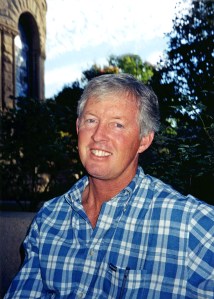
Newman

“Over the course of this novel, Newman writes with a vivid sense of place (“The snow fell all night, cleansing the blood-stained ground and creating a white canvas upon which creatures large and small could paint the tracks of the new day”) and a palpable respect for Montana’s land and its many denizens. Smith is something of a one-dimensional villain that would have benefited from deeper character development. However, Sam’s captors are depicted with a sense of depth and great sensitivity. The scenes involving the slaughter of bison and cattle are certainly brutal (“the blood now flowing freely across the roadway, the men tracking it every direction”) but not exploitatively so.

“A compelling and empathetic story of salvation.”

–Malcolm