 Back in the old days, kids walked from house to house when they went trick or treating. Parents often accompanied the younger kids and that was okay. The last neighborhood I lived in before moving to the country was a subdivision. Kids–up to ages long past their treat-or-treating years came by car. The cars went from subdivision to subdivision. Naturally, that was a greedy expediency many of us didn’t like and accounted for the fact we didn’t know most of the people who rang the doorbell.
There’s nobody out here on my rural road to ring the doorbell on Hallowe’en, but I keep my porch light off to indicate we’re not playing the game.
In addition to the caravans of cars bringing kids from the far side of town, Hallowe’en lost its lustre when kids expected a handful of full-sized candy bars: like I can afford 4-5 bars per person for a hundred people. Greed took the fun out of it. And the tricks got worse, too–actual vandalism instead of the more lame TP in the trees and soaped windows.
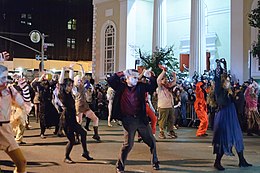
I still spell “Hallowe’en” with an apostrophe because, after all, the word is a contraction for Hallowed Evening. Most people don’t know that and more’s the pity. It’s okay, I think, to honor the dead, though I don’t believe in this nonsense that the so-called veil between worlds is thin on this holiday allowing more interaction between spirits and people. But, like the otherwise logical people who hang horseshoes over their doors “just in case,” you won’t find me anywhere near a cemetery on Hallowe’en.
Meanwhile, if you happen to walk down my road Tuesday night on All Hallows Eve without waking up ten thousand snarling dogs, I won’t be leaving a porch light on for you.
–Malcolm
 Malcolm R. Campbell is the author of the short story collection “Widely Scattered Ghosts.”
 My family started out with Compon’s Encyclopedia when my brothers and I were in grade school and junior high, and then moved on to the Encyclopædia Britannica which thereafter became my favourite. It was published as a physical book from 1768 to 2010, and there after as an online publication. My wife’s family had World Book. My Scot’s ancesters would approve of the thistle.
 My favourite reference book, which I see I mentioned on this blog about twenty years ago, is Brewer’s Dicitionary of Phrase and Fable. It’s very easy to get lost for hours in this one. Brewer’s, which has been around since 1870, is described by Wikipedia “is a reference work containing definitions and explanations of many famous phrases, allusions, and figures, whether historical or mythical. The “New Edition revised, corrected, and enlarged” from 1895 is now in the public domain, and Web-based versions are available online. The most recent version is the 20th edition, published in November 2018 by Chambers Harrap Publishers.”
 The Anti-Defamation League exists “To stop the defamation of the Jewish people and to secure justice and fair treatment to all.” I don’t think that’s too much to ask. According to the ADL website, “Our values guide our internal culture and shape the approach we take to our programs and initiatives externally. Confronting antisemitism, our founders established ADL based on their Jewish values. We build on their legacy as we speak out on behalf of all marginalized communities across the country and around the globe.”
 The recent attacks against Israel some from a terrorist organization supported by rogue states. Why do so many Americans support this? Apparently, they have been brainwashed by old myths and old fears. I have no tolerance for that any more than I have any tolerance for those who said the 9/11 attacks were justified and proclaimed their support for Bin Laden. They are like those who support the KKK.
 “The only thing that changes people is storytelling. If you tell a story then it’s either going to change somebody not at all, fundamentally or more often than not just at the edges and imperceptibly and maybe even enough so people will take it.” –
 Wikipedia writes that “
 Without all this sharing of events from our shared past, I think most of us would feel disconnected and alone. It’s as though stories flow through our veins. In many episodes of “Finding Your Roots” with Henry Louis Gates, a fair number of people appear on the show with no idea about their ancestries. Sometimes they never know their parents, much less their grandparents. Or, for a variety of reasons, their parents never shared any stories about grandparents and great-grandparents. So they were adrift in time and space.
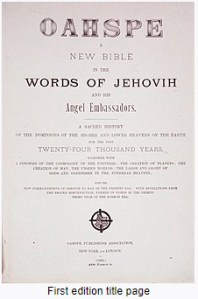 “Oahspe also provides missing details of ancient historical records regarding the origins of Earth’s major religions. Among them are life stories and teachings of the great prophets and law-givers from the various divisions of the earth, such as Zarathustra of Persia, Brahma, Capilya and Sakaya of India, Abraham and Moses of Egypt, Joshu of Nazareth, Eawahtah of the Americas, and Po, Chine and Confucius of China. Their teachings and doctrines are presented with lessons for a contemporary perspective on a new age that lights the way to Peace and Harmony through spiritual progress. According to Oahspe, all humanity has the responsibility to assist in its own development; and to that end, Oahspe provides ample guidelines for ethical conduct in our day. The book also previews the future, with prophecies and guideposts for the eventual establishment of the Creator’s “kingdom on earth” for all humanity. Oahspe, first published in 1882, is heaven’s gift for our times, and is now available in paperback for the first time in modern language.”
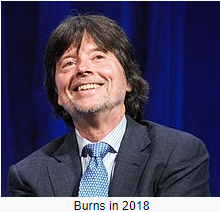
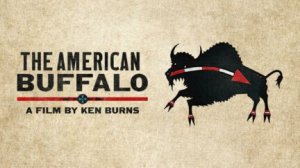 “This film will be the biography of the continent’s most magnificent species, an improbable, shaggy beast that nonetheless has found itself at the center of many of our nation’s most thrilling, mythic, and sometimes heartbreaking tales. It is a quintessentially American story, filled with a diverse cast of fascinating characters. But it is also a morality tale encompassing two important and historically significant lessons that resonate today.” – Ken Burns Website. I’m looking forward to this October 16 and 17.
 It upsets me to read that “progressive” university students support the terrorist organization Hamas which is backed by Qatar and Iran under the pretense that it’s the real government of Palestine. The reports of Hamas’ attack against Israel read as war crimes, not legitimate protests against Palestinian problems. I stand by Israel against these barbaric terrorist organizations that won’t leave it alone.
 I continue to enjoy the Kathy Reichs “Temperance Brennan” series of novels, having just ordered the 12th book in the series 206 Bones. I started reading these novels to learn more about the inspiration behind the “Bones” TV series and have not been disappointed. They read well, often put Temperance in danger when she goes into the field on her own recognizance, and have plenty of humor.
 As I fight against the stomach infection I got in June from unknown sources, I see that even after two rounds of antibiotics (along with green tea), the old medication Tagament that cured my stomach when this first happened years ago may prove to be the most effective. When I first had it, it was a prescription drug. Now it’s OTC. I’m feeling better.
 It’s been interesting noting the difference between “Chicago Fire” and the older series “Emergency.” The fire trucks on “Emergency” hit the burning structure with water immediately while “Chicago Fire” sends firefighters into the burning building first to search for those trapped and/or injured without charging up a hose. The “Chicago Fire” approach makes for good drama but intuitively looks like a wrong-headed way to fight fires. My own experience comes from a hands-on Navy fire fighting school. And yes, we learned that water will put out an oil fire.
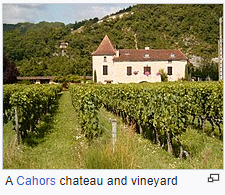 France should sell all that wine to the countless Facebook users who claim to drink wine like there’s no tomorrow. There are countless memes, including, “I cook with wine. Sometimes I put it in the food.”
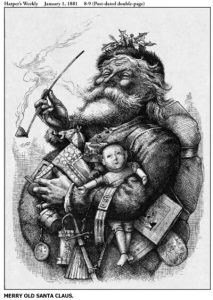 “America’s best-ever political cartoonist is renowned for creating the Republican Elephant and popularizing the Democratic Donkey. He also created the modern images of Santa Claus and Uncle Sam, influenced five victorious Presidential elections, and satirically commented on seven administrations.” –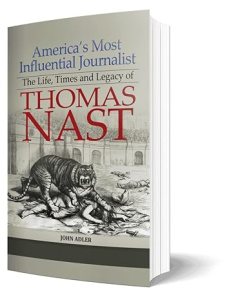


 Malcolm's Round Table