New Year’s Resolutions

  1. Boycott Gluten-Free Products – As I understand it, most people are not allergic to gluten and it has health benefits we’re being denied in the mad rush to get rid of it.
  2. Curse with more finesse – The best kinds of cursing, and other putdowns, are those people don’t realize aren’t very nice. So, I need to improve on this.
  3. Start Writing Potboiler Novels – Or, beach reads perhaps. These usually have little value, can be written quickly, and make lots of money. What’s not to like?
  4. Avoid Political “Discussions” on Facebook – Most of these are debates are between people with facts and people who think their ignorant/biased opinions are worth just as much as the facts. These threads never end well.
  5. Drink More Water – I read somewhere that we’re 200% water and that every day that we don’t drink as much water as we’re supposed to, we shrink and become less ourselves.
  6. Eat More Gravy – As Southerners know, gravy makes great food even better. So-called diet experts who live outside the South have been trying to subvert this truth for years.
  7. Stop Eating Brussels Sprouts – They cause gas. My Buick might get better mileage from them than I do.
  8. Ignore So-Called URGENT Petition Drives – When e-mails come in that say, “Malcolm, we need a billion signatures by midnight,” find out what good (if any) all those signatures will do.
  9. Stop Allowing Auto-Correct to Take Over My Writing:  If auto-correct changes my Facebook post or e-mail from “I love you” to “You’re a real shit,” there’s no need to go along with that.
  10. Stop Voting for Candidates Who Tell Me What They Will Do: Since we purportedly have a representative government, those elected should be doing what the voters want them to do and not what they want to do.
  11. Wear a Blindfold While Watching “Chopped” on TV – Most viewers of “Chopped” know that each show’s four chefs have to cook with mystery baskets that include crap that isn’t intended to be eaten by real people. If you must watch the show, protect yourself from goat eyeballs on a stick and pig guts with honey.
  12. Buy Higher-Quality Scotch – We can all afford the swill. But it doesn’t improve our lives like the good stuff. When you buy the good stuff, the results trickle down and make the world a better place for all of us.
  13. Buy More Books Locally and/or from Barnes and Noble and Powell’s Books Online – Let’s suppose there’s a bookseller online that’s close to being a monopoly. We don’t have to help it get bigger, do we?
  14. Drink More Tap Water – Studies show us that most of the high-priced bottle water either comes from somebody’s tap rather than the fountain of youth.  Plus, it litters the world with plastic bottles.
  15. Believe in What I Can Imagine – My beliefs are ecclectic, so there’s no reason to feel constrained by fads that don’t have anything new or transcendent in them.

–Malcolm
Visit me on Facebook.


Comfort Food

Comfort food is food that provides a nostalgic or sentimental value to someone and may be characterized by its high caloric nature, high carbohydrate level, or simple preparation. The nostalgia may be specific to an individual, or it may apply to a specific culture. Wikipedia

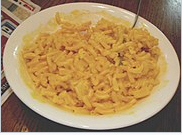
Mac & Cheese – Wikipedia photo.

Wikipedia lists about thirty popular comfort foods for the United States. I like many of them, including mac & cheese. I don’t like the green bean casserole because I got tired of it soon after it first showed up in everybody’s houses. Mashed potatoes are fine, but I prefer them baked, preferably in an oven rather than a microwave. I love grits, always with a lot of butter on top. Cornbread is great, but cornbread dressing is wonderful.

We all have our favorites, the kinds of meals we could eat multiple times per week without getting tired of them.

Books as Comfort Food for the Mind

Every year, magazines, newspapers, and websites choose the best books of the year. Some of these may, in time, become “comfort food,” the books we read over and over.
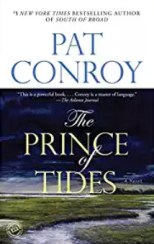
I’ve read The Prince of Tides and A Scots Quair multiple times. One is set in the southern U.S., the other in Scotland. I never tire of these two books, as some people never tire of mac & cheese.  We find something new in the books we like best every time we read them. They inspire us in some way. They might even impact our life’s journey.

Whatever they do, we keep them on our nightstands as old friends, wise teachers, or worthy competitors.

Escape or Smart Choice?

Some people call fast food an easy way out, one that’s not very nutritious and probably has too much salt and fat in it.  That’s probably true. I don’t see our comfort foods and comfort books that way. They give us what we need for body and soul without allowing us to escape into stuff that really isn’t good for us. Comfort stuff gives us what we need, whether it’s a food, book, movie, song, game, or often-taken hike in the woods.

Some say that when you crave certain things, it’s because your body or your mind need them. I think that’s true–not counting addiction, of course. When I run out of factory fresh new books to read, I usually grab an old book off the shelf and read it again. It’s almost always the very best thing I could possibly read at that moment. There’s usually synchronicity in the book grabbed off the shelf with whatever the gods think I need to know, remember, or act upon. Perhaps the same thing can be said for mac & cheese and grits.

–Malcolm

Malcolm R. Campbell is the author of the three-novel collection, “Florida Folk Magic Stories.”


If you’re naughty. Santa leaves SPAM in your stocking

Not the SPAM in a can, but the crap that shows up uninvited in your e-mail inbox and in the comments section of your blog. Fortunately, WordPress weeds out a lot of the junk. Google’s Gmail separates a fair amount of the annoying stuff, but I still get a lot of e-mails asking for money, asking for me to sign urgent petitions in which a million signatures are (for reasons never specified) “needed by midnight,” and offers far more Viagra than anyone would consider using in a hundred lifetimes.

Most of the SPAM weeded out by WordPress starts with something lame: “Hi, I want you to know that I read your blog every day and intend to tell my friends about it.” And then there’s a link to an online store or service that I don’t want.
My assumption is that as Christmas approaches, Santa reads the news and discovers that coal is really bad or really good depending on your politics. So, after a discussion with Mrs. Claus, he decided not to touch the stuff. Plus, many of today’s young people don’t equate coal in the stocking as evidence that their wrongdoings have been noted on the naughty list.

But SPAM, how nasty is that? It’s just another advertisement at best. At worst, it’s a way of opening a doorway to endless malware, viruses, and perhaps death. Of course, most of the medications we take indicate that death is a potential side effect, so how bad can death be? From Santa’s viewpoint, your friendly pharmacist in the white coat pushes more death than the anonymous spammer who promises riches in the Bitcoin market.

Most spammers who try to sneak their comments into this blog are trying to sell software that will write this blog for me and/or monetize it in some way that will be better for me–and any reader who believes the pitch–than winning the lottery. The pitches often begin with: “I notice you don’t have much new material on this blog.” Gosh, they probably sweet talk everybody like that. And then they continue with: “Most bloggers aren’t writers, so we’ll supply a slew of curated crap that will fill up your week’s post with the kind of stuff people want to read. You won’t have to write another word.”

My only question is this: “will the people who read that curated crap be so happy and inspired they’ll buy my novels?”

The spammers say, “Malcolm, of course, they will. You’ll be the new James Patterson.”

Wow, really? Where do I sign?

“Right here where you promise to hand over your next child, your house, your Jaguar, and the access codes to all of your bank accounts.”

Does that sound good to you? No, I didn’t think so. The thing is, the SPAM industry keeps trying to sell it to me. Apparently, it’s illegal to harm those people or even to create a virus that goes back to their computers and fries the hell out of them (the computers). Maybe I should call a conjure lady and ask her to put a hex on them, some kind of plague maybe like frogs in the kitchen and wasps in the bedroom.

Christmas SPAM seems to be the worst SPAM. Supposedly, if I sign up, I’ll experience joy and love and a guarantee that my stocking will never be filled with coal or more SPAM. Gosh, if that doesn’t represent the true magic and spirit of Christmas, I don’t know what does.

I almost feel like wishing the spammers Merry Christmas. Hmm, maybe next year. Between now and then, I’ll try to stay off the “naughty list.”

This has been a wonderful Christmas, one that didn’t require SPAM or smoke and mirrors to make it happen. I hope your Christmas Day is unfolding the same way.

Malcolm


Happy holidays however you celebrate the season

I still say “Merry Christmas” to most people because it’s hard to step away from one’s upbringing and switch over to the more generic “happy holidays.”

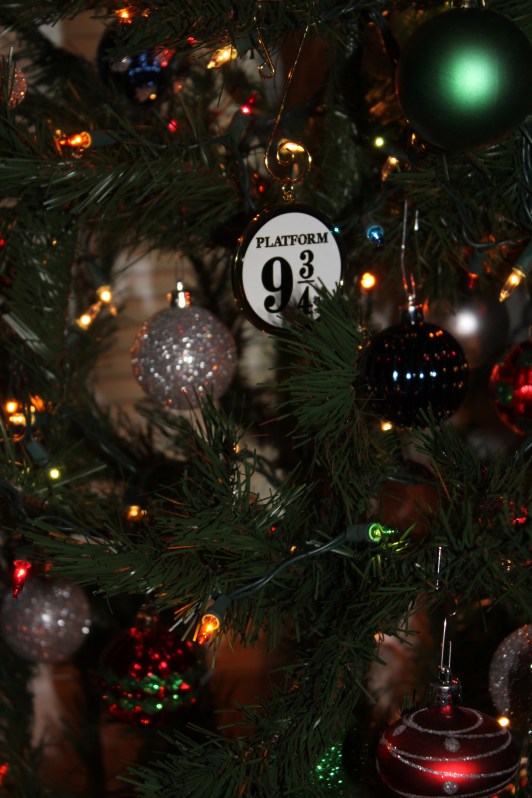
We put up our Christmas Tree on the Solstice and leave it up throughout the Twelve Days of Christmas. While I don’t expect everyone else in the neighborhood to leave all their decorations up until Twelfth Night, I feel bad when I see people throwing out their trees on Christmas Day as though they can’t wait to get them out of the house.
Several days ago, I posted a Steve Allen quote on my Facebook page, “If there is a God, the phrase that must disgust him is – holy war.” I don’t think any war is holy, nor do I think all the wars of words about appropriate and inappropriate holiday celebrations are holy–or even necessary.

We are free to believe what we want to believe.  I think we should be able to believe that without being attacked by the local newspaper, the homeowners’ association, thugs from ISIS and other arrogant belief systems, or by ignorant people on Facebook who think “Baby, It’s Cold Outside” is a rape song. I do draw the line at one faith’s decorations at public buildings or neighbors who put up so many lights their house can be seen from the space station.

Otherwise, it does my heart good to see that in spite of the commercialism, a lot of folks have found something larger than themselves and their government to believe in.

But why should it matter to anyone whether his or her neighbors believe in the same god or not whether they choose to celebrate him or her in a different way? I see no threat in that.

My views are rather eclectic, but due to the prevailing winds about “how people ought to believe,” I keep quiet about them for the most part. I don’t need the hassle. I do like the magic of the season regardless of how others choose to celebrate it. For me, it’s a profound time of the year regardless of the usual sniping about the Christian Church and secular humanity adopting a lot of pagan symbolism. That seems to bother people. I say, “so what?”

I see this as a time of unconditionally giving to others whatever their faith. I hope you have a great holiday season, perhaps with family and/or travel and/or traditions that speak to you and yours.

–Malcolm


Calendars with historic black and white photographs

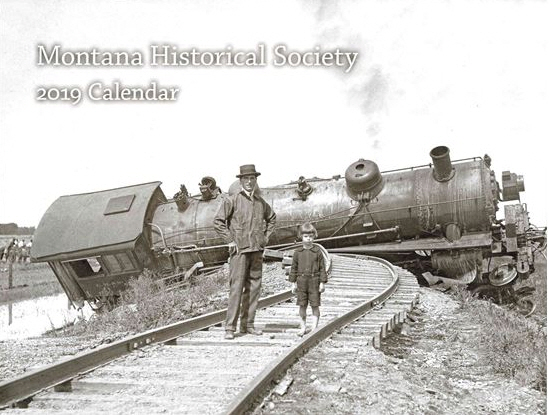
In our kitchen, we keep a colorful scenic calendar, sometimes featuring wildlife and sometimes featuring scenes from national parks and other inspiring landscapes. In my den, I always have a calendar of historic black and white photographs. It comes with my membership in the Montana Historical Society (MHS). These old photographs tell many stories and I never tire of looking at them throughout the year. As more and more archives are digitized, pictures such as those in the calendar are often available for research online. Here’s the cover of my MHS calendar for 2019:

Hmm, we seem to have a problem here. When I worked as a volunteer at a railway museum, our library included a lot of photographs of wrecked locomotives. One of our members had once worked on steam locomotives for the railroads. When I asked him what happened to the locomotives in the pictures, he said they hauled them into the shop, fixed them, and put them back on the line. Today, I suppose the insurance company would come out and mark the equipment as totaled.

These old pictures are better than rare treasure for history enthusiasts; fans of (for example) trains, old cars, historic buildings; teachers who are working on lesson plans for K-12 classes that focus on state history, authors, and others. The national park services has an archive of old photographs.

You can find other photographs online at the Library of Congress and in the archives of many states under such names as Florida Memory and Georgia Encyclopedia. (Some of these sites include teacher lesson plans.) This access has improved from the old days when one had to travel to a museum on the far side of the country to see roughly classified boxes of papers and photographs in a storage area. Likewise, the historical societies in many states also support the digitization of old newspapers, many of which are appearing in databases sophisticated enough to allow for searches on words in the news stories and photograph cutlines.

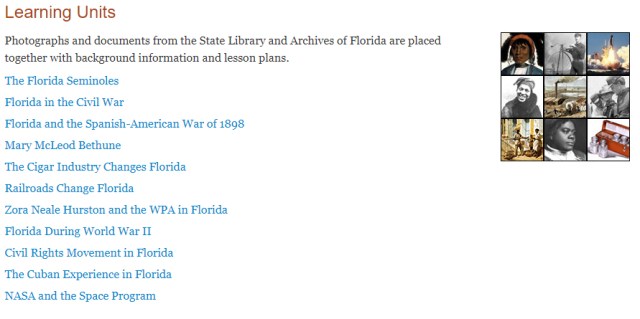
Here’s a sample from Florida Memory of the kind of resources available for teachers.

It bothers me when I hear that many state school systems no longer teach state history lessons. I know it’s often hard to squeeze in local history when courses must include all of world history or all of U.S. history into an hour a day for one or two semesters. Historic old pictures, when available in a print format, give school systems the opportunity of placing a few of them in frames (with captions) in hallways and classrooms. They might just attract student attention. My wife once curated and mounted an exhibit of old photographs in a high school where we used to live. Opening day attracted a lot of attention, including a news story in several papers.

I’ve been happy to see many of these old pictures showing up on Facebook, sometimes from sources such as “Smithsonian Magazine” that remind people of lesser-known events and people. Many of them get a lot of LIKES and comments, including “Why wasn’t this information in my school history books?” (I often wonder why as well.)

If you know about your state’s history, I think you have a better shot at understanding why things there are as they are. You can also help combat misinformation in hastily researched news stories and online essays in which the writer clearly doesn’t know what happened in his or her state prior to last week. Growing up in Florida, I constantly saw (and still see) mistaken pronouncements about the reasons for the Seminole Wars or about the conflicts between Spain and France to control the region. You can probably cite similar examples from the state where you live.

Old photographs won’t fix the gaps in our educational systems, but they might attract some attention to the many things we don’t know about the places where we live.

Malcolm

Sometimes I think historical research for my novels set in Montana (“The Sun Singer” and “Sarabande”) and Florida (“Conjure Woman’s Cat,” “Eulalie and Washerwoman,” and “Lena”) took more hours than writing the novels. I didn’t mind because the old photographs and newspapers were very addictive.


Some of my favorite noir movie lines

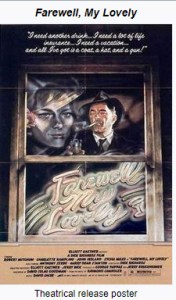
I’ve always been a fan of noir movies (and a few neo-noir movies as well). If you like noir and have Turner Classic Movies on your Cable or Satellite, they show a lot of them, especially on Noir Alley, a program with some cool commentary before and after the film. Here are some of my favorite lines, starting out with a 1975 neo-noir film with Robert Mitchum.

  • Wikipedia Photo

    “I needed a drink, I needed a lot of life insurance, I needed a vacation, I needed a home in the country. What I had was a coat, a hat and a gun. I put them on and went out of the room.” ― Raymond Chandler, of course.

  • “Okay Marlowe,” I said to myself, ‘You’re a tough guy. You’ve been sapped twice, choked, beaten silly with a gun, shot in the arm until you’re crazy as a couple of waltzing mice. Now let’s see you do something really tough—like putting your pants on.” – Dick Powell as Philip Marlowe in “Murder, My Sweet” (1944)
  • “I can afford a blemish on my character, but not on my clothes.” – Vincent Price as Shelby Carpenter in “Laura” (1944)
  • “You know what he’ll do when he comes back? Beat my teeth out, then kick me in the stomach for mumbling.” – Humphrey Bogart as Philip Marlowe in “The Big Sleep” (1946)
  • “You knew when a woman loves you like that, she can love you with every card in the deck and then pull a knife across your throat the next morning.” – Van Heflin as Jeff Hartnett in “Johnny Eager” (1941)
  • Wikipedia photo

    “What a beautiful picture. Moonlight. Sagebrush. My wife with a stranger.” Vincent Price as Lloyd Rollins in “The Las Vegas Story” (1952).

  • “With my brains and your looks, we could go places.” – John Garfield as Frank Chambers in “The Postman Always Rings Twice” (1946).
  • “Flossie had looks, brains, and all the accessories. She was better than a deck with six aces. But I regret to report that she also knew how to handle a gun. My gun.” John Hoyt as Spencer in Brute Force (1947).
  • “Maybe I’ll live so long that I’ll forget her. Maybe I’ll die trying.” – Orson Welles and Michael O’Hara in “Lady from Shanghai” (1947).
  • “Decency and integrity are fancy words, but they never kept anybody well fed. And I’ve got quite an appetite.” Howard Duff as Jack Early in “Shakedown” (1950).
  • Wikipedia photo.

    “When your head says one thing and your whole life says another, your head always loses.” – Humphrey Bogart as Frank McCloud in “Key Largo” (1948).

  • “I sell gasoline. I make a small profit. With that I buy groceries. The grocer makes a profit. We call it earning a living. You may have heard of it.” – Robert Mitchum as Jeff Bailey in “Out of the Past” (1947)

If you’re interested in film noir, one of my favorite books about it, Voices in the Dark: Narrative Patterns of Film Noir just happens to have been written by a colleague of mine, J. P. Telotte, from Berry College, Rome, GA. We saw a lot of noir films whenever we went over to his house for dinner. He’d bring a projector home from work and run one of the films he was discussing in the classroom. While we agreed on the film noir and the Federico Fellini films such as “Juliet of the Spirits” (definitely not noir), we always clashed on whether Katherine Hepburne and Meryl Steep were good actresses. I said “yes,” while he said “no.”

Some people think noir is a bit of a downer. Perhaps that’s true. But the atmosphere, the voice-over narration, and the snappy dialogue always lure me into it.

–Malcolm

You’ll find a touch of noir in Campbell’s audio book “Jock Stewart and the Missing Sea of Fire.”


A Few Creative Book Marketing Ideas

“I was talking with a class that I was teaching this past week about marketing strategies and realized we haven’t had a marketing post in a while. Twitter and Facebook are what I think of as old marketing standbys, but there are other, more creative ways to market. Of course, as the kids say, YMMV (your mileage may vary) with all of them. Below is a summary of what we discussed.”

Source: Creative Book Marketing Ideas – Indies Unlimited

As an author, I like reading posts about book marketing because there’s usually something new to me in each one. Plus, times change, and what worked five years ago may not be quite as effective now. Melinda Clayton is a publisher and a university teacher, so she sees more of what works and what doesn’t work than most of us.

She also includes links to other articles for writers at Indies Unlimited.

–Malcolm

Malcolm R. Campbell is the author of “Conjure Woman’s Cat,” “Eulalie and Washerwoman,” and “Lena.”

Paperbacks make great stocking stuffers

My wife an I are giving up on stocking stuffers this year because we seem to have an over-supply of stocking stuffers left over from past years. So, we said to hell with buying more Chapstick, Pears Soap, and Tic Tacs.

We do give each other books as Christmas gifts, but usually from a Christmas list rather than intuition. I read 10000000 books a year and that makes it hard for my wife to give me something I haven’t read. She reads fewer books and sticks to a group of authors she likes. Neither of us feels confident enough to buy each other a book unless we know (from a Christmas list) what we both really want.

Since some of my novels are available in paperback, I’m biased when I suggest that paperbacks make great gifts. Better yet, when you give them as stocking stuffers, you don’t have to wrap them. That’s a plus for me. While my wife can wrap gifts better than the gift-wrapping lady at the mall, the gifts I wrap guarantee that people will think I was sipping moonshine while I wrapped them.

When either of us splurged on a stocking stuffer, we’d put a gift card on it saying it was from Santa. No harm, no foul. Or, when we gave candy, we made sure there was enough of it to share. But as the years went by, all the old, utilitarian stocking stuffers didn’t work anymore because we each tended to buy them whenever we ran out. And, over time, we both realized that those gifty books sold in the front of the Barnes & Noble stores didn’t really work because nobody ever read them anyway.

As it turns out, each one of us has a storage locker in the garage with one thousand tubes of Chapstick, several hundred Snickers bars, enough Scotch tape for all of Google’s offices, rolls of Kodak film that we wouldn’t know where to get developed even if we were still using our old Honeywell cameras, shoelaces for an army, enough Q-tips to scare all those ear doctors who say, “don’t stick these things in your ears,” and fruitcake that’s been passed from one family to another since Herbert Hoover was President.

So, we agreed on the “no more stocking stuffers” plan. We don’t have a fireplace in this house, so we don’t hang stockings anyhow. They sort of degenerated over time into grocery sacks of stuff.

However, those of you who are steadfastly maintaining the old ways–that is, stocking stuffers–can switch over from office supply store nicknacks (extra pens and boxes of staples) and drugstore nicknacks (toothbrushes and Hall’s cough drops) to paperback books. Forget Kindles and Nooks and get the real thing! Avoid Amazon if you can and go to your local bookstore where real people are trying to earn a living by curating books that your loved ones will really appreciate.

Before you go to the bookstore, you need to break into your loved ones’ rooms and see what’s already there. Steal their Kindles and Nooks for an hour or so and make sure you don’t duplicate what they are reading on their screens, poor bastards. Years ago, we used the word “grok” to imply that we understood somebody or something. If you grok your loved ones, you can pick out books they’re most likely to enjoy.

If they don’t enjoy them, they’ll love you for trying your best even if you have to remind them that it’s the thought that counts.

Malcolm

Malcolm R. Campbell is the author of stocking stuffers named “Conjure Woman’s Cat,” “Eulalie and Washerwoman,” “Lena,” and “Sarabande.”


‘Technique alone is just an embroidered potholder’

“Technique alone is never enough. You have to have passion. Technique alone is just an embroidered potholder.” 
― Raymond Chandler

I just finished a novel (see picture) that was 99% technique and 1% nonsense. The author used a technique that’s so ubiquitous these days, it’s got to be more than a fad. It’s an epidemic.

It works like this. You’re reading a high-stakes chapter, probably a thriller, and at the end of the chapter something untoward happens such as, “Bob kicked open the door and noticed 25 men pointing their guns at him.”

You turn the page wondering, more than idly, how the hero’s going to get out of this mess. Do you find out? No. What you see is the beginning of a new section of the book called SIX MONTHS EARLIER and most of that section seems completely irrelevant or, in writer talk: a very intrusive backstory.

There’s no passion in this, and I’m not talking about the kind of passion Raymond Chandler was referring to when he wrote, “It was a blonde. A blonde to make a bishop kick a hole in a stained-glass window.” The story would have been more interesting if it had been a house of cards rather than a house of gimmicks.

The story lacked passion because when it came down to it the story and the characters didn’t really matter. Instead, they were cheap tricks strung together like the kind of necklace you can buy at a pawn shop for a couple of bucks. Unfortunately, the book cost more than that and didn’t have the gumption to acknowledge that, when compared to cheap hookers, it was more false.

The novel, written by an author whom the blurbs said was the next Stephen King or the next Michael Crichton, had an inventive beginning in which a passenger jet arrives at a small airport where the flight pilot and copilot discover that everyone on the ground is apparently dead. Unfortunately, the main characters immediately out themselves as dysfunctional. Suddenly, the novel reminds me of Chandler’s line, “From 30 feet away she looked like a lot of class. From 10 feet away she looked like something made up to be seen from 30 feet away.”

At a distance, the story has possibilities worthy of King and Chrichton. Up close, it’s dysfunctional characters and a lot of technique. The author has chosen a distasteful stew of technique, characters who are too broken to even speak to each other, and techno-speak with which to engineer this costume jewelry of a story.

Here’s a spoiler: Google, we learn, might be developing products that aren’t good for us even though they have plenty of technique in them and look like they are good for us. Well, that’s hardly a new idea. Nonetheless, it’s the driving force behind why the ground crew at the airport seem to be dead.

In the final analysis, there’s nothing to see here or, as Chandler says, “The moment a man begins to talk about technique that’s proof that he is fresh out of ideas.”

It takes guts, I think, to tell a story straight rather than relying on stale smoke and cloudy mirrors. Dead on Arrival is dead on arrival.

Malcolm


Becoming irrelevant at the speed of light

d wrld iz moving fst. d old ways R 4gottn. d nu ways R untested. wot do U do now?

Perhaps the first time an ancient person discovers s/he no longer fits well into the world is when he must ask his or her 5th-grade grandson or granddaughter how to set up and configure the new computer or cell phone.

Perhaps the ancient person sees how out of touch s/he is when confronted with a list of recent songs, singers, and movies and realizes s/he has never heard of any of them.

Or, perhaps–and this is heavy stuff–the discovery that one is becoming irrelevant at the speed of light occurs when an old man or an old woman discovers that most of what passes for urgent and interesting these days just doesn’t matter.

Prospective lack of relevance is often brought home to an aging writer when s/he looks at a book marketing guru’s list of hot topics for prospective bestselling books and realizes s/he has never heard of them or doesn’t understand why they are hot. The aging writer often looks at the names of purportedly relevant writers who–according to essays in writers’ magazines–are doing important work and/or who are part of the prestigious faculty for MFA writing programs and asks, “Who are these people?”

Those of us who were brought up as children of the 60s or who were conditioned to believe each person has within them all the skills and knowledge to become the very best they can be are now wondering “what the hell happened.” We were in those days fighting “the establishment” which could be variously translated as the military/industrial complex or the “we’ve always done it this way” line of thought. So, our own particular kind of brainwashing led us to believe that one way or another we would make a difference and be part of our generation’s wont to be a catalyst for change. And yet, the world continues to face the same problems and so do we.

And lately–from the point of view of an ancient person–many of the solutions to the old problems now seem worse than the problems. Those on both sides of the political divide seem to have lost their minds.

I wonder if it was always an arrogant goal to think one–or even his/her generation–would ever be relevant other than on some statistician’s spreadsheet about attitudes from one decade to the next when it came to either changing the world for the better or changing himself/herself in transcendent ways that explained “the big picture.” Yes, maybe the children of the 1960s were full of themselves. Unfortunately, according to studies, a lot of them told out and ultimately joined “the establishment” and began to look more and more like the people they were protesting against when they were young.

I’ve read that youth tends to feel immortal and old people tend to feel like they could have been contenders if they hadn’t taken the wrong path or fallen in with the wrong people or the wrong ideas. If you’re over 70, does that idea strike a chord?

Some say that every time a person takes a positive step, the world becomes slightly better even though the changes aren’t earthshaking or noticeable. Maybe that’s the best we can hope for. Maybe relevance is simply pride and ego and nothing else. Maybe each of us has carried a small nugget of relevance within ourseves for a lifetime and hasn’t been aware of the bits and pieces of good we have done.

Malcolm