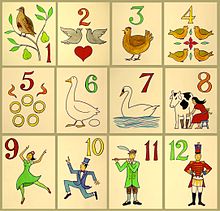
 Actually, if that happened they (the partridge in a pear tree) would probably end up in the garage where they would never be seen again. That’s fine. I detest pears. The cats would probably eat the partridge or vice versa.
My wife and I got books, candy, calendars, and plush throws for those chilly Georgia nights. These we can use, along with new lamps for the master and guest bedrooms. When we had multiple cats, they played in the pile of used wrapping paper. Last night when we opened gifts, our indoor/outdoor cat was asleep in the bedroom and our 25-year-old calico no longer cares about it (the paper).
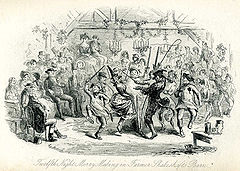 Our decorations usually go up late and stay up through Twelfth Night when my wife is supposed to give me twelve drummers drumming. Well, more for the garage. Of course, it’s bad luck to leave the decorations up after Twelfth Night. Personally, I think it shows a lack of taste to throw the Christmas tree out for the trash truck late on December 25th.
I’m fairly traditional about this, following the Christmastide schedule as noted in Wikipedia: “In 567 the Council of Tours proclaimed that the entire period between Christmas and Epiphany should be considered part of the celebration, creating what became known as the twelve days of Christmas, or what the English called Christmastide. On the last of the twelve days, called Twelfth Night, various cultures developed a wide range of additional special festivities. The variation extends even to the issue of how to count the days. If Christmas Day is the first of the twelve days, then Twelfth Night would be on January 5, the eve of Epiphany. If December 26, the day after Christmas, is the first day, then Twelfth Night falls on January 6, the evening of Epiphany itself.”

This year, I added a new element to the Christmastide festivities called falling off the step ladder while putting up with lighted garland around the front door. That resulted in a headache and now a sore place where my head it the deck. I do not intend for this to become a new tradition.
My wife and I have sinus conditions that make us dizzy at times, so I told my wife not to put up the garland alone because she might fall off the deathly hallow. I guess it figures that I’d be the one calling off the ladder.
For your own safety, do not introduce any step ladders into your Christmas celebrations.
I hope your Christmas is happy, merry, and bright–and safe!
–Malcolm
 ock at the door, Prophet Song forces us out of our complacency as we follow the terrifying plight of a woman seeking to protect her family in an Ireland descending into totalitarianism. We felt unsettled from the start, submerged in – and haunted by – the sustained claustrophobia of Lynch’s powerfully constructed world. He flinches from nothing, depicting the reality of state violence and displacement and offering no easy consolations. Here the sentence is stretched to its limits – Lynch pulls off feats of language that are stunning to witness. He has the heart of a poet, using repetition and recurring motifs to create a visceral reading experience. This is a triumph of emotional storytelling, bracing and brave. With great vividness, Prophet Song captures the social and political anxieties of our current moment. Readers will find it soul-shattering and true, and will not soon forget its warnings.’ – Esi Edugyan, Chair, Booker Prize.
 When Kirkus Reviews praises a book by saying, “An exceptionally gifted writer, Lynch brings a compelling lyricism to her fears and despair while he marshals the details marking the collapse of democracy and the norms of daily life. His tonal control, psychological acuity, empathy, and bleakness recall Cormac McCarthy’s The Road (2006). And Eilish, his strong, resourceful, complete heroine, recalls the title character of Lynch’s excellent Irish-famine novel, Grace (2017)” it’s certainly worth a look. Those of us who remember “The Troubles” (1960s-1990s) will feel an eerie sense of Deja Vu to the violent world of the Irish Republican Army.
 Those of you who’ve read this blog for a while know that I drive out in the middle of the night to a nearby QuikTip, Exxon, BP, or other nearby gas station with a mini-mart and stock up on last-minute bargains such as Pork Rinds, Tee shirts with various logos, a case of oil, and other treats that help make opening gifts a festive occasion each year.
 Neither of us has been well lately, so the indoor and outdoor decorations aren’t as lavish as usual. But they suffice. We used to send out a Christmas (Yule) letter but stopped that several years ago. We still send out a few cards, but now they’re always late if we get around to them.


 In general, I try to support KIVA, Tibet, and the National Parks. This puts me on a list of people who would have to be rich to respond to all the projects that need funding. I support the International Campaign for Tibet because I believe that China’s illegal occupation of Tibet and its ongoing policy of erasing Tibetan culture and religion is one of the most noxious atrocities on the planet.
 I support
  The Six-month tummy ache continues as the Gastroenterology Department runs a slew of tests. All are normal so far. This experience is pretty much like having a strong case of mono for six months (I’ve been there and done that). The adoption of the
  I’m re-reading One Hundred Years of Solitude by Gabriel Garcia Marquez. It’s been a while. And I still despise the first sentence. Among other things, this novel has had a strong influence on the magical realism genre. Wikipedia says “Since it was first published in May 1967 in Buenos Aires by Editorial Sudamericana, One Hundred Years of Solitude has been translated into 46 languages and sold more than 50 million copies. The novel, considered García Márquez’s magnum opus, remains widely acclaimed and is recognized as one of the most significant works both in the Hispanic literary canon and in world literature.”
 Ah, “The Crown” has returned to finish out the rest of the season. In the episode we saw last night, Prime Minister Tony Blair tries to convince the queen that the monarchy is out of touch with everyday people and needs to modernize. She thinks not. Better to get rid of it completely, but then nobody asked me. Harry Potter fans will notice that the actress who’s playing the queen, Imelda Staunton, played the nasty Dolores Umbridge in the Hogwarts films. That fits.
 We watched the two-night “MasterChef Junior Home for the Holidays” and, as usual, find it hard to believe these kids can cook so well. When I was ten years old, I was playing cowboys and Indians in the backyard. But these children are turning out meals that could actually be served in a high-end restaurant. Ramsay gets his family into the act as commentators and judges. I wonder if he has to pay them. As usual with their kids’ shows, somebody gets a pie in the face. Guess who?
 I believe I’ve read most of the James Patterson series about Alex Cross. So, I’m looking forward to Alex Cross Must Die which was released last month. Typically–as a frugal Scot–I’m waiting for the price to come down before I buy it. From the publisher: “One of the greatest fictional detectives of all time (Douglas Preston & Lincoln Child) is in the sights of the Dead Hours Killer, a serial murderer on a ruthless mission.” I’m not exactly holding my breath about the outcome, but when I find a series of novels I like, it’s hard not to sell the house to pay for the latest installment.
 When I worked as a home manager at a developmental disabilities unit of the Illinois Department of Mental Health, people often asked if there was a career path. I told them that we kept advancing up the chain of command until we became patients. The same path exists for writers.
 While based on APA clinical practice guidelines, hospital treatment protocols vary depending on age, types of voices heard, and the persistence of hallucinations when manuscripts are set aside for the day. And yet, when all is written and done, the writer can only be discharged when s/he stops writing often with the assistance of Alprazolam 0.25 mg PRN.

 The American


 Why is it that otherwise polite people (who are introduced as close friends) by relatives who live outside the South find it necessary to say with a perfectly straight face “I’m sorry” when we say we’re from Georgia? If they weren’t friends of my relatives, I could respond in all kinds of ways.
 My wife, I think, wants to slap the shit out of these people. I understand that because she was born here in Georgia very near where we now live. I was born in California and lived in Oregon, New York, Illinois, and Pennsylvania before settling in Georgia. The “I’m sorry” people don’t know any of this and if they did, it wouldn’t matter, because they’re living life looking for an excuse to say nasty things about Southerners.
 Malcolm's Round Table