Peter Ruffell’s short foreword tells the reader that these 17 little stories, and the poem which completes the book, started life during writing sessions at Off The Cuff, a writing workshop in Weymouth. The length of these stories reflects that: they’re a little longer (and, thus, meatier) than flash fiction, but short enough to read one while you’re enjoying (say) a mid-morning cup of tea.
Here’s a brief review by Judi Moore of a book I haven’t read. It sounds tempting. I love misdirection and humor with a touch of absurdity. Not enough to drink tea (gag) while reading, but enough to pour a dram of a single malt whisky and plunge right in.
There must be a thousand gimmicks on the Internet showing emerging writers how to become better-known writers. Some “gurus” advocate “street teams” who read and talk-up an author’s books. Some suggest various methods for gaming Amazon’s algorithms so that an out-of-nowhere book suddenly becomes a bestseller. Others say each of us needs a giveaway book that shows readers our style that includes links to the primary books we’re trying to sell.
I’ve had dinner at Antoine’s numerous times and I like their food. One has to earn the kind of reputation they have. But that doesn’t mean everyone else is chopped liver.
There are stories–some probably true–that tell of unknown writers who followed a guru’s publicity program and suddenly sold $100,000 worth of books. These often sound like the claims I used to see in chain letters. And, notably, while I read a lot, I’ve never heard of any of the authors who became rich according to these claims.
If you look at a lot of prospective books on Amazon and elsewhere, you’ll see that the Kindle edition of a well-known author’s fiction costs more than the hardback edition of an unknown author’s novels. Well, obviously people are going to pay more for a dinner at Antoine’s Restaurant than a quarter pounder and fries at McDonald’s.
Yet, sometimes I think emerging authors are setting their prices too low. This reminds me of the old phrase “I can get it for you wholesale.” Sure, but how good is it?
I don’t expect to compete–on price–with John Grisham or J. K. Rowling. Yet, if I set the price of my books too low, this gives prospective readers the idea that I’m not charging more because my work isn’t worth more. Nor would I expect a mom and pop diner in Peoria to charge as much as Antoine’s. However, when a new restaurant or an emerging author sets prices too low, I think they are devaluing their work.
As C. Hope Clark (Funds for Writers) has said on multiple occasions, writers are often expected to jump at the chance to attend a conference or serve on a panel “for the exposure.” Why do those in charge of writers’ retreats expect us to jump at the chance when everyone else supplying something to the venture–from publicity to catered meals–is being paid?
In a recent blog post, Clark said, “A few people will get their feathers ruffled. ‘Not me’ or ‘I know a lot of exceptions to that’ but the grand majority of people see free as something of lesser value; otherwise, it wouldn’t be cheap. And if something costs more, there usually has to be a reason.”
I agree. Yes, FREE might have its place, but generally, it’s not a good place. It makes us look cheap and unworthy. As Hope says, “In the long run, you deem what you are worth, and the more you give it away, the lower your stock value.”
I don’t think this is the impression we want readers to have. Experience has taught me that giving away books seldom leads to anything positive: the people who get them don’t flood Amazon with positive reviews or trip over themselves to get to my other books. The same can be said for pricing everything at 99₵. Do mainstream authors to this? No, of course not, so when we do it, the price just screams AMATEUR.
Frankly, I don’t trust cheap or free. When I download cheap or free, I’m usually disappointed. I definitely don’t go looking for more of these authors’ works because my time is worth more than the books’ low prices. Sad, but true.
We have a duty, perhaps a right, to price our books reasonably, neither free nor what James Patterson expects. I don’t think it helps us as authors to devalue our work with too much CHEAP and too much FREE.
This column of books, authors, and publishing links used to run frequently on this blog until I began shifting most of the links to my author’s page on Facebook. Maybe I shouldn’t have done that. So, for old time’s sake and/or a change of pace, here (after a long absence) is a page of links for readers, writers, and publishers.
Tariffs have been in the news lately, so I’ve included a link to one that affects books (item 1). Readers of this blog probably know that Joy Harjo is one of my favorite poets. I’m pleased to see her new recognition of her talents. (item 4).
News:The Book Industry Speaks Out Against China Tariffs, by Jim Milliot – “Five members of the book publishing and bookselling industry appeared Tuesday at hearings being conducted by the U.S. Trade Representative over the Trump administration’s proposal to impose a 25% tariff on $300 billion of goods imported from China, including books. The representatives at the public hearing emphasized a number of reasons why books should be excluded from the tariffs, arguing that because publishers and booksellers operate on thin margins, the imposition of tariffs would almost certainly lead to higher book prices for consumers and could force some bookstores and publishers out of business.” (Publishers Weekly)
Review:Sorcery of Thorns, by Margaret Rogerson, June 2019, fantasy 14 and up – “An apprentice librarian faces a magical threat against a Great Library…An enthralling adventure replete with spellbinding characters, a slow-burning love story, and a world worth staying lost in.” (Kirkus)
Lists:Terrify Yourself with These Ten Horror Novels, by Brian Evenson – “Short stories tend to be scarier than novels: their tightness of focus allows them to do away with pesky things like backstory and character development and elaborate setting and offer a blazing unity of effect. A novel’s scare is more a creeping dread, a tension that builds slowly and inexorably and leaves you deeply unsettled even after the book is finished. For me, the most frightening books are not about scary clowns or demons or witchcraft, but those that show the awful things humans are capable of doing to one another.” (The Millions)
Harjo – Wikipedia Photo
News:Joy Harjo Becomes The First Native American U.S. Poet Laureate, by Lynn Heary and Patrick Jarenwattananon – “Poet, writer and musician Joy Harjo — a member of the Muscogee Creek Nation — often draws on Native American stories, languages and myths. But she says that she’s not self-consciously trying to bring that material into her work. If anything, it’s the other way around.” (NPR) See Harjo’s website here.
How To: 7 Things to Look Out for While Proofreading, by Lauren M. Bailey – “Each stage in the editing process improves a manuscript and requires an acute attention to detail. But even if you’ve written the most brilliant prose and meticulously researched your book, readers will dismiss the work as sloppy, amateur, and unprofessional if it’s riddled with typos. Frustratingly, these types of mistakes are often the hardest to catch in our own work. Our brains are so busy with the higher-order tasks in writing that our eyes literally see what they want to see. Though proofreading errors are difficult to spot, once you know what to look for—and have some handy tricks for uncovering them—you’ll be amazed (and probably slightly horrified) at what you can catch.” (Kirkus)
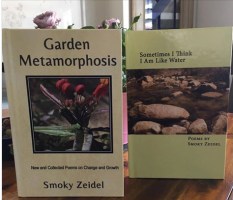
New Editions: Smoky Zeidel’s poetry collections (Garden Metamorphosis and Sometimes I Think I Am Like Water) are now available in hardcover editions. (Thomas-Jacob Publishing)
Film: Bestselling Novel by French-Moroccan Leila Slimani To Hit the Big Screen, by Teresa Kerr – “Rabat – The Perfect Nanny, a bestselling novel by French-Moroccan Leila Slimani is making its way to the big screen, thanks to three production companies: Legendary, Why Not Productions, and Pan-Européenne.” (Morocco World News)
Quotation: “We are cups, constantly and quietly being filled. The trick is, knowing how to tip ourselves over and let the beautiful stuff out.” – Ray Bradbury
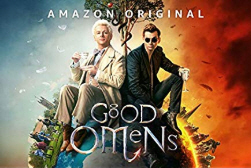
News:Thousands petition Netflix to cancel Amazon Prime’s Good Omens, by Alison Flood – “More than 20,000 Christians have signed a petition calling for the cancellation of Good Omens, the television series adapted from Terry Pratchett and Neil Gaiman’s 1990 fantasy novel – unfortunately addressing their petition to Netflix when the series is made by Amazon Prime.” (The Guardian)
Obituary:Uighur author dies following detention in Chinese ‘re-education’ camp, by Alison Flood – “The death of the prominent Uighur writer Nurmuhammad Tohti after being held in one of Xinjiang’s internment camps has been condemned as a tragic loss by human rights organisations.” (The Guardian)
Book Bits is compiled sooner or later by Malcolm R. Campbell, author of Conjure Woman’s Cat.
If my first novel had been a Pulitzer Prize finalist, I might have been ruined as an author. Instead, Eowyn Ivey follows up on her extravagant novel The Snow Child (2012)with a new work called To the Bright Edge of the World that’s being well received.
What a stunning debut, a beautifully realized re-telling of an old Russian Fairytale updated to 1920 and re-set in Alaska. A young couple moves to this rugged and unforgiving land and has trouble making ends meet on a farming homestead. They see or think they see, a young woman on the edge of the forest. Nobody else in the area has seen such a child, so Mable and Jack are doubted, thought to be having troubles adapting and staying sane through the long lonely winters.
Ivey lives in Alaska and worked for many years as a newspaper reporter there; this gives her the observational skills and knowledge of the territory to give readers realism that works as a solid foundation for a story that just might sound like magical realism at times. Kudos to Ivey for doing more than simply re-telling an old story with new clothes. In spite of the influences, this is a wondrous original work with characters of great depth and a plot that delivers for both readers of realistic tales and magical works.
The ending–which I won’t give away here–works within the context of a fairy tale and a story realistic enough to have been a veteran reporter’s feature story about a couple from back east who probably never guessed that Alaska would demand everything they could give.
Highly recommended for individuals as well as book clubs.
Notice: If this post contained any real potpourri, you’d be sneezing by now. Come to think of it, I don’t know why well-meaning people thrust potpourri on innocent people who walk into a bathroom, living room, bookstore, Wicca supply shop, or auto supply store and then start sneezing their asses off.
Moving to Juneau?
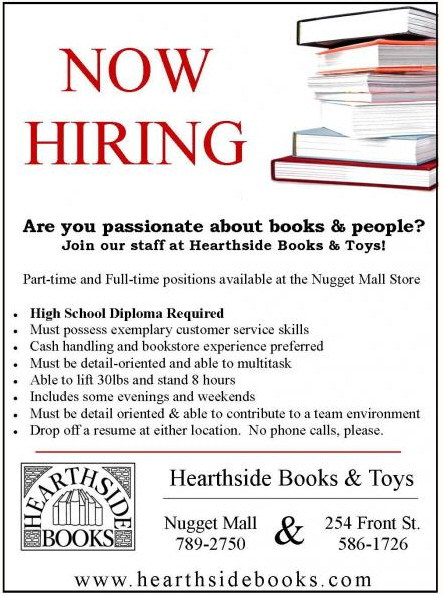
If so, there’s work. I’d take this job in a New York minute (whatever that is) if I lived there:
The Sun Singer
If you’re one of the wonderful people who downloaded a free Kindle copy of The Sun Singer during the recent giveaway, thank you! If you like it, you may also like its gritty sequel Sarabande:
The Strand Bookstore
Since I have worked in historic preservation, I’m a fan of the National Register because it draws attention to a historic site or object and imposes no restrictions on the owner’s use of the property. Not so, the government overreach in forcing landmark status on New York City’s famous Strand Bookstore. The bookstore fought against the designation because it comes with rules that impact how the slim-profit-margin store can use the building it owns. I signed the petition against this kind of nonsense.
Medical Update
I posted this medical update on Facebook and since I’m too lazy to write a fresh medical update, I’ll just paste it into the blog:
Darn it, rain
I was planning to mow the yard after supper until I noticed that it’s getting a bit dark outside (at 2 p.m.). The weather RADAR indicates that I might not be cutting grass even though we just got one of our riding mowers back from the shop and it’s ready to go.
Fried chicken for dinner tonight, but there’s not enough for you, so don’t stop by unless you stop at the KFC on hightay 27 before you get here.
“The intellect is a great danger to creativity . . . because you begin to rationalize and make up reasons for things, instead of staying with your own basic truth—who you are, what you are, what you want to be. I’ve had a sign over my typewriter for over 25 years now, which reads “Don’t think!” You must never think at the typewriter—you must feel. Your intellect is always buried in that feeling anyway.” – Ray Bradbury
If there’s a place for logic, perhaps it’s in your research. Facts matter, even in fiction, so it’s a bad sign getting those wrong, worse yet finding out from other people that you got them wrong. A long-time journalism professor and author of textbooks, my father often said that one of the worst things a journalist could do was misspell a person’s name. For one thing, it made him or her look sloppy. For another, it called into question everything else in the new story. If your research is flawed, small inaccuracies may kill your best work.
Otherwise–logic, as Bradbury suggests–gets in the way of our stories and even ourselves. Logic often leads to doubt, even self-doubt, and the frame of mind that arises out of that can easily become a barrier to the story you wish to tell. If you don’t think you can write it, you won’t. If you think you’re not the person to tell the story, you won’t be able to tell it. Our stories lead us down strange roads where it’s best to just keep going rather than thinking, “Holy crap, I’m lost.”
In some cases, being lost is a good thing because how you find your way out makes a good story, or at least provides the confidence you need to continue. Goodness knows, there’s not a lot of validation for aspiring writings and emerging authors, so allowing yourself the time and excitement of being lost from time to time is much better than fighting being lost. And besides, it’s easy to become prey for the doubters in your life who think you’ll never write anything, much less anything that gets published and sells a few copies, maybe a lot of copies.
Plus, it seems that when we use logic to try and puzzle our stories out of one misstep or another or one troublesome scene or another, we’re not likely to tell a story that’s true within itself and resonates with readers. I know one writing expert who says the stories we write are already “out there” in some kind of limbo area waiting for us to find them and tell them. I’m not sure I want to go that far. I do see, though, that stories appear to have an innate intelligence that wants to go in a particular direction for one reason or another. So, as we said years ago, the author has to go with the flow rather than thinking up logical rationale for swimming against the story’s current. If you’re swimming against the story’s current, you’re thinking. Stop it!
Down the road, you can do your thinking during the editing process. Then you’ll find inconsistencies, holes in the plot, and possibly other things that don’t add up. Or, maybe you won’t.
This is going to sound strange, but when I find a bunch of prospective characters who are doing one thing or another, I find it best not to judge them or find some logical yardstick that proves they’re messed up. Better to write down what they’re doing and discover the story in it. Just don’t think too much about what you’re doing.
One of the problems of reading a lot of throw-away novels in between the high-quality novels you talk about on Facebook and Goodreads is discovering the book you’re reading suddenly looks familiar.
This seems to be a problem with thrillers (where there’s a lot of violence) and romances (where there’s a lot of sex) where everything is the same until you come to a pivotal scene where the author opted for a blast of creativity and did something unique with the action.
It’s a bit disconcerting to be 100 pages into a book when suddenly you realize, “Crikey, I’ve read this book already.” Not only did I not recognize the title, but for 99 pages everything seemed new. I guess that means that either nothing memorable happened or that I skimmed through a lot of words.
Women’s fiction seems to be a problem in this regard because novels are often re-issued with new titles and new author pseudonyms, so there’s no way to know the book you just bought is already in a box in the attic or garage.
At least Amazon tells you that you already bought the book, but this doesn’t help if you buy some books from Powell’s, B&N, Indies Unlimted, and at bricks and mortar stores. Apparently, the quantity of words obscures the fact that a reader has seen all this before. As an author, I wonder how another author can write so many pages in so many books that I don’t recognize the plot and characters before I get to the weird scene where the deja vu occurs.
I wonder how often this happens. I hope it happens often because otherwise, it’s just me.
“It hadn’t occurred to me until I read them that antiwar novels could be funny as well as serious. “Catch-22” is crazy funny, slapstick funny. It sees war as insane and the desire to escape combat as the only sane position. Its tone of voice is deadpan farce. “Slaughterhouse-Five” is different. There is much comedy in it, as there was in everything Kurt Vonnegut wrote, but it does not see war as farcical. It sees war as a tragedy so great that perhaps only the mask of comedy allows one to look it in the eye. Vonnegut is a sad-faced comedian. If Heller was Charlie Chaplin, then Vonnegut was Buster Keaton. His predominant tone of voice is melancholy, the tone of voice of a man who has been present for a great horror and lived to tell the tale. The two books do, however, have this in common: they are both portraits of a world that has lost its mind, in which children are sent out to do men’s work and die.” – Salman Rushdie in What Kurt Vonnegut’s “Slaughterhouse-Five” Tells Us Now
Wikipedia Photo
I’ve been a fan, not only of Salman Rushdie, but of both Heller and Vonnegut, so I agree about the “funny” when it’s part of an otherwise grim work. Those of us who watched M*A*S*H as a movie or a TV series know the sharp knife humor can have in an otherwise serious work. One reader review of one of my Florida Folk Magic novels said that since I was writing about a grim subject, she saw no place for the humor I included. Needless to say, I didn’t respond, though I didn’t agree. Humor, I believe, not only helps keep us seen during insane times, but it introduces within a novel a strong and necessary counterpoint to the primary flow of horror and dread.
Perhaps, like the booze and jokes at a wake, humor–while it may contain a dash of denial–helps us cope with the worst of life. Perhaps it shows us that in the worst of times, we are still human. Or, perhaps it’s such a wild card that it shocks some sense and sensibility back into us when our lives and/or our world seem to have hit rock bottom. Heaven doesn’t need humor as much as hell needs humor.
Humor, it seems, can also show us the senseless reality of horrible things in a way that melodramatic prose cannot. In a way, satire and humor bring out the idiocy of events and views in a clearer way than a straight recitation of facts. Long ago, I learned that as a psychic/empath, I could most easily “read” a person by saying something humorous or otherwise unexpected during a conversation. Suddenly, as they try to figure out the comment, they become open and transparent. Yes, I know this isn’t a nice thing to do, but I never promised you I was a choir boy. Likewise, the unexpected humor (or farcical statement) can blast open a reader’s mind to the real truths in a grim novel. S/he sees, then, what s/he might otherwise miss.
Of all the novels I’ve read about war, I was probably more devastated by Johnny Got His Gun and All Quiet On The Western Front than any other fiction. Yet, they do no remain in my memory with the same power as Slaughter House Five and Catch 22. Why? Because they were a one-note samba of horror, unrelenting, and without a moment’s rest.
While the characters in war are likely to tell the worst possible jokes about their situation, the author isn’t there to poke fun at them but of the idiocy of their situation. So, authors risk the truth whenever they have an urge to turn the novel into an ongoing joke. The humor, like the devil, is in the details, the unexplainable moments, the orders from a bureaucracy far away, and the system itself.
Make the readers laugh. They may not thank you for it, but they will be stronger for it, long term.
Tomorrow is the beginning of our 1,800- mile journey with House of SpeakEasy where we are traveling to 10 cities during the next 10 days to bring books and poetry to readers. We will be delivering books to undeserved communities and partners along the way on workshops, story exchanges, readings and more. The tour will depart from Pioneer Works in Red Hook, Brooklyn, New York tomorrow, Thursday, June 13. We hope to see you there!
Poets, fiction writers, essayists, and other artists have long been at the forefront of protests against unfair regimes, laws, and negative cultural practices. They still are being censored, imprisoned, and killed. So, I find it hard to protest against the increased amount of political discussion on writers’ sites these days. I suppose if a reader stays within a specific genre or group of authors and mostly reads their material, this increase in politics might be less noticeable. I see it because I’m always searching for writing news sites for information for my author’s page on Facebook.
On that page, I provide four-to-five links a day about recent book news. But my sources are becoming more and more political and making that harder for me to do without politizing the page. That is, I’m finding less information about new releases and author interviews and writing tips, and more information about authors’ views about present-day politics. If I link to such articles very often, I’ve become a political site rather than a books and authors site.
I applaud writers who speak out even if I don’t agree with them. But speaking out is good! Let’s face it, my Florida Folk Magic Series of three novels speaks out against the KKK and the Jim Crow laws of the 1950s.
Let’s face it, politics in the United States at the present moment is–for want of a better analysis–a fractured, polarized mess. It’s natural for writers to speak out about it. Even so, many readers turn to fiction and poetry for entertainment, the discovery of new ideas, and to experience their love of words. I really think some, perhaps many, of those readers do not want the worst of the daily news embedded in every novel and poem they read.
I tend to avoid political books that focus on the current moment because I don’t want to pay $25.00 for a book that contains the same stuff I see on the daily news and that will be out of date in a few years. Even my favorite writers have to wait for the Kindle or mass market paperback versions of their novels to come out before I buy them. As a writer, I think that “too much” current politics dates a novel and makes it unlikely to be read five years from now. So, I’m not going to write a novel about a bunch of people who want to impeach Trump or who want to keep him from being impeached. Stephen King might be able to carry it off, but it’s beyond me, and once Trump is gone, who’s going to read the book?
What about you. Do you look for novels that explore or exploit the current political debates of the day? Or, do you read what you usually read and hope it doesn’t sound like either CNN or FOX news?
 Peter Ruffell’s short foreword tells the reader that these 17 little stories, and the poem which completes the book, started life during writing sessions at Off The Cuff, a writing workshop in Weymouth. The length of these stories reflects that: they’re a little longer (and, thus, meatier) than flash fiction, but short enough to read one while you’re enjoying (say) a mid-morning cup of tea.


 News:
News: 



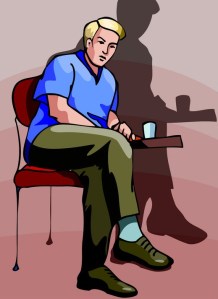 Otherwise–logic, as Bradbury suggests–gets in the way of our stories and even ourselves. Logic often leads to doubt, even self-doubt, and the frame of mind that arises out of that can easily become a barrier to the story you wish to tell. If you don’t think you can write it, you won’t. If you think you’re not the person to tell the story, you won’t be able to tell it. Our stories lead us down strange roads where it’s best to just keep going rather than thinking, “Holy crap, I’m lost.”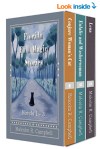
 This seems to be a problem with thrillers (where there’s a lot of violence) and romances (where there’s a lot of sex) where everything is the same until you come to a pivotal scene where the author opted for a blast of creativity and did something unique with the action.


 On that page, I provide four-to-five links a day about recent book news. But my sources are becoming more and more political and making that harder for me to do without politizing the page. That is, I’m finding less information about new releases and author interviews and writing tips, and more information about authors’ views about present-day politics. If I link to such articles very often, I’ve become a political site rather than a books and authors site.
 Malcolm's Round Table