Protect the time and space in which you write. Keep everybody away from it, even the people who are most important to you. ~Zadie Smith
Perhaps this will seem like a surprising time to talk about protecting one’s writing time. We’re all facing the possibility of empty store shelves, prospective quarantines, disruptions of travel plans–not to mention getting COVID-19.
Many of those who write say it’s as important as breathing and that they can’t live without it. I’ve written before about the challenges the stay-at-home writing spouse has with protecting his/her time. If that time is not bringing income into the household, then the 8-5 spouse/partner who is supporting the family might assume the writing is a hobby and can be disrupted as need be with calls to pick up something at the store, prepare dinner for the boss with little notice, keep the house clean, and do all the shopping.

Now, as the U.S. has raised the threat level of the virus from “What, me worry?” to “Find out who’s to blame,” conserving time to write will probably become more difficult; if you were around during the 1970s gasoline shortage, then you know that thousands of people spent a good portion of each week trying to find a service station with any gasoline and, once they did, there might have been a wait of an hour or more in a long line.
If this happens again with such essentials as toilet paper and food, then trips to the grocery store might take many hours per week. Obviously, the family comes first, whether it’s food or safety. The 8-5 working spouse might get furloughed if they work for a company whose product or service takes a huge hit from the emergency.
Yet, I encourage you to write and/or do the online research or library research your stories need because this is what defines you as a person whether it’s bringing in money or not. Yes, I know it’s difficult seeing multiple hours of daily writing time collapse down to an hour or 30 minutes. Perhaps your approach shifts gears from poetry or a period novel to something like “Pandemic, a Diary.”
Even stolen moments of time can be enough to keep you breathing and give you a reason to hope that when the pandemic’s over, you’ll be a fulltime storyteller again.

 Several student responses are likely: (1) A dozen synonyms for said. (Yes, there’s a difference between “he said,” “he yelled,” and “he whispered.”) But they don’t help if the words that are said don’t sound any different in tone, structure, word choice, accent, and focus than the three other people in the conversation. (2) The student thinks up a list of eccentric phrases and distributes these amongst the characters, rather like dealing out cards, so that EVERYONE TALKS FUNNY. The teacher is likely to say, “The people sound like they just escaped from a carnival freakshow.”
 If I’d known that a romance novel with a title similar to a famous Hollywood movie, one categorized on Amazon as Erotic Thrillers, Romantic Erotica, Erotic Suspense, was in the running, would have waited a few weeks before signing up for another contest.
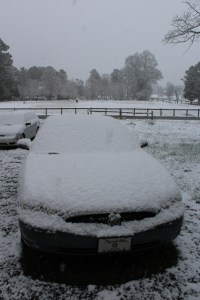 We had a bit of Northwest Georgia snow for a while yesterday, thick enough to cover the yards and mess up your hair if you walked out into it with a camera. It all melted away by mid-afternoon.
 In spite of my criticism about the amount of backstory in Cemetery Road, I enjoyed reading the novel. The small-town alliances and secrets make for a very complex story that’s even hard for a man returning to his old hometown to figure out. Suffice it to say, there is great depth in the characters and enough lies to cover almost everything that happens.
 My website will expire on the 20th of this month. I’m sad to see it go, but it’s no longer financially viable. I’ve deleted most of the information on it, leaving a home page with links to my writing. I’m happy to say that a fair number of people visited this site every month. Thank you.
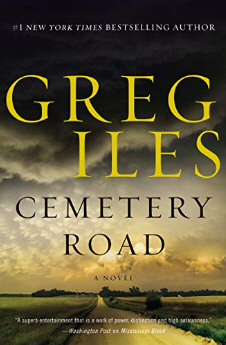 The protagonist, Pulitzer-prize winning journalist Marshall McEwan, returns to the small town where he grew up because his father is in ill health and his newspaper business is failing. (I would have used a different name since this one is too close to Marshall McLuhan, the famous media expert and philosopher). Marshall’s old friend is murdered and thus begins the current-day primary plot of the novel.
 I skip the acknowledgement section unless I’m reading a book that posits an alternative history or a modern take on a real history because I want to know what parts of such books are true. Otherwise, acknowledgements seem like sucking up:
 When I research the kinds of products that were in used during, say, the time-period of “Little House on the Prairie” (which had a general store), I wonder how the film crew verified what products they could show and what products they couldn’t show. Many product availability dates are obscure, given in terms of decade rather than specific year.
 I no longer feel guilty when I don’t write every day. At some point, I rebelled against the idea because I have a history of rebelling against almost everything. So, I write when I feel like it.
 Malcolm's Round Table