When I was in grade school, everyone knew the answer to this question: “the shadow knows.”
“The Shadow” was a radio drama that aired between 1937 and 1954 with tie-ins to comic books and novels. The show featured crime fighter Lamont Cranston who was a great detective with a few unusual powers. A few films followed the end of radio programs including Alec Baldwin’s in the 1994 version that lost money and wasn’t well received. I no longer remember whether I listened to any radio episodes when I was a kid; it’s possible because when I was home sick from school there was plenty of stuff on the radio to keep my attention.
Now James Patterson has bought the rights to the material, kicking off the story with The Shadow (2021) co-written with Brian Sitts. The novel is lightweight fiction compared to Patterson’s Alex Cross series so, while it was fun to read, it was a bit more of a spoof than a hard-boiled detective novel.
From the snippets of the radio show I’ve heard, Patterson and Sitts will have to ramp up the action if any sequels are produced for this first one, which has been said to be setting the stage and doesn’t have the ambiance of the original radio series.
So far, the storyline just isn’t edgy enough to hold up as a series. This is the look and the tone I want to see.
Patterson and Sitts have their work cut out for themselves. “As you sow evil, so shall you reap evil! Crime does not pay…The Shadow knows!”
When I used to read Tarot cards and the I Ching, people were simultaneously curious about the future and nervous about hearing what it might be. A person’s feelings about the results of fortune telling were based to a great extent on what exactly they thought the future was/is.
Some people believe in fate, a concrete future stemming from the workings of the cosmos while others believe in destiny stemming from an individual’s probable decisions leading toward a specific or general situation or set of circumstances. I don’t believe in either or that the future is engraved in stone in any way.
The best point of view I heard about a psychic reading is an old one, one that proposes that a reader is standing on the roof of a tall building viewing multiple city streets that are, of course, not totally visible to people or cars on those streets. S/he sees two cars approaching an intersection without traffic signals. They’re moving a the same speed. One prediction might be that there will be a collision. Yet that prediction is not fixed because either car may change its speed, pull into a parking garage, or stop at a store. The prediction, then, is merely a possibility based on current conditions.
Some say that the future is part of (or all of) God’s plan and that He/She moves in mysterious ways. The Presbyterians used to believe in predestination about not only the future in this world but whether or not we’d end up in heaven or hell in the world to come. The outcome was considered fixed. I was a Presbyterian in my K-12 years and thought that belief was silly. Later, Kabalistic studies convinced me there was nothing mysterious about the workings of the Creator.
Some say all time is now. Everything thing that will happen is happening at this moment in one venue or another. We just can’t observe all the venues with our physical senses. Lena, the cat in my Florida Folk Magic Series, has this view.
Some quantum physicists say that everything that can happen, will happen in one universe or another. This tends to be my view because I believe we create our own reality. That is to say, the future is what we are creating unconsciously (usually). A lot of people subscribe to this idea in a speculative sense but deny it when it’s applied to real conditions. They don’t want to believe that if they’re in one of the two cars the psychic sees from the roof of the tall building, they have chosen to be in the collision if there is one.
That notion is counter-intuitive and/or horrifying when you get down to specifics and so people think it’s easier to say that God, fate, destiny, luck, or randomness determines the future rather than to say one has any responsibility for it. Personally, I want the responsibility and find that much more palatable than disagreeing with Einstein and believing that God does play dice with the universe. You won’t be surprised to hear that I never express this belief in public after a tragedy because that would shake up the belief system of another person who is suffering a loss.
In fact, most of the time, it’s just better for me to keep my mouth shut except in “what-if?” posts like this one where many readers will just assume I got into the locoweed again.
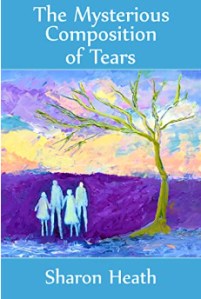
Thomas-Jacob Publishing has released the latest addition to Sharon Heath’s The Fleur Trilogy, The Mysterious Composition of Tears (July 18). Currently available in Kindle and paperback, The novel book follows History of My Body, Tizita, and Return of the Butterfly.
From the Publisher:
After a series of climate calamities, physicist Fleur Robins takes off for deep space in a desperate attempt to save the species from extinction. During her mysteriously prolonged absence, the internet has crashed, fire and flood have devastated whole countries, and End of Times cults have proliferated. There have been some intriguingly hopeful changes, too—nanoparticle holograms have replaced electronic devices, young people are witnessing exquisitely colorful “Shimmers,” and the most gifted of them converse regularly with animals and trees.
While Fleur’s distraught husband Adam leads their Caltech physics team in frantic efforts to pinpoint her whereabouts, and Fleur herself plots her return home, their teenaged children Callay and Wolf fall in love with surprising partners. But when the charming son of an End of Times pastor crosses Wolf’s path during a particularly vibrant Shimmer, events are set in motion that will upend everyone’s life and transform planet Earth itself.
This latest installment of Sharon Heath’s saga of the quirky Nobelist Fleur is simultaneously a vision of what awaits us in a post-Covid world, a wild romp through quantum reality, and a deep sea dive into the dark and light vagaries of the human heart.
From the C. G. Jung Institute of Los Angeles
Come and join us at the Institute Clubhouse or via Zoom on September 10th at 10:30 a. m. for a book reading and signing by Jungian Analyst Sharon Heath of her sequel to The Fleur Trilogy. Admission is free, but registration is required
When I came inside from yard mowing around lunchtime today, I poured a glass of Celtic Ale. Robbie, our indoor/outdoor cat who thinks anything on my TV tray belongs to him, tried to get the glass away from me. So Lesa poured a little in a saucer and he turned his nose up at it like that wasn’t the same stuff I had the glass.
What he does like is the really hot (spicey) Jazzy Jambalaya soup from Campbell’s. I have it with late-night movies but often need an Alka Seltzer as soon as I finish it. If I leave any in the bowl, Robbie jumps up on my TV tray and licks it all up. No chaser. No hairballs. No crazy behavior. What’s wrong with this kitty?
According to Campbell’s website, “This ready-to-eat soup is loaded with antibiotic-free chicken meat, Andouille sausage, rice, and cooked ham, plus veggies and a mixture of flavor-packed spices. Let’s not forget: our fill-you-up soup is also blended with a tasty cayenne pepper sauce that makes it a must-try for any Cajun food fanatic!”
I love Cajun food, so the soup works for me even though you probably won’t find it on the menu at the Atchafalaya Restaurant in New Orleans. They also serve Creole food, but I won’t hold that against them!
At one time, our family had a share or two of stock in Campbells. So, whenever somebody asked if we had anything to do with the soup company, we could shrug and say, “But of course, we do own stock.” But that’s long gone, so I can mention the soup without it being a conflict of interest.
Film noir is famous for its sarcastic, metaphor-filled voice-over monologue that often shows just how cynical the protagonist is about life. I thought of this while re-reading Ruta Sepetys Out of the Easy which gets the style and ambiance of the New Orleans French Quarter just right. I appreciate this line about Willie, the bordello madam: “The voice was thick and had mileage on it.”
One of my favorite lines comes from the former TV series “Early Edition” (1996-2000) about a guy who knows stuff because he gets the newspaper a day early: “The fog was as thick as hash-house oatmeal and twice as cold.”
Two silhouetted figures in The Big Combo (1955). The film’s cinematographer, John Alton, was the creator of many of film noir’s stylized images. – Wikipedia
As “Private Eye Monologue” says, “The signature narration style in Film Noir. A bored-looking, world-weary, the utterly cynical detective (hardboiled and/or defective) with his feet on the desk meets a Femme Fatale, while the voiceover gives us his mental play-by-play:” She walked through my door like a tigress walks into a Burmese orphanage — strawberry blonde and legs for hours. No dame her age could afford a coat like that, and the kinda makeup she had on gave me a good idea how she got it. She had bad news written on her like October of ’29.
The 1946 film “The Big Sleep”(Bogart and Bacall) by Raymond Chandler/William Faulkner, and others, is one of the more enduring noir films because of the stars, author, and director, Howard Hawkes. Chandler’s lines are memorable within the genre: “Dead men are heavier than broken hearts,”“I don’t mind if you don’t like my manners. They’re pretty bad. I grieve over them during the long winter nights,” and “Neither of the two people in the room paid any attention to the way I came in, although only one of them was dead.”
Wikipedia describes Night and the City as “a 1950 film noir directed by Jules Dassin and starring Richard Widmark, Gene Tierney and Googie Withers. It is based on the novel of the same name by Gerald Kersh. Shot on location in London and at Shepperton Studios, the plot revolves around an ambitious hustler who meets continuous failures.” One can’t help but notice: This is like the Greyhound station for DEATH!
From “Murder, My Sweet,” we get: “Okay Marlowe,” I said to myself, ‘You’re a tough guy. You’ve been sapped twice, choked, beaten silly with a gun, shot in the arm until you’re crazy as a couple of waltzing mice. Now let’s see you do something really tough—like putting your pants on.’“
From the “Lady from Shanghai”: “Maybe I’ll live so long that I’ll forget her. Maybe I’ll die trying.”
And “Key Largo” “When your head says one thing and your whole life says another, your head always loses.”
According to Wikipedia, “Farewell, My Lovely is a novel by Raymond Chandler, published in 1940, the second novel he wrote featuring the Los Angeles private eye Philip Marlowe. It was adapted for the screen three times and was also adapted for the stage and radio.” I like the 1975 version (classified more as neo-noir) with Robert Mitchum the best: “It was one of those transient motels, something between a fleabag and a dive” and “Moose never would have hurt her. It didn’t matter to him that she hadn’t written in 6 years. It didn’t matter that she turned him in for a reward. The big lug loved her… and if he was still alive… it wouldn’t matter to him that she’d pumped 3 bullets into him… What a world.”
There’s no way to sum all this up except to say that anyone who loves noir has already gone over to the dark side.
–Malcolm
Malcolm R. Campbell is the author of the pseudo-noir thriller Investigative Reporter.
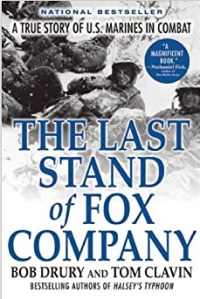
I’m fairly sure I’ve read all of Jeff Shaara’s novels from his two novels about Gettysburg up to his novel about the Korean War The Frozen Hours. Before I read it, I had already included a backstory about two characters in my Florida Folk Magic Series that included service in the 1st Marine Division in Korea. Since my work in progress, Pollyanna Hoskins includes these characters, I’ve placed one of them with Fox Company tasked with guarding a strategic pass.
Here we have 234 marines holding off 10,000 Chinese soldiers. This is mentioned, of course, in Shaara’s book that covers the entire war. I wanted more specific information about the brave and determined men of Fox Company. There’s plenty of information online, but The Last Stand of Fox Company is very specific about Captain Barber’s three platoons and how they faired day by day against a vastly superior force in a harsh Korean winter when the temperatures were -34 °. While water and food and feet were frozen, the low temperatures saved some of the wounded whose wounds were frozen, keeping them from bleeding to death.
The entire campaign around the Chosin Reservoir in North Korea is called “frozen Chosin” for a reason.
Using the terminology of the day, my character is still “shook” in his life in the years after the war. “Shook” meant “to go mental,” later described as shell shock and then PTSD. After reading the account of Fox Company’s defense of a major road at Toktong Pass, I’d expect all of them, the few left standing to be shook.
From the Publisher
November 1950, the Korean Peninsula: After General MacArthur ignores Mao’s warnings and pushes his UN forces deep into North Korea, his 10,000 First Division Marines find themselves surrounded and hopelessly outnumbered by 100,000 Chinese soldiers near the Chosin Reservoir. Their only chance for survival is to fight their way south through the Toktong Pass, a narrow gorge that will need to be held open at all costs. The mission is handed to Captain William Barber and the 234 Marines of Fox Company, a courageous but undermanned unit of the First Marines. Barber and his men climb seven miles of frozen terrain to a rocky promontory overlooking the pass, where they will endure four days and five nights of nearly continuous Chinese attempts to take Fox Hill. Amid the relentless violence, three-quarters of Fox’s Marines are killed, wounded, or captured. Just when it looks like they will be overrun, Lt. Colonel Raymond Davis, a fearless Marine officer who is fighting south from Chosin, volunteers to lead a daring mission that will seek to cut a hole in the Chinese lines and relieve the men of Fox. This is a fast-paced and gripping account of heroism in the face of impossible odds.
When I was in elementary school, I saw many headlines in the daily papers about the Korean War. Needless to say, I didn’t understand the big picture. But the war has fascinated me in part because it’s more or less forgotten. But, it occurred just a few years before my novel-in-progress Pollyanna Hoskins is set. So, one way I’m adding depth to my novel is by including characters who were in Korea, the man as a marine corporal, and the woman (Pollyanna) as a marine nurse serving in MASH units and field hospitals.
The title of Jeff Shaara’s book comes from a poem by one of the marines on Fox Hill:
The long nights. Too long. Time stops, frozen in place. I beg the frozen hours for the Sunrise. Too many many memories Ice and Death I’m ready to join my friends.
And so, I can’t help but include bits and pieces of this war, partly because the heroism there has been mostly forgotten and partly because it’s a major factor in the world where my characters lived in the early 1950s.
If your reading speed is faster than the amount of money in your wallet, then you’ll end up re-reading many of the books on your shelves. I often re-read books by John Hart (The Hush), Kristin Hannah (The Nightingale), Pat Conroy (The Prince of Tides), and Ruta Sepetys (Salt to the Sea). I think I’ve read all of these authors’ books multiple times because they are well-written and speak to issues larger than their plots.
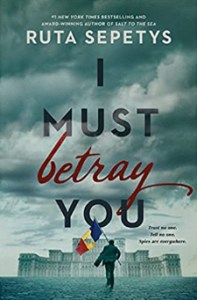
As I re-read I Must Betray You, I find myself simultaneously captured by the story it tells and horrified at the life Romanians led under the regime of Nicolae Ceaușescu who led the country until the revolution of 1989. I remember this from news reports, though I had no idea how pervasive the expectation was that “good citizens” were all expected to inform on each other.
As a Libertarian (not a Republican using the term falsely), I think we already live under too much surveillance from highway license plate readers that track who goes where to NSA listening to conversations that are expected to be private. But, as I read I Must Betray You, I think maybe things here are either much better than my worst fears or are heading in the direction of my worst fears.
The New York Times reviewer said the novel is “A gut-wrenching, startling historical thriller about communist Romania and the citizen spy network that devastated a nation, from the #1 New York Times bestselling, award-winning author of Salt to the Sea and Between Shades of Gray.”
My thoughts are: (a) Why does a dictator “need” to deny so much freedom to his/her country’s citizens? and (b) How do so many people put up with their government’s atrocities for so long?
From The Publisher
Romania, 1989. Communist regimes are crumbling across Europe. Seventeen-year-old Cristian Florescu dreams of becoming a writer, but Romanians aren’t free to dream; they are bound by rules and force. Amidst the tyrannical dictatorship of Nicolae Ceaușescu in a country governed by isolation and fear, Cristian is blackmailed by the secret police to become an informer. He’s left with only two choices: betray everyone and everything he loves—or use his position to creatively undermine the most notoriously evil dictator in Eastern Europe. Cristian risks everything to unmask the truth behind the regime, give voice to fellow Romanians, and expose to the world what is happening in his country. He eagerly joins the revolution to fight for change when the time arrives. But what is the cost of freedom? Master storyteller Ruta Sepetys is back with a historical thriller that examines the little-known history of a nation defined by silence, pain, and the unwavering conviction of the human spirit.
Of course, I know one thing Cristian Florescu doesn’t know. The dictator and his wife aren’t going to stay in power because a revolution is coming. But even if he knew, could he hold it together like a person in a storm who knows the storm will ultimately move out to sea? Yet, I appreciate his spunk, his beliefs, and the risks he’s willing to take. I think all of that goes beyond what most of us in the U.S. would be willing to do to get back to the kind of government the founders intended.
You may feel totally different things as you read this book. That’s fine. The point is, that in addition to providing us with a good story, Sepetys provides us with a lot to think about in the countries where we live.
Many authors, especially lately, have written books about the end of the world as we know it. I think the first novel I read about an apocalypse in our world was the 1949 Earth Abides by George R. Stewart. In spite of its theme, which seemed all too real to me as a junior high school student–I liked the novel a lot. Stewart’s antagonist was disease.
Today, I see a lot of novels in which the culprit is climate change, and that’s to be expected. Early on, I read Hiroshima (1946) by John Hersey, On the Beach (1957) by Nevil Shute, and countless nuclear war-related novels since. Those books probably influenced my belief that Truman was wrong when he dropped atomic bombs on Hiroshima and Nagasaki.
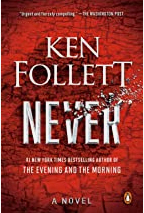
To avoid getting into the realm of spoilers here, I’m not doing to tell you how Never ends. Yes, it does involve the prospect of nuclear war. People seem to be of two minds about how a nuclear war might start. Primarily, people presume Russia or China will suddenly attack the United States or whatever rationale brings either country to that point. Others presume the war would be started by a rogue nation like Iran or North Korea that has nothing to lose by harming the United States and other western nations.
What’s sobering about Follett’s novel is how small and/or isolated provocations, many of which involve a so-called “appropriate response” can escalate into a potential conflict that might involve nuclear weapons. In this scenario, it doesn’t take long for countries that have responded to attacks with conventional weapons to respond with a measured conventional weapons response to suddenly be on the brink of a war much larger and more difficult to stop.
This well-written, realistic novel provides readers with a lot of food for thought. It’s one of those books that’s very hard to stop reading even though there are chores to be done and bedtime to consider. I hope some of those who read it will be impacted as I was impacted by Hiroshima and On The Beach and resolve that there’s never a justifiable reason for using a nuclear weapon.
Once an author begins a new novel or short story, there’s no such thing as “not writing” even when s/he isn’t actually writing. The characters are always present. The need to gather more information is equally present. It’s hard to explain this to people who see me reading online or a paper book (yes, they still exist) and assume I’m taking a break. Nope, doesn’t happen.
My novel in progress is called Pollyanna Hoskins. If you read Thomas-Jacob Publishing’s free anthology, then you saw the first chapter of this novel in my “Smokey Hollow Blues” short story. Before I wrote that short story, I’d been trying to write another novel set in Glacier Park. But, I couldn’t do it. My novels set in the park (there are three of them, I think) were too far back in time for me to just plug into their matrix and start writing about the high country again.
However, I’d already written four novels in my “Florida Folk Magic Series,” so it was easier to step back into that world again. So, I’m writing about north Florida again. And a CIA operative. And the Klan. And a bit of conjure. I grew up in this world, so it’s home–for better or worse. I know it sounds weird, but the stories a writer writes choose him/her rather than the other way around.
I thought I was done writing about the Florida Panhandle. Well, I guess not. As it turns out, an author is never really done writing about anything.
Imposing Content-Based Restrictions on Teachers Through Law Violates Free Expression
FOR IMMEDIATE RELEASE: Pen America, July 5, 2022
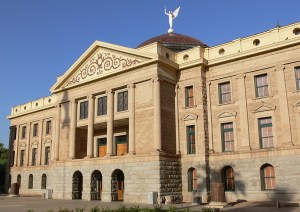
AZ Capitol Building – Wikipedia Photo
(NEW YORK)– Since Republican state legislators began proposing educational gag orders in January 2021, votes on these legislative restrictions on the freedom to read, learn, and teach have generally broken down along partisan lines.
Last week, however, 11 Democrats in the Arizona House of Representatives introduced HB 2634, an unsuccessful bill that would have banned from school curricula “any textbook or other instructional material…that contains any matter reflecting adversely on persons on the basis of race, ethnicity, sex, religion, disability, nationality, sexual orientation or gender identity.”
In response, Jeremy C. Young, senior manager of free expression and education at PEN America. said: “Government-imposed censorship of students and teachers is always the wrong approach, no matter the motivation, and no matter which side of the political aisle it comes from. Educational gag orders have no place in our schools, period.
Had HB 2634 become law, Arizona teachers might have been unable to assign materials that depict historical or literary instances of discrimination to educate students about why discrimination is wrong — such as the Supreme Court’s Plessy v. Ferguson decision or the works of Pulitzer Prizewinning author Toni Morrison. We should never seek to impose content-based restrictions on teachers through the force of law. Doing so violates the principle of free expression and impoverishes student learning in the classroom.”
 When I was in grade school, everyone knew the answer to this question: “the shadow knows.”
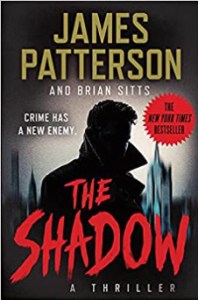 Now James Patterson has bought the rights to the material, kicking off the story with The Shadow (2021) co-written with Brian Sitts. The novel is lightweight fiction compared to Patterson’s Alex Cross series so, while it was fun to read, it was a bit more of a spoof than a hard-boiled detective novel.
 When I used to read Tarot cards and the I Ching, people were simultaneously curious about the future and nervous about hearing what it might be. A person’s feelings about the results of fortune telling were based to a great extent on what exactly they thought the future was/is.
 The best point of view I heard about a psychic reading is an old one, one that proposes that a reader is standing on the roof of a tall building viewing multiple city streets that are, of course, not totally visible to people or cars on those streets. S/he sees two cars approaching an intersection without traffic signals. They’re moving a the same speed. One prediction might be that there will be a collision. Yet that prediction is not fixed because either car may change its speed, pull into a parking garage, or stop at a store. The prediction, then, is merely a possibility based on current conditions.
 Some quantum physicists say that everything that can happen, will happen in one universe or another. This tends to be my view because I believe we create our own reality. That is to say, the future is what we are creating unconsciously (usually). A lot of people subscribe to this idea in a speculative sense but deny it when it’s applied to real conditions. They don’t want to believe that if they’re in one of the two cars the psychic sees from the roof of the tall building, they have chosen to be in the collision if there is one.

 What he does like is the really hot (spicey) Jazzy Jambalaya soup from Campbell’s. I have it with late-night movies but often need an Alka Seltzer as soon as I finish it. If I leave any in the bowl, Robbie jumps up on my TV tray and licks it all up. No chaser. No hairballs. No crazy behavior. What’s wrong with this kitty?
 I love Cajun food, so the soup works for me even though you probably won’t find it on the menu at the Atchafalaya Restaurant in New Orleans. They also serve Creole food, but I won’t hold that against them!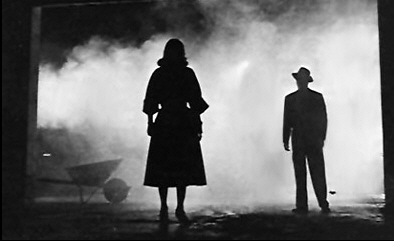
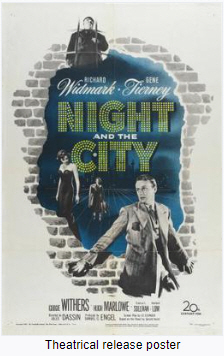 Wikipedia describes Night and the City as “a 1950 film noir directed by Jules Dassin and starring Richard Widmark, Gene Tierney and Googie Withers. It is based on the novel of the same name by Gerald Kersh. Shot on location in London and at Shepperton Studios, the plot revolves around an ambitious hustler who meets continuous failures.” One can’t help but notice: This is like the Greyhound station for DEATH!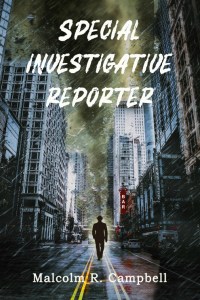
 When I was in elementary school, I saw many headlines in the daily papers about the Korean War. Needless to say, I didn’t understand the big picture. But the war has fascinated me in part because it’s more or less forgotten. But, it occurred just a few years before my novel-in-progress Pollyanna Hoskins is set. So, one way I’m adding depth to my novel is by including characters who were in Korea, the man as a marine corporal, and the woman (Pollyanna) as a marine nurse serving in MASH units and field hospitals.
 Today, I see a lot of novels in which the culprit is climate change, and that’s to be expected. Early on, I read Hiroshima (1946) by John Hersey, On the Beach (1957) by Nevil Shute, and countless nuclear war-related novels since. Those books probably influenced my belief that Truman was wrong when he dropped atomic bombs on Hiroshima and Nagasaki.
 Malcolm's Round Table