Thinking of Memorial Day

If I lived in Washington, D. C., I would visit the Wall again because of all the memorials and monuments I’ve seen, this holy place hits me the hardest, and that’s the feeling we need on this holiday.

Reflected her in my photograph, my wife and I are looking at the name of a former high school classmate of mine.

We hear that many men die and fall to the ground before they know they are dying. Others know, and the accounts of their thoughts are varied–some focus on getting medical help, and others most likely are thinking of their families or possibly that the spot where they have fallen is the spot where they belonged at that moment because falling is part of the sacrifice that is an integral rite of passage many endure to keep our country free.

No doubt few believed their deaths would be celebrated by people spending money on holiday sales.

Dying soldiers often have little time for contemplation because their time is too short and/or their pain is too intense. We can hope they wanted the best for those at home: family and friends who would mourn their passing longer than it took the soldier to reach his/her last breath. That “best” might be a wonderful life in a free country where happy times fill their days in the day-to-day art of living.

Perhaps that life, in the soldiers’ thoughts, included barbecues, time at the beach, and flag-waving parades with bands and color guards and music. Perhaps that fife included sitting in a bar with three fingers of Jack Daniels with or without the trite words, “Do you come here often?”

Whether the dead were conscripts or volunteers, they probably didn’t think that their hardships proscribed what those back home should be doing with their time, paid in full as it was by the men who march away.

But a Memorial Day sale? That still seems inappropriate even though the dead paid the price so that we could go out and save a buck in their memories. As long as we don’t forget them while getting 30% off on a new extravagance.

–Malcolm

Mama Don’t Allow No Writin’ Prompts ‘Round Here

Trouble is, websites, magazines, and other purported supporters of writers in training keep saying,  “Well, we don’t care what Mama don’t allow, Gonna create those prompts anyhow.”

Lord preserve us from such people and the greatest time wasters they foist upon us rather than providing articles that actually help.

In fact, a poke in the ass with a #4 pencil would be more useful.

If an aspiring writer needs a prompt before s/he can write something, perhaps s/he should consider another line of work, like crime or politics.

Writing prompts appear for one reason only: they are easier for a website or magazine editor to create than an article.  All you gotta say is something like, “Five people walk into a restaurant and order burgers and then get into an argument about the condiments that need to go on them (the burgers). All hell breaks out. Marriages fail. Ultimately the cops are called and interview the five people while eating the burgers.”

Sure, you can write a short story or a novella or possibly a novelette from this prompt, but why waste your time even if the website (like one place I know) wants you to submit your work so others can vote on the best story. Let’s say you win. So what? You don’t get a check or even any resume material.

Waste of time. Should have listened to Mama or watched Yam Yam win Survivor 44.

Might as well have spent the time watching the grass grow because, while doing that, you might have come up with your own story idea maybe for practice, maybe for submission to a little magazine, or maybe to develop into a novel with or without NaNoWriMo.

Good work arises out of our own passions and interests and experiences. It’s that simple.

–Malcolm

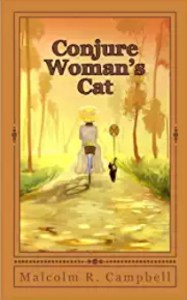
Malcolm R. Campbell is the author of the Florida Folk Magic Series, four books about conjure and the Klan in the Florida of the 1950s.

What writers don’t say

Look for what writers don’t say and you’ll find their greatest truths or, if not that, important clues to what the story is about, indications that beyond the shallow waters of the obvious, there’s depth and knowledge for readers to discover, and a prickly feeling on the back of your neck that your subconscious mind is being visited by things half-remembered that when found shine a steady light on what the writer didn’t spell out.

Those reading my short story “Moonlight and Ghosts” in the short story collection Widely Scattered Ghosts know that the main character takes a dim view of the state of our mental health system, in part the fact that the centers using the group home approach (that was working) gave way to the cheaper “let’s turn the mentally ill out into the community where, in reality, few people will help them.”
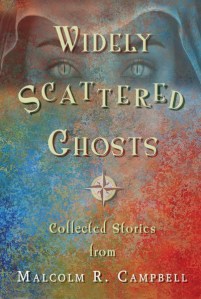
My view, as I wrote the story, was that those released from group homes were basically left for dead. I assert this in the story’s opening lines (copyright (c) 2018 by Malcolm R. Campbell):

“THE LIGHT OF the harvest moon was brilliant all over the Florida Panhandle. It released the shadows from Tallahassee’s hills, found the sandy roads and sawtooth palmetto sheltering blackwater rivers flowing through pine forests and swamps toward the gulf, and, farther westward along the barrier islands, that far-reaching light favored the foam on the waves following the incoming tide. Neither lack of diligence nor resolve caused that September 1985 moon to remain blind to the grounds of the old hospital between the rust-stained walls and the barbed wire fence, for the trash trees and wild azalea were unrestrained, swings and slides stood dour and suffocated in the thicket-choked playground, humus and the detritus of long-neglect filled the cracked therapy wading pool, and fallen gutters, and shingles and broken window panes covered the deeply buried dead that had been left behind.”

One thing I didn’t say in the story was that the hospital was real, one I’d visited in one of its earlier incarnations when it was brightly lit and clean and well staffed but then, as funding cuts showed our true feelings about the mentally ill and the developmentally disabled, the care and facilities ran into a downward spiral until the facility was eventually abandoned. Later it would be razed and the property turned into a neighborhood of upscale homes where it’s my profound hope that the residents hear ghosts on quiet nights.

To reinforce the focus of the story, the opening lines quoted here are a close paraphrase of the style of the opening lines of  “The Dead,” a 1914 short story by James Joyce, a favorite writer of mine. My intent was not to gain notoriety by paralleling a famous writer’s work but to drop a subliminal guidepost into my story.  Goodness knows, folks like T. S. Eliot said “The Dead” was one of the greatest short stories ever written. It would be vain of me to compete with that, but more likely that a few people who read my story might have read “The Dead” and would see that my intent was to reinforce my main character’s belief–and my own as well.

Such clues are left for readers to find. Those who “get it,” “get it.” Those who don’t find the clue don’t lose anything as they read other than a clue they won’t miss. Writers do this a lot and then English teachers (unfortunately) tell students what they did not see. So it goes.

Nonetheless, I think I’ve mentioned here before that writers often conceal the most important parts of their work.

–Malcolm

Interview with You Know Who

Today’s guest is, at best, infamous.

Reporter: Just who the hell do you think you are?

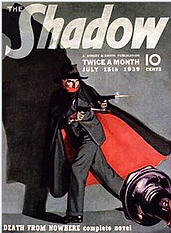
Shadow

Me: The Shadow.

Reporter: So you’re the guy who knows what evil lurks in the hearts of men.

Me: Right.

Reporter: Now that we’ve established your creds, let’s get down to what my readers want to know. When did you first decide o be a writer?

Me. God, that is so lame.

Reporter: Sorry, I’m not God, but I pretend to be when writing hardboiled, ass-kicking copy for the local mullet wrapper.  According to my notes, my readers want to know if you are a plotter or a pantser.

Me: I put my trousers on two legs at a time.

Reporter: How do you do that?

Me: I jump off the bed.

Reporter: That’s better than telling me I’d asked another lame question.

Me: It was lame, but I think you knew that already. Look, nobody reads interviews like this unless the subject is Tina Turner (may she rest in peace) or maybe John Grisham.  Then, the research staff comes up with better questions.

Reporter:  So, where do you get your ideas?

Me: When I’m rolling on the river.

Reporter: I’ve never heard that phrase before.

Me: You were born yesterday.

Reporter: At high noon.

Me: Figures.

Reporter: Look, I have a deadline coming up and that bastard editor of mine is going to want a scoop, maybe two scoops if you like raisin bran.

Me: Plastics.

Reporter: I’ve never heard that before.

Me: Good, then you’ll get an above-the-fold headline with this story. And seriously, if you need the true facts for your story, I knew I was going to be a writer in a past life and I never plot anything I write unless it’s a lie.

Reporter: Off the record, is there any evil in my heart?

Me: The weed of crime bears bitter fruit!

–Malcolm

Looking back to decisions not made and roads not taken

When I was younger and reading about the Knights of the Round Table, Merlin, and Arthur, I tried to figure out how Merlin lived his life backward. Was he born at 100 years of age and then each year became a year younger? Possibly, though when interacting with Arthur, Merlin knew the past, a time he couldn’t have experienced yet. I finally let the matter sit on a dusty shelf and enjoyed the stories without worrying about Merlin’s claim except to believe him when he spoke to Arthur about the future.

When people get older that dirt–I don’t think I’m there yet–they’re often asked if they could go back in time and change one mistake, would they do it. I suppose the question is easier to answer if somebody committed a crime and is now serving a life sentence.  Undo the crime and you’re no longer doing the time. That sounds like a no-brainer.

But what about the rest of us? Sometimes I feel sad about doing ABC instead of XYZ. But then I think about how different my life would have been if I’d made the opposite decision. I get tangled up in the complexity of it all because changing one decision would ripple throughout my life and a thousand things I’m happy about would probably be wiped out of existence. I wouldn’t have “been there” for those things to happen. I wouldn’t be married to my soul mate or had a great daughter and granddaughters.

What might have been always feels bittersweet when considered in a vacuum. But when the totality of a lifetime–without Merlin’s knowledge of the purported future–is considered, the consequences of changing even the smallest thing loom very large. So when people ask me that question, my answer is always that I wouldn’t change a thing. I wouldn’t dare.

Inasmuch as I created the life I have lived, I think it’s best to keep living it because in spite of the things I could have done, where I have ended up is just what the “doctor” ordered.

The cat in my Florida Folk Magic series says past, present, and future happen simultaneously. Who am I to disagree?

–Malcolm

Book three of the Florida Folk Magic Series.

When Police Chief Alton Gravely and Officer Carothers escalate the feud between “Torreya’s finest” and conjure woman Eulalie Jenkins by running her off the road into a north Florida swamp, the borrowed pickup truck is salvaged but Eulalie is missing and presumed dead. Her cat Lena survives. Lena could provide an accurate account of the crime, but the county sheriff is unlikely to interview a pet.

Lena doesn’t think Eulalie is dead, but the conjure woman’s family and friends don’t believe her. Eulalie’s daughter Adelaide wants to stir things up, and the church deacon wants everyone to stay out of sight. There’s talk of an eyewitness, but either Adelaide made that up to worry the police, or the witness is too scared to come forward.

When the feared Black Robes of the Klan attack the first responder who believes the wreck might have been staged, Lena is the only one who can help him try to fight them off. After that, all hope seems lost, because if Eulalie is alive and finds her way back to Torreya, there are plenty of people waiting to kill her and make sure she stays dead.

Destined to get in trouble when religion comes up

In “real life,” I seldom talk about religion because I learned early on at the church where I grew up, that asking questions got me into trouble–usually with Sunday school teachers who ratted me out to my parents.

I did not agree with the concept of missionaries because I saw the approach as arrogant, especially when the missionaries’ targets were marginalized people including Indigenous Americans where the Christian religion was one of the methods used to “civilize” the tribes. “Civilizing” the “native people” has often been a strong component of the ruling classes’ approach that includes teaching the Gospel. The rationale: “We want them to be more like us.”

I think Indigenous peoples are fine the way they are, though I do support helping them improve health conditions, education levels, &c. Our Protestant church supported missionaries who came to visit from time to time and talked about their work. Their dedication could not be questioned. When asked if the Sunday school class had questions, I asked what was wrong with the religion the indigenous people already had. The answers were about what you might expect, the gist of which “those people” were worshipping fake gods.

So, we think our god is better, I said. Well, obviously, otherwise we wouldn’t believe what we believe. I maintained that what one believes is a personal thing and that it shouldn’t be the role of organized churches in concert with the government to “force” people to accept our beliefs and/or to feel discounted for the gods and rituals that have been important to them.

I got into similar arguments about the slander and repression of witches and others following a natural way because it was the church’s invention that they were worshipping Satan (a Christian concept and not a part of witchcraft).

So there it is: getting into trouble not about the focus of the faith but the rules about the faith that were codified by the hierarchy of the church whether Catholic or Protestant.

I have never subscribed to the idea that believers need pastors, priests, bishops, and others standing between them and their God. All those people impose rules and regulations which come from them and not from the unknowable creator we worship.

But questioning such things in a southern town in the 1950s was considered, I guess, the work of the so-called devil. So, I learned to keep quiet. Keeping quiet was safer, less of a hassle, and a way to keep from being an outcast. Now, the only thing I’ll speak out about is those who try to codify their beliefs into law. I have no tolerance for them and wonder what it is in their belief systems that makes them want to force their ideas on others.

I prefer to leave people alone and let them believe as they wish without the censure of government or the organized churches.

Malcolm

You create your own reality: that idea is a hard sell

Some people say we–as individuals and groups–create our own reality. And by this, I mean the literal reality we experience rather than the more limited (but true) idea that we control how we view and react to reality.

The belief that we create the future we’re stepping into is a hard sell because, in part, nobody wants to take responsibility for fabricating a “bad things happen to good people” world for themselves. My response to that is usually, then create a reality in which bad things don’t happen.

This subject has been on my mind for a lifetime and, quite likely, many lifetimes. Since it’s a belief and not an avocation, I don’t have (or want) the kinds of credentials or resume that leading proponents of this belief such as Robert Lanza can bring to a debate. I don’t even remember when I first stumbled across the concept, though I think it was in high school. But it’s always made sense to me even though it’s never good to tell others that such things make sense to me.
I don’t want to go through life fielding questions like: “So Malcolm, what you’re saying is that if a person is killed in a terrible car accident, they created that accident?”

Yes, I am.

The idea that something like that could be true is senseless if one believes life is what it appears to be: you’re born,  you do various things, you die, and that’s all she wrote. This belief seems so flawed to me, I don’t know where to begin. But it’s the consensus, I think, even for those who devoutly believe in an afterlife.

But I think life is more complex than the idea that we only have one life so we best make the most of it.

Yes, we should make the most of it, though I think we’ll be back. And part of making the most of it is learning how to cope with the realities we create. I have no need to convince you of this, though I do think it’s worth pondering.

Malcolm

If we stick our heads in the sand, maybe the oceans won’t rise enough to drown us

“One of the penalties of an ecological education is that one lives alone in a world of wounds. Much of the damage inflicted on land is quite invisible to laymen. An ecologist must either harden his shell and make believe that the consequences of science are none of his business, or he must be the doctor who sees the marks of death in a community that believes itself well and does not want to be told otherwise.”
― Aldo Leopold, A Sand County Almanac

As for climate change, what do you think? Is it an excuse for more goverwent overreach, dire predictions from environmental groups who want your donations, or the reality we all face?

Let’s suppose NASA developed a shuttle system to transport people to a distant planet that is more or less exactly like Earth was before we screwed it up. I wonder how many people would leave.

Would you?

I don’t think I would, but I suppose there would be a long line of people looking for a cheap and easy fix. That is, to leave the sinking ship.

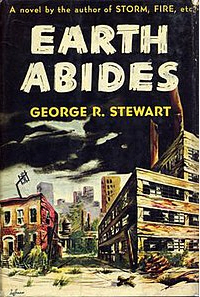
I remember the title of a long-ago novel called Earth Abides. Personally, I think the earth will last, though most of us may not be here to see it. It’s just easier to keep doing what we’re doing. That’s my  guess. As George Stewart wrote, “Men go and come, but earth abides.”

Let’s suppose we believe Earth is bigger than the problems we have wrought, does that justify continuing to destroy it? Or, is it easier to keep destroying it and let the end come when it will?

We should be smarter than that, allowing the world to go down hill into chaos, but I wonder if we are.

What do you think?

–Malcolm

Gallimaufry for the Seventh of May

  • Let’s get this out of the way first. No, I did not watch the coronation. I saw Elizabeth’s, first on news reels and later on television, and didn’t have the stamina to go through the pomp and circumstance again. My wife watched it at the far end of the house. She says it went well, though since Charles I and Charles II didn’t fare as well as some English monarchs, one might have thought today’s Charles would be supersitious about the same. Apparently not.

  • My wife continues to go to physical therapy once a week to “fix” the hand that was rendered crippled by a tech at her doctor’s office who hit a nerve while drawing blood. So far, we are paying for all this. I think the doctor’s office should be paying for all this. It appears she will need PT for some time unless there’s a miracle breakthrough. Meanwhile, her right hand isn’t vey efficient at anything.
  • According to Gretchen A. Peck, in an article for Editor & Publisher Magazine, “While … champions for local news have been hard at work, powerful forces have been running a counteroffensive — undermining the press, impeding access and making it easier for members of the public and political class to sue news organizations.” It’s one thing to say reporters’ rights are secure; it’s another to tell that to the a cop while he’s taking you into custody or otherwise impeding your work as a reporter. We need to reaffirm the necessity of a free press.

  • A digestive ailment has forced me to eat bananas (gag) and stop drinking coffee (yikes). By the way, plain yogurt really tastes bad.
  • Original Cast

    Every few years or so, we miss the TV shows from one network or another because the local affiliate is fighting with DISH network over money. This year, we’re missing ABC shows. That means no “Grey’s Anatomy” just as the main character more or less leaves the show.  Since we’ve been watching the show since it began in 2005, it feels like family members have been kidnapped now that we’re missing episodes. It seems like we need to sue somebody, but I guess we’d have to prove damages other than the angst of having the program missing from our weekly schedule.

  • On top of that, we missed this week’s episode of “Survivor” because the local station pre-empted it to cover a breaking news story. Sigh.

–Malcolm

‘The President’ by Miguel Ángel Asturias

“Neither Gabriel García Márquez nor Mario Vargas Llosa had yet been born when the Guatemalan Miguel Ángel Asturias began to write his first novel, El Señor Presidente, in December 1922. He labored on it for a decade while living in self-imposed exile in Paris, then returned home when the Great Depression left him strapped for money, only to find that his work was unpublishable because the dictator whose reign it portrayed had given way to an even more cruel and oppressive one. When he finally self-published the novel in Mexico in 1946, it was riddled with typographical errors, and a definitive edition did not appear until 1952.” – Larry Rohter in The Inventor of Magical Realism

From the Publisher

“Winner! Nobel Prize for Literature. Guatemalan diplomat and writer Miguel Angel Asturias (1899-1974) began this award-winning work while still a law student. It is a story of a ruthless dictator and his schemes to dispose of a political adversary in an unnamed Latin American country usually identified as Guatemala. The book has been acclaimed for portraying both a totalitarian government and its damaging psychological effects. Drawing from his experiences as a journalist writing under repressive conditions, Asturias employs such literary devices as satire to convey the government’s transgressions and surrealistic dream sequences to demonstrate the police state’s impact on the individual psyche. Asturias’s stance against all forms of injustice in Guatemala caused critics to view the author as a compassionate spokesperson for the oppressed. “My work,” Asturias promised when he accepted the Nobel Prize, “will continue to reflect the voice of the people, gathering their myths and popular beliefs and at the same time seeking to give birth to a universal consciousness of Latin American problems.”

Critics note that while living in Paris,  he was greatly influenced by the surrealists and that this led not only to the structure of his work but his influence over subsequent authors’ understanding of the role of indigenous cultures in “real life” and fiction as well as the value of mixing fantasy into an otherwise realistic work.

Wikipedia notes that, “Critics compare his fiction to that of Franz Kafka, James Joyce, and William Faulkner because of the stream-of-consciousness style he employed” while Nahum Megged writes that his protagonists are those who are in harmony with nature and the antagonists are those who are out of sync with the natural world.

I do believe that in spite of his Nobel Prize, he is often overlooked when the origins of magical realism are discussed.

–Malcolm

Malcolm R. Campbell’s novels are written in the magical realism and contemporary fantasy genres. You can find them listed here.