It takes a lot of moxie to rear children intelligently and lovingly

Since it’s an old word, let’s note that the online dictionary defines “moxie” as “force of character, determination, or nerve.” Parents have a covenant with their children to care for them properly. On the other hand, some parents are too busy, too bored, or too inept to care for their kids.

But there’s hope. A new product named “Moxie” is now on the market for parents who don’t have real moxie. Price tag: $799. Wikipedia says, “A social robot is an autonomous robot that interacts and communicates with humans or other autonomous physical agents by following social behaviors and rules attached to its role.”

Apparently, a lot of parents without moxie want Moxie because the product’s website is slow to load.is slow to load. Once there, they will learn that:

“Moxie is powered by SocialX®, Embodied’s breakthrough software platform that supports advanced conversation through:

  • Conversational AI
  • Body Language
  • Eye Contact
  • Emotion
  • Behavior Analytics
  • Premium Curated Content”

They will also learn that Moxie is “huggably soft,” you know like a parent would be if s/he were there. Moxie reaches life skills to kids from five to ten years of age, preparing their delicate psyches for the wonder years ahead. Moxie is purportedly their “bestie robot friend.”

USA Today approves: “Moxie is a robot companion on a mission to learn how to become a good friend to humans. Sent from the Global Robotics Laboratory, or G.R.L. for short, what Moxie needs is a real-life robot mentor, and the G.R.L. has chosen that mentor to be a child. Designed to engage with all kids needing to learn social, emotional, and life skills in the face of autismanxiety, depression, and more, Moxie and its mentor go on a series of missions that help them both to learn and grow.” I take issue with the notion that a robot will help with autism and anxiety.

 In fact, most of the product reviews are favorable. This surprises me because the entire concept is flawed–not in the construction of the robot but in the notion we want a robot rearing our children because the parents can’t be bothered with it.

Maybe those who buy Moxie are really looking for Mary Poppins. 

–Malcolm


If God told you the Earth would end tomorrow, what you you do today?

I’d do what I always do. Read books, spend time with my wife, and probably write a blog post about the number of people running around like chickens with their heads cut off. What would it serve, though, to do anything else than the things that have made one happy up to that point?

Since I’m combative, my response to God would “No it isn’t” unless I was drunk and might say “I hope you enjoy it.”

More and more scientists and philosophers are saying that the “reality” we see is an illusion and/or it’s a simulation. If so, the end of the Earth would be an illusion. I believe this. So, quite possibly I would see life and consensus reality the same way I always had. Those who don’t see the illusion aspect of life would probably believe they were caught between the pages of an apocalyptic novel like George R. Stewart’s Earth Abides or, worse yet, Cormac McCarthy’s The Road.

Either book–or a similar book–would be a learning experience because people would remain stuck within their pages until they realized (a) perception is reality, and (b) you create your own reality. If more people understood that now, we might avoid the wrath of climate change. We are already stuck, it seems, within the idea of climate change and, for the most part, don’t seem worried enough to do anything about it–or create a different reality.

Perhaps that’s too much responsibility to consider.

Malcolm

The cat in my novel “Conjure Woman’s Cat” sees reality in the way I’ve described it here. That’s why I have cats.

‘Nothing Like It in the World,’ by Stephen E. Ambrose

“While originally well received by the public at large, many reviews of the book by professional historians and other scholars, researchers, and experts in the field appearing in the weeks and months after its release were highly critical of the work as being poorly researched and edited as well as inadequately fact checked. Several longer form papers and commentaries were also produced by well-known experts on the history of the Pacific Railroad which documented in detail that the book was rife with factual errors, misquotes, contradictions, demonstrably misleading and/or inaccurate statements, and unsupported conclusions.” – Wikipedia

I first read this book when it came out in 2001. It was good reading and taught me a lot of things that only received cursory attention in high school and college history courses. Naturally, I was discouraged by the negative reviews the book received over time. Ambrose died in 2002, so her wasn’t around to defend himself. Nonetheless, I still think the book is worth a look because it presents the general story of the road that I doubt most college students graduating with a B.A. don’t know about. Most important are the facts that President Lincoln was the primary force behind a transcontinental railroad and that much of the surveying and other initial work began while the North was fighting a civil war.

From the Publisher

“In this New York Times bestseller, Stephen Ambrose brings to life the story of the building of the transcontinental railroad, from the men who financed it to the engineers and surveyors who risked their lives to the workers who signed on for the dangerous job.

“Nothing Like It in the World gives the account of an unprecedented feat of engineering, vision, and courage. It is the story of the men who built the transcontinental railroad—the investors who risked their businesses and money; the enlightened politicians who understood its importance; the engineers and surveyors who risked, and sometimes lost, their lives; and the Irish and Chinese immigrants, the defeated Confederate soldiers, and the other laborers who did the backbreaking and dangerous work on the tracks.

“The U.S. government pitted two companies—the Union Pacific and the Central Pacific Railroads—against each other in a race for funding, encouraging speed over caution. Locomotives, rails, and spikes were shipped from the East through Panama or around South America to the West or lugged across the country to the Plains. In Ambrose’s hands, this enterprise, with its huge expenditure of brainpower, muscle, and sweat, comes vibrantly to life.”

The Central Pacific Railroad started in Sacramento and was built towards the east. It merged with Union Pacific in 1996. At present, the primary class-one railroads which operate freight lines which are often used b Amtrak, are the Union Pacific (UP), Burlington Northern Santa Fe (BNSF), Canadian Pacific (BP) which recently acquired Kanas City Southern, Norfolk-Southern NS), and CSX Transportation.

That first railroad line, along with road operating in the North or South has become quite a sizeable rail network. Watching today’s tack crews add track or repair track gives one an appreciation of the manual work done on the CP by Chinese employees and the work done on the UP by Irish employees.

–Malcolm

Malcolm R. Campbell and his wife worked for a railway museum, restored old cars (including the one used by President Harding, and operated locomotives to move a large amount of rolling stock around the property  which grew from 12 acres to 30 acres while we were there.

‘American Prometheus’ – Remembering the book that inspired the movie

“Oppenheimer’s warnings were ignored—and ultimately, he was silenced. Like that rebellious Greek god Prometheus—who stole fire from Zeus and bestowed it upon humankind, Oppenheimer gave us atomic fire. But then, when he tried to control it, when he sought to make us aware of its terrible dangers, the powers-that-be, like Zeus, rose up in anger to punish him.” American Prometheus by Kai Bird and Martin J. Sherwin (2005)

Before the United States was done with Julius Robert Oppenheimer (April 22, 1904 – February 18, 1967), he was declared a security risk by the Eisenhower administration. You learn this on the first page of this definitive, Pulitzer-Prize-winning book about a mystic and theoretical physicist who was as complex as his Nobel-Prize-worthy work that was far flung from nuclear weapons.

From the Publisher

American Prometheus is the first full-scale biography of J. Robert Oppenheimer, “father of the atomic bomb,” the brilliant, charismatic physicist who led the effort to capture the awesome fire of the sun for his country in time of war. Immediately after Hiroshima, he became the most famous scientist of his generation–one of the iconic figures of the twentieth century, the embodiment of modern man confronting the consequences of scientific progress.

He was the author of a radical proposal to place international controls over atomic materials–an idea that is still relevant today. He opposed the development of the hydrogen bomb and criticized the Air Force’s plans to fight an infinitely dangerous nuclear war. In the now almost-forgotten hysteria of the early 1950s, his ideas were anathema to powerful advocates of a massive nuclear buildup, and, in response, Atomic Energy Commission chairman Lewis Strauss, Superbomb advocate Edward Teller and FBI director J. Edgar Hoover worked behind the scenes to have a hearing board find that Oppenheimer could not be trusted with America’s nuclear secrets.

American Prometheus sets forth Oppenheimer’s life and times in revealing and unprecedented detail. Exhaustively researched, it is based on thousands of records and letters gathered from archives in America and abroad, on massive FBI files and on close to a hundred interviews with Oppenheimer’s friends, relatives and colleagues.

We follow him from his earliest education at the turn of the twentieth century at New York City’s Ethical Culture School, through personal crises at Harvard and Cambridge universities. Then to Germany, where he studied quantum physics with the world’s most accomplished theorists; and to Berkeley, California, where he established, during the 1930s, the leading American school of theoretical physics, and where he became deeply involved with social justice causes and their advocates, many of whom were communists. Then to Los Alamos, New Mexico, where he transformed a bleak mesa into the world’s most potent nuclear weapons laboratory–and where he himself was transformed. And finally, to the Institute for Advanced Study in Princeton, which he directed from 1947 to 1966.

American Prometheus is a rich evocation of America at midcentury, a new and compelling portrait of a brilliant, ambitious, complex and flawed man profoundly connected to its major events–the Depression, World War II and the Cold War. It is at once biography and history, and essential to our understanding of our recent past–and of our choices for the future.

From Kirkus Reviews

That Oppenheimer (1904–67) was a rare genius is beyond doubt; his colleagues at CalTech, Göttingen and Los Alamos were impressed to the point of being cowed by his intellect, and “Oppie” was far ahead of even his professors in the new world of quantum theory. He was a rare bird in other ways as well. A child of privilege whose very luggage excited discussion among his cash-strapped European colleagues, he identified early with left-wing causes and was reportedly better read in the classics of Marxism than most Communist theoreticians; and, though a leftist, he expressed enough fondness for the U.S. that those European colleagues sometimes thought him a chauvinist. Worldly in many ways, he was something of a naïf. In time, he shed some of his clumsiness and became the model of a committed intellectual, unusually generous in sharing credit with students and colleagues and able to wear his achievements lightly. (“I can make it clearer,” he once remarked of a thorny physics problem, “but I can’t make it simpler.”) The authors lucidly explain Oppenheimer’s many scientific accomplishments and the finer points of quantum mechanics. More, they examine his life in a political context, for, though one of the fathers of the atomic bomb, Oppenheimer warned against its proliferation and noted, as early as 1946, that our major cities were now susceptible to terrorist attack, the only defense being a screwdriver—to open “each and every crate or suitcase.” His prescience and conscience cost him dearly: Oppie was effectively blacklisted for more than a decade and rehabilitated only at the end of his too-short life.

A swiftly moving narrative full of morality tales and juicy gossip. One of the best scientific biographies to appear in recent years.

If the Christopher Nolan feature film has captured your attention and interest in the father of the bomb and you want to know more, American Prometheus is a good starting point. As Wikipedia notes, “The film was released on the same day as Barbie, a fantasy comedy film directed by Greta Gerwig based on Mattel’s Barbie fashion dolls and media franchise, and distributed by Warner Bros. Due to the tonal and genre contrast between the two films, many social media users created memes about how the two films appealed to different audiences, and how they should be viewed as a double feature. The trend was dubbed ‘Barbenheimer’. In an interview with La Vanguardia, Cillian Murphy endorsed the phenomenon, saying ‘My advice would be for people to go see both, on the same day. If they are good films, then that’s cinema’s gain.'”

–Malcolm

Where were you October 3, 1992 when someone shouted, ‘Live from New York, it’s Saturday Night!’? 

Two days ago, a Time Magazine story headlined: “The Controversial Saturday Night Live Performance That Made Sinéad O’Connor an Icon.” I agree, it did , but that wasn’t the reaction at the time. Then, and probably up to the day she died, the reaction was pure hatred and scorn for her protest against the Catholic Church about a problem that had for years been obvious to everyone. Even her friends had nothing good to say about her on October 4th and afterwards.

She followed a long tradition of protest singers that went back to Pete Seeger, Joan Baez, Bob Dylan and almost everyone else who was singing during the Vietnam War years.

According to Time, “Speaking with the New York Times in 2021, O’Connor said she had no regrets, though the backlash was overwhelming. ‘I’m not sorry I did it. It was brilliant. But it was very traumatizing. It was open season on treating me like a crazy b-tch.'” 

Jeremy Smith, writing in Film said, “My memory is tainted by the ensuing smear campaign, a campaign that did not end until today, when Sinéad O’Connor died at the infuriatingly young age of 56 – and I’m probably a fool to believe this denigration will cease just because she’s not around to defend herself anymore. I’ve never seen a popular musician face such unremitting scorn. Not even close. But O’Connor — contrary to the narrative seared into our psyches by a media that could not bear her scorched-earth declaration that the Catholic Church is, charitable works be damned, a factory of institutionally abetted child abuse — never stopped speaking her truth. That continues to be our truth and our shame.”

Well said, and I hope that in time those who slandered her will one day see that she bravely spoke the truth, a truth that most people preferred not to mention.

–Malcolm


Thunder and Lightning Salad

Sara Bradley, who won the recent episode of  “Chopped” (a TV show competition on the food network) representing chefs from the south, served a Thunder and Lightning salad. This easy-to-make salad doesn’t have a Wikipedia entry, so I can’t show you a free-to-use photo. The judges liked it, and as they talked about it, I realized that it’s been years since I had it.

You can find recipes all over the Internet for it, most with variations from the original that, while fine for experimentation, aren’t the standard which includes several tomatoes, several cucumbers, one Bermuda onion, white vinegar (1/2 cup), and sugar (1/2 cup or a little less to taste).  I avoid recipes that include bell peppers since the pepper flavor permeates the whole shebang.  White wine, hot sauce, herbs, and Canola oil: forget it.

Traditionally, the vegetables are cut into large pieces. That is, the tomatoes are cut into wedges, and the cucumbers are peeled and cut into fat slices. The onions are sliced the way you would if you were putting them on a hamburger and cut in half. These are left large so people who don’t like raw onion can pick them out.

Mix up the vegetables and onion in a large bowl. Stir the vinegar and sugar together and then drizzle this over the salad and refrigerate overnight.

This salad goes well with minute steak, pork chops, and even barbecue–or whatever catches your fancy. I have no idea how Sara Bradley made this salad on “Chopped,” so I’ve tried to give you the most basic form. Some people swap Vidalia or other sweet onions for the Bermudas.

And, so sorry for the lack of a photo of the salad.

–Malcolm

ADDITIONAL PARENTS JOIN LAWSUIT AGAINST BOOK BANS IN FLORIDA’S ESCAMBIA COUNTY

FOR IMMEDIATE RELEASE – PEN.ORG

(PENSACOLA, FL)— Five additional parents today joined a first-of-its-kind federal lawsuit filed earlier this spring challenging the removals and restrictions of books from libraries in a Florida school district that violate their rights to free speech and equal protection under the law.

The amended suit, led by the free expression organization PEN America, Penguin Random House and a diverse group of authors and parents of Escambia County students, seeks to ensure access to books on a wide range of topics with a wide range of viewpoints. The plaintiffs are represented by Ballard Spahr LLP and Protect Democracy, a non-partisan, pro-democracy group. Read the amended complaint, filed today, here.
This brings the number of parent plaintiffs in the case to seven, with 10 children from diverse backgrounds in elementary, middle and high school. The suit was filed originally on May 17 against the Escambia County School Board asking for books to be returned to school library shelves where they belong. After the complaint was filed, the plaintiffs were granted time to amend it with additional plaintiffs.

“As a Black mother of two teenage girls, I know how important it is for our children to have access to books like The Freedom Writers Diary and Beloved,” said Carin Smith, a parent who joined  the lawsuit. “I respect the right of parents to make decisions with and for their own children. In my opinion, we should not shy away from the real, raw struggles this country has faced, and my girls shouldn’t be deprived access to books on those issues because our stories make someone else uncomfortable.”

Benjamin Glass, another parent joining the suit, noted, “Someone with a master’s degree in library science, also known as a librarian, should be deciding what’s in libraries – not politicians. Parents, of course, should be involved in what is in their own child’s best interest to read. But they shouldn’t be making decisions on behalf of other people’s children. You parent your child, I’ll parent mine, and we’ll let librarians do their jobs. That sounds good to me.”

Since the lawsuit was filed in May, the Escambia School District has continued its policies of removing books from school libraries. In that time an additional 21 book titles have been challenged and 17 have been restricted, including Pulitzer Prize winning Middlesex by Jeffrey Eugenides, the landmark graphic novel Watchmen by Alan Moore, and the horror novel It by Stephen King.

“School officials shouldn’t use their authority to force their own ideological convictions on students,” said Suzanne Nossel, CEO of PEN America. “The new plaintiffs have kids in middle and high schools, going through a pivotal time of learning, exploration and intellectual development. We should not be sending them the message that books are dangerous. By defending their freedom to read, we will ensure that schools remain places where students are exposed to complex ideas and stories instead of being taught that society does not trust them enough to allow them to pick up a book.”

The authors involved in the suit, all of whom have either already had their books removed by the district and/or restricted from student access, include author and children’s book illustrator Sarah Brannen, young adult fiction authors David Levithan, George M. Johnson and Ashley Hope Pérez, and children’s book author Kyle Lukoff, all of whom have published works focusing on identities that are historically underrepresented in school libraries.

Lynn Oberlander, counsel at Ballard Spahr LLP, noted, “In removing and restricting access to over 150 books from the libraries on the basis that they expressed disfavored viewpoints, the school board in Escambia County violated the constitutional rights of students, parents, authors and publishers. We are pursuing this case to vindicate those rights, and to stop agents of government from limiting access to ideas and perspectives with which it disagrees in our nation’s schools.”

“The school board is removing books from the school library based on the political views of a small minority,” said Shalini Agarwal, counsel for Protect Democracy. “In removing and restricting the books, the school board is overriding the recommendations of district review committees designed to evaluate books with parent and community feedback. This isn’t simply an affront to parents, it’s a violation of the First Amendment and Equal Protection Clause.”

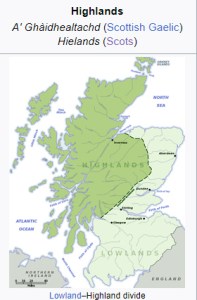
Stories set in Scotland’s Highlands have been popular for years even though the characters don’t sound like Highlanders

Since my ancestry goes back to the Scottish Highlands, I usually notice how the characters’ language is portrayed in novels. Going back in time, Highlanders spoke Scots Gaelic (Gàidhlig). Or, they spoke Highland English. Sad to say, Gàidhlig has fewer and fewer native speakers every year, though I do hear of attempts to keep the language alive, one say being–as Wikipedia describes it–“Gaelic-medium education (G.M.E. or GMEScottish GaelicFoghlam tro Mheadhan na Gàidhlig, FTMG) is a form of education in Scotland that allows pupils to be taught primarily through the medium of Scottish Gaelic, with English being taught as the secondary language.”

The Scots that most Americans believe is Scots is lowland Scots or Lallans. So it is that novelists writing about the era of Scotland’s clans use words based on Lallans. To my ear, this is as absurd as representing all Americans by the English spoken in Georgia even though the characters in the novel live in, say–Maine. Think of your favorite novel set in one of the New England states with the characters speaking with a strong Southern Dialect.

That sounds wrong because it is wrong. That’s the reaction I have to American novelists featuring Highlander characters speaking lowland Scots. A little research would tell the author how absurd this is. What Highlanders spoke can be found quickly on Wikipedia: “Highland English (Scots: Hieland Inglis) is the variety of Scottish English spoken by many in the Scottish Highlands and the Hebrides. It is more strongly influenced by Gaelic than other forms of Scottish English.”

I suppose one can say that American authors are more accustomed to the words derived from Lallans or Broad Scots, so they believe using the words that Highlanders really spoke will sound wrong to their readers if they used Highland English.

A note at the beginning of the novel would clarify why the novel’s characters from the Highlands don’t sound like Robert Burns’ poetry.

Malcolm

Eddie Muller’s ‘Noir Bar: Cocktails Inspired by the World of Film Noir’

Eddie Muller  (Dark City: The Lost World of Film Noir) is, perhaps, the reigning noir expert and champion, and he’s now writing about the booze people drank in the shadows. Those of you who watch Turner Classic Movies know him as the host of “Noir Alley,” the network’s weekly presentation of noir films which, I’m happy to say, will probably continue now that Hollywood has rallied behind TCM (which the parent company was thinking about sending to the chopping block) as a valuable curator and presenter of classic cinema.

From the Publisher

Eddie Muller—host of TCM’s Noir Alley, one of the world’s leading authorities on film noir, and cocktail connoisseur—takes film buffs and drinks enthusiasts alike on a spirited tour through the “dark city” of film noir in this stylish book packed with equal parts great cocktail recipes and noir lore.
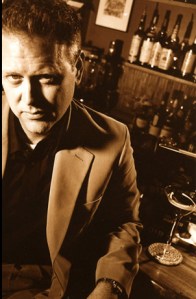

“Eddie Muller’s Noir Bar pairs carefully curated classic cocktails and modern noir-inspired libations with behind-the-scenes anecdotes and insights on 50 film noir favorites. Some of the cocktails are drawn directly from the films: If you’ve seen In a Lonely Place and wondered what’s in a “Horse’s Neck”—now you’ll know. If you’re watching Pickup on South Street you’ll find out what its director, Sam Fuller, actually drank off-screen. Didn’t know that Nightmare Alley’s Joan Blondell inspired a cocktail? It may become a new favorite. Meanwhile, Rita Hayworth is toasted with a “Sailor Beware,” an original concoction which, like the film that inspired it (The Lady From Shanghai), is unique, complex, and packs a wallop.

​”Featuring dozens of movie stills, poster art, behind-the-scenes imagery, and stunning cocktail photography, Noir Bar is both a stylish and exciting excursion through classic cinema’s most popular genre.”

Sample Recipe

CORPSE REVIVER NO. 2 INSPIRED BY 1946’S DECOY

“A Corpse Reviver is the obvious choice to accompany this film. There are many derivations of this cocktail, so-called because it was purported to be a foolproof hangover cure. My preference is the No. 2, popularized by Harry Craddock at the Savoy Hotel. The original called for Kina Lillet, which is no longer available. I use Cocchi Americano. If you want to be cheeky, substitute Blue Curaçao for the Cointreau and call it a Methylene Blue.

“NICK AND NORA GLASS, chilled

SHAKER, strained

1 ounce gin

¾ ounce Cointreau

¾ ounce Cocchi Americano

½ ounce lemon juice

Absinthe rinse (or Pernod)

Garnish lemon peel twist”

This is a tasty cocktail. I ordered one in an Alexandria Restaurant because I liked the name. It was very good! Go with the absinthe version if you can. If you like booze, dark movies, and dark drinks (as I do) this book’s for you.

–Malcolm

Malcolm R. Campbell normally drinks Scotch or red wine while writing. These cocktails are tempting, but setting up a bar with all the ingredients costs a lot of dough.

Committee to Protect Journalists recognizes distinguished media advocates

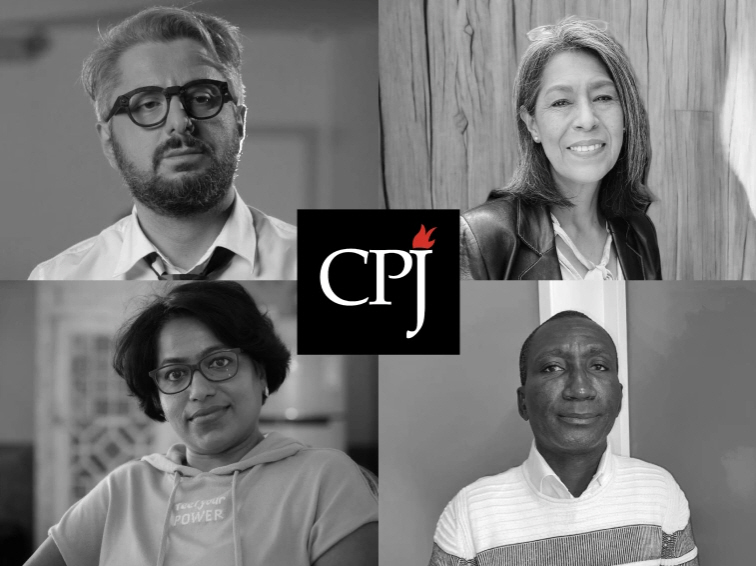
New York, June 29, 2023—The Committee to Protect Journalists will celebrate four extraordinary journalists from Georgia, India, Mexico, and Togo with its 2023 International Press Freedom Awards.

In the face of a stark decline in press freedom worldwide, this year’s awardees have continued to report the news amid government crackdowns, kidnapping, exile, and the rising criminalization of their work, championing the importance of independent reporting at this critical juncture.

“Attacks on the press are rising, yet journalists continue to step up and report on the vital issues that empower us all,” said CPJ President Jodie Ginsberg. “It is our honor to recognize this year’s awardees: formidable reporters working tirelessly to expose corruption, abuse, and wrongdoing despite considerable efforts to silence them.”

CPJ will also honor Alberto Ibargüen, president of the John S. and James L. Knight Foundation with the 2023 Gwen Ifill Press Freedom Award, an award presented annually by CPJ’s board of directors in recognition of an individual’s extraordinary and sustained commitment to press freedom.

CPJ’s 2023 awardees are:

Ferdinand Ayité (Togo):

Ayité leads L’Alternative, one of Togo’s top investigative outlets, known for its fearless coverage of alleged corruption and protests against the rule of President Faure Gnassingbé. Facing persistent legal harassment and threats, Ayité and L’Alternative editor-in-chief Isidore Kouwonou fled Togo in March 2023, days before they were sentenced to three years in prison on charges of insulting authorities and false news. Ayité is a member of the Organized Crime and Corruption Reporting Project and collaborated on the Panama Papers investigation in 2016, focusing on tax avoidance schemes by Indian companies based in Togo. His phone number also appeared on the Pegasus Project’s list of journalists allegedly selected for potential spyware surveillance.

Shahina K.K. (India):

A senior editor for Outlook magazine, Shahina is a veteran Indian journalist, covering gender, human rights, and marginalized communities. She was one of the country’s first journalists to be charged under a draconian anti-terror law weaponized against journalists in the country for over a decade. Shahina has continued her reporting, despite awaiting trial for a case opened in 2010, when local government officials sought to criminalize her reporting on a questionable police investigation. As of June 2023, Shahina is on bail pending trial, where she faces a maximum of three years in prison and a fine if convicted. A Muslim by birth, Shahina has been subjected to extensive harassment by Indian right-wing groups seeking to silence her reporting on religious minorities and vulnerable caste groups.

Nika Gvaramia (Georgia):

Gvaramia is the founder and director of independent broadcaster, Mtavari Arkhi (Main Channel), founded in 2019. Gvaramia, who has worked in journalism since 2012, previously held government positions and served on the legal team representing opposition leader and former President Mikheil Saakashvili. As a TV presenter, Gvaramia was known for exposing alleged government corruption and abuses. He served more than a year of a 3.5-year sentence for alleged abuse of office—charges that were widely denounced as politically motivated—before receiving a presidential pardon in June 2023. Gvaramia is the only journalist in Georgia to receive a prison sentence in retaliation for their work since CPJ started keeping records of jailed journalists in 1992.

María Teresa Montaño (Mexico):

Montaño is a prominent investigative reporter and founder and editor of The Observer, an investigative outlet. Her journalism features investigations of corruption, transparency, gender violence, and accountability. Her reporting has led to threats, surveillance, and harassment from state and local authorities. In 2021, in retaliation for her reporting, she was abducted by three men who held her at gunpoint and stole her files on a corruption investigation involving state officials. The kidnappers, whose identities are still unknown, threatened to kill her if she reported the crime. After leaving Mexico for a short period following her abduction, Montaño has since resumed reporting in the country, despite the increasingly dangerous environment for journalists.

Now in its 33rd year, CPJ’s annual International Press Freedom Awards and benefit dinner honor courageous journalists from around the world. The event, to be held on November 16, 2023, in New York City, will be chaired by Meredith Kopit Levien, president and CEO of The New York Times Company.

For more information on attending or sponsoring CPJ’s International Press Freedom Awards, please call Buckley Hall Events at (+1) 914-579-1000 or CPJ’s Development Office at (+1) 212- 300-9021, or email CPJIPFA@buckleyhallevents.com.