Review: ‘The Girl Who Played with Fire’

The late Stieg Larsson (1954 – 2004) left a legacy that includes the Millennium Trilogy of novels, a dispute between his life partner of 30 years and his family over the estate, and an unfinished forth book that would continue the story he began in The Girl with the Dragon Tattoo and ended with The Girl Who Kicked the Hornet’s Nest.

As the second book in the trilogy, The Girl Who Played with Fire, is as absorbing as The Girl with the Dragon Tattoo. Once again, the primary characters are the crusading magazine journalist Mikael Blomkvist and the illusive goth super computer hacker Lisbeth Salander. Blomkvist and Salander are both complex, three-dimensional characters, the former, no doubt, inspired by Larsson’s career focus as a journalist. Salander is less goth than she was in “tattoo” and her background and motivations are more fleshed out.

Cast of Characters and Plot

Readers will know from the back cover blurb that Millennium Magazine’s investigative journalism in this book focuses on sex trafficking, that two people are killed before the material is published and that Salander is a suspect.

Once matters played out in The Girl with the Dragon Tattoo, Salander went on vacation. Unfortunately, this initial section of the book appears to have little to do with the plot. Salander’s development as a person gains strength during this vacation section. She does get involved in a harrowing experience. Yet, these events do not come into play later in the novel.

Except for other supporting characters whom readers met in “Tattoo,” most of the characters have few shades of grey. To some extent, they are stereotypes of the roles they play: liberal and conflicted journalists, sadistic had guys with a brutal and horrific way to life, and police with a dutiful approach but very little imagination.

Writing Style and Approach

Larsson tells his story from the viewpoint of multiple characters. This works more often than not in “Fire” because the reader sees what everyone is doing and what conflicts between them are upcoming. The approach works less well in cases where the point of view shifts to a character who, in real life, would think certain things, yet Larsson conveniently focuses their attention on something else.

One question on the reader’s mind, for example, is likely to be: “Are the police right about Salander and the murders?” Larsson goes into a “listmania” amount of detail about almost every part of the magazine work and police work, including the characters’ thoughts. Yet after the murders occur, he does not allow Salander to think either “I hope they don’t find out I did it” or “why the hell do they think I did it?” Such thoughts would go through most people’s minds. The tension is ramped up through the fact Salander does not ponder this, but it is an artificial device.

The surprising thing about the Millennium Trilogy phenomenon is that the books are popular (35 million copies sold as of last summer) in spite of their length. While some readers complain that they “just couldn’t get into “Tattoo,” the books sell well and generate a large number of reader reviews on Amazon and commentary on blogs and news stories.

The exceptional level of detail contributes to the length (“Fire” in paperback has 724 pages) and—at its best—immerses the reader into the the worlds of both the predators and prey in the book. The reader is brought “close in” to the action. At its worst, the detail wastes time, especially when it focuses on things (such as Salander spending a day shopping for furniture for her apartment) that do not advance the plot.

On Balance

On balance, the book succeeds. Its high points are the author’s development of Lisbeth Salander, the intricacies of its plot, and the author’s use of mini-cliffhanger plot points when he shifts the story’s view point from one character to another. The Guardian’s comment that Salander is a Laura Croft for grown-ups is certainly apt.

The ending of the book is satisfactory in terms of emotional justice for characters and readers. However—like other scenes in the book—it relies a bit too much on contrived coincidences. Nothing is totally resolved, though we can forgive the author that because at this point, since there’s still another book to come.

The Controversy Surrounding the Estate

Larsson died without a will. According to Swedish law, his life partner of 30 years does not have the rights of a spouse. Consequently, Larsson’s assets, including control of the books, passes to his brother and father rather than to Eva Gabrielsson.

Gabrielsson contends that the brother and father were virtually estranged from Larsson and herself and that she helped plan the Millennium series from the beginning. On the Support Eva web site, she also claims that “she was there when he received death threats from ultra-nationalist groups” and was an integral part of everything that the rest of the family had nothing to do with. Larsson’s own experience clearly was a major factor in the creation of the Blomkvist character and the other investigative journalists and she says she was part of it.

The brother contends in press releases, some of which you can find on the Stieg Larsson web site, that the family has been more than fair, that it has returned to Gabrielsson many assets she held in common with Larsson, and that they are willing to work with her in creating additional books. They contend that had Larsson wanted her to have total control of the estate, he would have married her and/or created a will.

Fuel will be added to this fire when Gabrielsson’s new book Stieg & Moi becomes available in Europe next week. Meanwhile, Gabrielsson will work on another Millennium Book. See “Stieg Larsson’s partner plans to complete final Millennium novel.” See also “Stieg Larsson feud hots up with partner’s memoir.”

Some commentators have said that the controversy surrounding the estate has the same flavor of the novels itself: that is, it’s about men who hate women. While that characterization’s accuracy depends on the “side” one takes in the dispute, it adds another level of detail and drama to an appealing series of books.

–Malcolm R. Campbell

Malcolm R. Campbell is the author of three novels, including the 2010 “Garden of Heaven: an Odyssey” about a man suspended between heaven and hell in a world where one place is often mistaken for the other.

Review: ‘The Templar Salvation’

The Templar SalvationThe Templar Salvation by Raymond Khoury
My rating: 4 of 5 stars

Raymond Khoury’s The Templar Salvation (2010) sequel to The Last Templar (2006) is better than the original. Like the original, The Templar Salvation presents a story of lost/hidden church secrets with dual time lines, a lot of historical detail, and plenty of action.

In the present day, Khoury brings back FBI agent Sean Reilly and archeologist Tess Chaykin in a race with terrorist Mansoor Zahed to find a cache of early Christian documents. In 1203, while the Fourth Crusade siege of Constantinople is in progress, a small band of Templars sets out to rescue and then hide the same set of documents. In both time lines, the Catholic church doesn’t want the documents to come to light.

The Last Templar featured an amazing opening scene. The Templar Salvation’s opening, while slightly less spectacular is action-oriented and inventive. Tess is in danger. Sean rushes to the rescue and, in spite of the law enforcement resources available in Turkey and at the Vatican, becomes the point man in a search for Tess, Mansoor, the documents, and a variety of people who end up dead.

The Templar Salvation is more tightly woven than The Last Templar. It also contains fewer “talky scenes” where Tess and/or Sean explain elements of the 1203 story to present day police officers as though 800-year-old information trumps current evidence or the need to get out of the squad room with some sense of urgency. The Templar Salvation might be called “The Book That Will Not End.” Tess, Sean and Mansoor find themselves within nanoseconds of being killed (or worse) numerous times throughout the story only to escape/survive and keep on searching, fighting or running.

Nonetheless, the improbable story somehow makes for more exciting reading than The Last Templar. The Templar Salvation is a violent, tangled, twisted, groaner kind of escapist read that features the kind of over-the-top, don’t-worry-about-civilian-deaths-and-collateral-damage law enforcement that viewers of the TV series “24” tuned in every week to see.

Like agent Jack Bauer in “24,” Sean Reilly is as relentless as a Terminator in his quest for neutralizing the bad guys and possibly obtaining justice. And, like Jack, Sean keeps going, going and going even though his wounds would have killed ten normal men.

The book is a guilty pleasure.

View all my reviews

Malcolm R. Campbell is the author of “Jock Stewart and the Missing Sea of Fire,” “Garden of Heaven: an Odyssey,” and “The Sun Singer.”

Review: ‘Labyrinth’ by Kate Mosse

Labyrinth (Languedoc Trilogy, #1)Labyrinth by Kate Mosse
My rating: 4 of 5 stars

Kate Mosse’s engaging and well-researched novel Labyrinth (2006) brings readers another version of the Holy Grail and those who would protect it, seek it, destroy it and use it. Labyrinth joins Khoury’s The Last Templar (2006) and The Templar Salvation (2010) and Neville’s The Eight (1997) and The Fire (2008) in its presentation of a religious secrets story that switches back and forth between time periods and characters.

Set in thirteenth-century Languedoc and twenty-first century southern France, Labyrinth presents readers with medieval and modern characters who are searching for the Grail with good and bad motives. Alaïs du Mas, the daughter of the steward of historical character Raymond-Roger Trencavel in Carcassona, resides in a world where Cathars and Catholics live in harmony with each other. Alice Tanner, a professor of English literature in Sussex, is a volunteer in an archeological dig in the Sabarthès mountains in France in 2005.

The lives of these dual protagonists—and the characters around them—become intertwined across history when Alice inadvertently discovers some of the Grail secrets Alaïs dedicated her life to protect. Alaïs’ world is under attack by a Crusade and subsequent inquisition ordered by Pope Innocent III in 1208 against the Cathars who were viewed by Rome as a heretical sect. Alice’s world is that of a modern police investigation into deaths and thefts linking a mainstream archeological dig with a shadowy world of those who follow or oppose the Grail.

The mirror aspects of the characters’ lives across the centuries serves Mosse and her plot well. Unlike Dan Brown, who viewed the Grail as Mary Magdalene and Arthurian literature that viewed the Grail as a sacred chalice, Mosse presents instead the secret artifacts which are intended to lead true seekers through both a real and a figurative labyrinth to the Grail as a transcendent experience.

With the exception of a slow beginning and a few sections where the detail in both the modern and medieval worlds becomes more history and travelogue than a novel, Labyrinth is a well-told story. The novel’s discussion guide notes that the book begins with short glimpses of the leading characters without any narrative to tie them together or explain their motives, and then asks “what effect does this have on you, as a reader?” It’s a good question. Some readers will find it slow and unnecessarily obscuring of the story, while others will find that it heightens the intrigue and suspense.

For readers who want to know more about the life and times of the Cathars, Mosse includes a historical note, a selected bibliography, information about the langue d’Oc spoken in Alaïs’ world as well as a glossary of Occitan words.

View all my reviews

Copyright (c) 2011 by Malcolm R. Campbell, author of two hero’s journey novels,The Sun Singer and Garden of Heaven.

Book Review: ‘Song of the Twice Born’

Song of the Twice Born: Book 1 The Mirror of SirrusSong of the Twice Born: Book 1 The Mirror of Sirrus by Seth Mullins
My rating: 5 of 5 stars

Seth Mullins has followed his mythic quest novel “Song of an Untamed Land” (2005) with “Song of the Twice Born – Book I: The Mirror of Sirrus.” Set in a mythical land reminiscent of America’s wild west during the age of discovery, this first installment of an epic fantasy trilogy tells the individual stories of a small group of characters who live in a veritable oasis of calm in a world of warring peoples.

This ambitious novel shows what happens to individuals living within perilous times when they are confronted with the more perilous truths about themselves. A dwarf named Sirrus has introduced a magic mirror into the temporary serenity of Aspen Meadows. When an individual gazes into the mirror, s/he sees an unflinchingly accurate portrayal of his or her bedrock truths and goals. In as much as truths are quite startling, if not potentially debilitating, Sirrus provides commentary and spiritual advice.

Since Sirrus’ advice to Eden, Galya, Marek, Brieran, Ejol, Jin and Enofor (whom we met in “Song of and Untamed Land”) is often more blunt than comforting, he asks each of them to spend time contemplating the revelations by recording his or her spiritual experiences in a journal. Like any journal, each entry records the spiritual and psychological truths unearthed via the mirror within the context of memories and day-today life and struggles. Each character must not only come to terms with past triumphs and losses, but with the seeming inevitability of death or capture when either the Assymyan or Churan army overruns their sanctuary.

Mullins paints landscapes, cultures, peoples and spirituality on a wide canvas that may remind readers of such classics as Stephen R. Donaldson’s “The Chronicles of Thomas Covenant” and J. R. R. Tolkien’s “Lord of the Rings.” The epic scope of this story is made human and vibrant by the very personal journal entries of each character. In less capable hands, “Song of the Twice Born” might have become a collection of indirectly related character studies or short stories. Instead, the character’s points of view link together well into a very real and readable transcendent adventure.

View all my reviews

–Malcolm R. Campbell is the author of the hero’s quest novels, “The Sun Singer” and “Garden of Heaven: an Odyssey.”

Book Review: ‘The Miracle of Mercy Land’

The Miracle of Mercy Land: A NovelThe Miracle of Mercy Land: A Novel by River Jordan
My rating: 5 of 5 stars

This wise, well-told 1930s-era story about a young woman from the back woods of Bittersweet Creek, Alabama, who moves to a nearby city to work for the newspaper will haunt the jaded cloak off a cynic and the bloom off a Southern Magnolia in the arena of pure beauty.

A preacher’s daughter, protagonist Mercy Land is steeped in the spiritual and plain-spoken common sense of the rural South. She carries her heritage deep in her humble soul when she begins work for Doc on the Bay City “Banner.” While Doc is the epitome of a caring, community oriented small town newspaper editor, his kindness contains sad flaws.

The focal point of the novel is a shining book of light that appears out of nowhere on Doc’s desk. The book knows everything, roads taken and roads not taken, about the residents of Bay City. It contains secrets only an arrogant individual would dare to know. But then, why did it appear? To read or not to read is the bittersweet question that follows Doc and Mercy with more urgency than the daily news.

Like any good editor, Doc finds it difficult to sit on the story of a lifetime. Like any young woman who fondly recalls her formative years, Mercy cannot ignore what the book knows about a childhood companion who vanished without a trace years ago.

From Mercy’s point of view, “To say that it became a distraction would be a flat-out lie. It became an obsession. Doc swore me to complete secrecy so that no one in town knew a thing. But that wasn’t the toughest part; he swore me to keep the secret from everyone in Bittersweet Creek.”

As Jordan writes in a note to the reader at the end of the book, this is a story about choices and their impact on a person’s interconnected relationships. The novel’s fine-spun wisdom, mysterious and engaging plot and shimmering magical realism are the stuff of dreams and wondrous storytelling.

View all my reviews

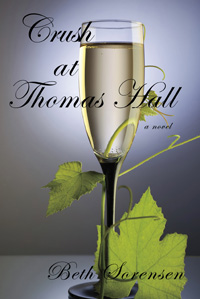
Book Review: ‘Crush at Thomas Hall’

When Cassandra Martin attends Crush Weekend at Virginia’s Thomas Hall Winery with her good friends Sarah and Michael, she experiences the multiple meanings of the word “crush” in Beth Sorensen’s soon-to-be-released romantic mystery Crush at Thomas Hall.

In wine making, the crush–often called a grape stomp when it’s done with bare feet–gently splits the skins of the recently harvested grapes allowing the juice to escape. Thomas Hall’s annual Crush Weekend is a festive event in which long-time friends of the powerful Baker family gather to help with the harvest, taste the wine and enjoy each others company.

Cassandra quickly develops a crush on winery CEO and confirmed bachelor Edward Baker. The feeling is mutual. Yet, she has recently buried an abusive and controlling husband, and Edward–for all his gentle intentions–is used to being in charge. His behavior is not only emotionally crushing, but reminds her of the worst moments of her marriage.

A college professor on sabbatical to rediscover her life, Cassandra is a highly intelligent protagonist, eager to soak up not only the ambiance but the art and science of wine making. Yet, in personal matters, she is indecisive, vacillating between losing herself in Edward’s arms and running away to a safe place where she can avoid the danger of emotional commitments.

Complicating her evolving romance is talk of millions of dollars of funds embezzled from the winery, a dead body in the wine cellar, and an attack that sends Cassandra to the hospital. Beth Sorensen has spun a compelling mystery of champagne dreams and family intrigues in Crush at Thomas Hall. Sorensen’s protagonist must decide whether to continue her round-the-world travels or seriously consider whether she should make a commitment to Edward and his winery. No matter that she decides, she’s in jeopardy, for there is every indication that the killer wants her stomped dead and out of the complicated picture.

Crush at Thomas Hall is an exciting, romantic and highly recommended fine-vintage debut novel.

Malcolm R. Campbell is the author of “The Sun Singer,” “Jock Stewart and the Missing Sea of Fire,” and “Garden of Heaven.”

Review: John Atkinson’s ‘Timekeeper II’

Timekeeper IITimekeeper II by John Atkinson
My rating: 5 of 5 stars

In John Atkinson’s 2008 novel Timekeeper, Johnnyboy leaves his dysfunctional Virginia home at fourteen after his father “Bugdaddy” beat him again. In Oklahoma, Chief calls him “Timekeeper” and sends him on a vision quest to find himself. He does, but he is not yet whole.

At the beginning of Timekeeper II, scheduled for a September 21, 2010 release from il Piccolo editions, Atkinson writes, “I went to the Sacred Mountain in the flesh, but didn’t see it clearly until I returned in a ghost world dream.” Timekeeper II isn’t a clock-time, linear novel. It’s a dreamtime novel where all the dualities that haunted Johnnyboy must be brought into harmony in order for Timekeeper to face the world and himself as a fully integrated person.

The dualities arise in Timekeeper’s mind like opposing armies: a humiliated, illiterate man in a world where the ability to read is not only mandatory, but presumed; a man of mixed white and Native American parentage who is unaccepted and foreign in both worlds; a seeker on the path who left home to find himself while leaving his mother and first spiritual teacher Morning Song behind to face the wrath of an abusive father who once said, “Don’t turn Indian on me, boy! I’ll kill you dead in your tracks.”

Timekeeper II is a rare treat, a window that opens and re-opens into a dreamer’s world where events and personages from the world of form and the world of spirit mix and interact and sometimes contradict each other. Neither Chief nor the illusive and powerful Round Woman will give Timekeeper clear and definitive self-help lessons. Instead, he must take on the role of a shaman and enter the ghost world and find spirits who will help him heal himself.

Once again, John Atkinson has conjured up a gritty, highly original story where reality itself turns in upon itself and carries both his protagonist and his readers through the fires of transformation into a world where all conflicts disappear. Timekeeper II is highly recommended for all adventurous readers.

View all my reviews >>

Malcolm R. Campbell is the author of “Garden of Heaven,” “The Sun Singer” and “Jock Stewart and the Missing Sea of Fire.”

Why I review the books I review

Truth be told, if my name were James Patterson and/or if I worked for the New York Times, a fair number of readers might be waiting to see what I (or my newspaper) had to say about “The Girl Who Kicked the Hornet’s Nest” or “Frankenstein: Lost Souls.”

But I’m not and I don’t.

I’ll probably read “The Girl Who Kicked the Hornet’s Nest” because I enjoyed the late Stieg Larsson’s “The Girl with the Dragon Tattoo.” I probably won’t review it, though, because by the time I get around to reading it adding one more review to a slough of them on Amazon or GoodReads just isn’t going to matter.

More importantly, though, is the fact that Stieg Larsson’s books don’t need any help, nor do they need any cautionary words or warnings. But small-press and self-published authors do need publicity, so I’m going to focus on novels from those sources when I find books I like.

I have no delusions of grandeur about this. My review isn’t going to catapult an unknown author onto the New York Times bestseller list. The book world runs on publicity. The trouble is, those who don’t need it keep getting more of it. Those who do need it get very little of it because they’re not already famous.

This is one of those paradoxes that drives authors nuts. “Why,” they ask, “is there a million dollar marketing budget for a book that’s going to become a bestseller with no marketing at all?” And, “Why are a hundred reviewers lining up to review the last James Patterson book when, really, everything that could be said about it has already been said?”

Mob instinct, I would say.

I would much rather offer my humble opinion about a book you might not hear about at all unless you chance upon my blog review or my GoodReads review. Perhaps you will find a title you like and you’ll buy a copy. After you read it, you might tell your friends about it.

The authors of the books I review may have worked for a year or two writing their books. In some cases, they struggled with their manuscripts off and on for decades. I think they deserve a chance to be read. That’s why I review them.

Malcolm

Book Review: ‘An Echo in the Bone’

An Echo in the Bone (Outlander, #7) An Echo in the Bone by Diana Gabaldon

My rating: 5 of 5 stars
Like many fans of the “Outlander” series, I “met” author Diana Gabaldon on an online literary forum in the days of yore when CompuServe was the Internet service provider. At the time, Diana was posting what she referred to as “chunks” of her work-in-progress and garnering very enthusiastic comments and a fair amount of interesting discussion. The excerpts were so fluid and natural, I fair thought we might all end up speaking either Highland English or Gàidhlig before the manuscript was complete. In 1991, the writing chunks became “Outlander.”

In the years that followed, we traveled with Sassenach (English people and Lowlanders) Claire Beauchamp Randall through multiple countries in time lines beginning in 1945 and 1743. In 1945, she’s married to Frank Randall. In 1743, she’s in love with Highlander James Fraser.

As “Outlander” led to a sequel and then another sequel, I thought it rather presumptuous to review any of the installments of a series (heading toward 17 million copies sold in 21 languages and 24 countries) written by the very gracious mentor for the writers on the CompuServe Literary (now Books & Authors) Forum.

But 19 years and seven books have passed since I read the opening line “It wasn’t a very likely place for disappearances, at least not at first glance” as former combat nurse Claire Randall surveyed a 1945 Inverness bed and breakfast with “fading floral wallpaper” where she was celebrating a second honeymoon with Frank. Surely Diana would say “dinna fash” if I told her I was mustering up the grit to say a wee word or two.

Were I to distill this wordy review down to basics and say only a wee word or two, it would be this. “An Echo in the Bone” is the best book in the series since the first one.

Some readers have criticized the novel’s episodic presentation and multiple story lines. On the contrary, I view this approach as one of the novel’s many strengths, others being the evolving characterizations of individuals series readers have known for years, the exceptional detail and historical accuracy, and the author’s clear focus on the tension, danger and humor that make a darned fine story.

With “An Echo in the Bone,” we have regained the tension and tight plotting that we lost to come extent in “The Fiery Cross” and and “A Breath of Snow and Ashes” which spent too much time with everyday affairs at the expense of the stories’ primary thrusts. Well after “Outlander,” it was almost as though the uniqueness of a modern and highly skilled medical practitioner living two centuries before her own time was being asked to carry too much of the books’ weight.

“An Echo in the Bone,” however, is exceptionally strong. Multiple characters grow in multiple times and places, and the episodic approach strengthens the drama of the strong doses of harm’s way in each lifeline we’re following. Drama is not contained by linear time, a fact Diana has proven many times over, and this time out, she has honed her writer’s scalpel to a fine edge indeed.

The use Fort Ticonderoga and the September and October 1777 Battles of Saratoga as a major focal point anchors the novel in historic time and provides a memorable counterpane for compelling action sequences and character development without losing the series hallmark (often earthy and humorous) interactions between a feisty Sassenach and a volatile Highlander.

No one need try to read “An Echo in the Bone” as a standalone novel, for the characters have too much history for that and there’s no way to catch up with it short of, say, adding some distracting and/or helpful footnotes. And then there’s the cliffhanger ending, or–more accurately–the multiple cliffhanger endings. Some readers are saying (basically), “Diana, how can you do this to us?”

My last wee world or two is: How can she not, for storytelling doesn’t get better than this.

View all my reviews >>

Copyright (c) 2010 by Malcolm R. Campbell

With each purchase of my novel “The Sun Singer” in any format, Vanilla Heart Publishing makes a donation to Glacier National Park in support of this year’s centennial celebration. It’s only $5.99 on Kindle.

“The Sun Singer,” an adventure novel that also bends time, is set in Glacier National Park’s Swiftcurrent Valley.

Review: ‘Torden, Hear the Thunder’

Torden, Hear the Thunder Torden, Hear the Thunder by C. Kirkham

My rating: 5 of 5 stars
“Torden, Hear the Thunder” is a delightful story about eleven-year-old Niesje Brouwers and her powerful, high-stepping Friesian horse. Niesje, who is helping her aunt and uncle for a year on their Dutch farm, discovers a seriously wounded black stallion on the property. While her uncle is dubious about the horse’s chance of survival, Niesje is determined to save it; ultimately, a strong bond is formed. While the Brouwers don’t know where the horse came from, the reader knows it has survived an explosion on a World War I battlefield in Belgium.

While this historical novel was written for children 9-12 years old and older, it’s an interesting story for adults and young adults, especially those who love Friesian horses and/or who are attuned to the world of dressage The story focuses on Niesje, farm life, and her developing friendship with Torden. She worries about being allowed to participate in dressage–for which she must ride astride in an “unladylike manner”–and about what she will do when it’s time for her to leave the farm and go back home where there is no provision of keeping the horse.

C. Kirkham, who has written a realistic and accurate book, ends up indirectly teaching the reader a lot about a horse breed that almost became extinct. And then, in the final climatic chapters, an unexpected adventure teaches Niesje more about the world’s dangers than she expected to learn.

View all my reviews >>

Copyright (c) 2010 by Malcolm R. Campbell, author of “Jock Stewart and the Missing Sea of Fire” and “The Sun Singer” from Vanilla Heart Publishing.