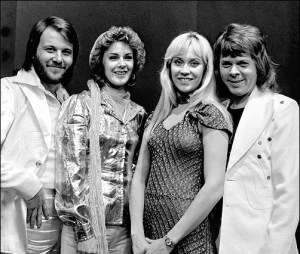
“COPENHAGEN, Denmark — The four members of the Swedish pop quartet ABBA, who triumphed at the 1974 Eurovision Song Contest with the peppy love song “Waterloo,” on Friday got one of the most prestigious knighthoods in Sweden from the Swedish King Carl XVI Gustaf.
‘The Order of the Vasa was handed out for the first time in almost 50 years. Agnetha Faltskog, Björn Ulvaeus, Benny Andersson, and Anni-Frid Lyngstad became ‘Commander of the First Class’ of the order for “very outstanding efforts in Swedish and international music life.'” –Associated Press
–
I’ve heard their music for years. I liked it, too. Never figured they’d become knights. Something to smile about when there’s so much strange news out there.
“A torch song is a sentimental love song, typically one in which the singer laments an unrequited or lost love, either where one party is oblivious to the existence of the other, where one party has moved on, or where a romantic affair has affected the relationship. The term comes from the saying, ‘to carry a torch for someone,’ or to keep aflame the light of an unrequited love. It was first used by the cabaret singer Tommy Lyman in his praise of ‘My Melancholy Baby.'” – Wikipedia
Torch singers appeared in supper clubs featuring music and dancing and were often shown in movies with such clubs. I loved torch songs whether it was Patsy Cline singing “Crazy,” Billie Holiday singing “Solitude,” or Dale Storm singing “Dark Moon.” My family wasn’t affluent enough to go to supper clubs or adventurous enough to go to the better dive bars, so my exposure to torch singers came exclusively through movies, records, and the singers’ TV appearances.
1948 photo
Though I was a big fan of Patsy Cline, when it came to torch singers, my favorite was Julie London who had an active singing career (32 albums) up until the late 1960s. She recorded “Motherless Child,” “Don’t Worry About Me,” “A Foggy Day,” and many other standards. As her sultry, contralto voice began to falter, she turned to acting in movies (“Man of the West,” “The Wonderful Country”) and television (“The Julie London Show, “The Big Valley.”)
She appeared as head nurse Dixie McCall throughout the entire 122-episode run of the action-adventure drama “Emergency!” from 1972 to 1977. The series focuses on the paramedics, firemen, and hospital support staff, showing (I think) a more accurate look at firefighting techniques than shows like “Chicago Fire.” London’s second husband Bobby Troup (to her right in the photo) was also in the cast. The show was produced by her first husband Jack Webb. Like London, Troup came from the music business.
I’ve had fun watching the currently available “Emergency!” reruns via the DISH Network and appreciate the style and presence she brings to the role even though it’s a bit difficult to stop seeing London as a sexy torch singer.
My favorite color is blue. While haint blue is useful on porches and front doors, it’s too light for a signature color. I need navy blue, the blue of ocean water just before the light is gone, the blue of twilight over the city. Naturally, I love the blues which is why I mentioned them often in my novel Conjure Woman’s Catand its sequels.
According to SantaFe.com, “Blues is the name given to the musical form and the music genre that emerged from the African-American communities and the black cultural melting pot of the American South of the 1890’s, drawing on a fascinating mixture of African-American spirituals, traditional songs, work songs of the slaves, field hollers, shouts and chants, folk ballads, European hymns, contemporary dance music and rhymed simple narrative ballads. During their back-breaking toil in the fields of the Southern plantations, black slaves developed a “call and response” way of singing to give rhythm to the drudgery of their work.”
While I especially like the blues when sung with a piano or guitar accompaniment, I fully appreciate George Gershwin’s 1924 instrumental approach for piano and jazz band, “Rapsody in Blue,” that I first heard on my father’s 78 rpm records. The composition was controversial from the beginning because it mixed classical music and jazz.
According to Wikipedia, “The Rhapsody is one of Gershwin’s most recognizable creations and a key composition that defined the Jazz Age. Gershwin’s piece inaugurated a new era in America’s musical history, established Gershwin’s reputation as an eminent composer, and eventually became one of the most popular of all concert works. In the American Heritage magazine, Frederic D. Schwarz posits that the famous opening clarinet glissando has become as instantly recognizable to concert audiences as the opening of Beethoven’s Fifth Symphony.”
As a clarinet player in high school and college bands, that opening glissando caught my attention and never let it go. First, it was a perfect beginning to the piece. Second, I couldn’t play that 17-note gliding upward cry on my clarinet for love or money. (Not that anyone offered either.) You can hear a YouTube performance here.
What Gershwin produced was not a “jazz concerto” but a rhapsodic work for “piano and jazz band” incorporating elements of European symphonic music and American jazz with his inimitable melodic gift and keyboard facility.
As Classic FM notes, “Gershwin’s original title for it was American Rhapsody. But, by chance, Ira had been to an exhibition of Whistler’s paintings and saw the painter’s Nocturne In Blue And Green of the Thames at Chelsea. Why not call the new piece Rhapsody In Blue instead, he suggested. The title would reflect the European and American influences. Also at Ira’s suggestion, George contrasted the syncopated character that dominates the tune with an expressive romantic theme the composer had previously improvised at a party.”
And so the music plays forever in our consciousness even when we don’t have a band or a record or an audio file.
While the rest of the USA was listening to “Chances Are,” “Don’t Be Cruel,” and “All I Have to Do is Dream” in the 1950s, I was learning about jazz and the blues from my father’s large collection of 78 rpm records. My musical “philosophy” (haha, like I had one) came from a 1931 song by Duke Ellington, “It Don’t Mean a Thing if it Ain’t got that. . .” Well, you know.
I’ve always preferred jazz and blues to just about everything else except, perhaps, songs by Pete Seeger and the Weavers. Sooner or later, when moving to a new town, I would find the local jazz station even though it never earned as much money as the so-called “top forty” stations.
So naturally, I liked “I’ve Got It Bad and That Ain’t Good” by Duke Ellington and Paul Francis Webster released in 1941. A lot of other people liked it, too, since everybody who was anybody sang it, including Cannonball Adderley, Ivie Anderson, and Louis Armstrong. Cher, who–like me–wasn’t born when the song came out, sang the version I liked the best on her 1973 album “Bittersweet White Light.” Many think this album contains some of her best work, though it didn’t do well.
I ended up liking Cher a lot, probably because of this album, surprising everyone knew me.
I still like jazz, blues, and ragtime best which means, I guess, that–music-wise–I’ve still got it bad and that ain’t good.
–Malcolm
My musical preferences usually make their way into my novels.
You don’t know me, but I’ve listened to your music from the beginning. I liked everything about it until one day you switched to rock. Too many joints that day, Bob? I came back later and I’m still here except now I’m too hard of hearing to listen to music. Wanted to hear “Rough and Rowdy Ways.” No dice, don’t think twice, it’s wall right.
Back in the old days, I wanted to write you a letter demanding that you stay away from Joanie. She didn’t know me either, but I also listened to her music from the beginning. While riding on a train goin’ west. I fell asleep for to take my rest. I dreamed a dream that made me sad, concerning Joan Baez who said the war was bad but that we weren’t destined to protest it on the same streets on the same days.
Everything I did for years seemed to have one of your songs or Joanie’s songs tied to it. The songs didn’t cause me to do what I did; they just seemed to fit my prevailing moods. Yet, I always wanted to escape the constraints of college and follow Mr. Tambourine Man. I listened for that jingle-jangle world before heading out to my paper route into the realities of Betton Road and Randolph Circle.
And today you’re still here. That makes me happy because so many people are gone by now. I may be nearly deaf, but I still hear your music in my mind. All of it. Thanks for all that. Oh, and congrats on the Prize, you know which one I mean.
In the old days years before I was born, people were expected to know how to play the piano. My parents grew up in a swing and big band era where the most popular person at a party was they guy who could sit down at a piano and play popular music that everyone else could sing to or dance to. I was, I think expected to be a modern version of Cosmo, the piano player in “Singin’ In the Rain.”
What I wanted to play.
Unfortunately, the guitar was fast becoming the instrument of choice long before I was old enough to go to a party. Unfortunately, I was what is often called “beat deaf,” defined in the Wikipedia entry as “a form of congenital amusia characterized by a person’s inability to distinguish musical rhythm or move in time to it.”
My music teacher, who probably suffered through my years of piano lessons more than I did, focused on classical music. I grew up on classical music and liked it fine, but learning to play Chopin, Lizst, and Schumann didn’t appeal to me, plus classical music was written with the assumption that the pianist could co-ordinate the use of his/her left hand on the bass clef with what the right hand was doing on the table clef.
What I music teacher wanted me to play (Chopin’s Polonaise in A♭ major, Op. 53)
The best I was ever able to do was play music themes and other songs which allowed the left hand to play chords rather than what was written. Needless to say, I wasn’t the hit at any parties.
According to my parents, the “worst” thing I could play was my own mix of the traditional wedding march and the traditional funeral march. I think mother was in the kitchen fixing pork chops while I was in the livingroom ostensibly for my daily practicing when I tried that tune on for size. It didn’t take long for her to appear and ask WHAT IS THAT? I said I was trying to use music to express what I thought about marriage. She shook her head and went back to the kitchen. I switched over to “The Darktown Strutter’s Ball” to which she shouted MUCH BETTER.
I never was invited to the Ed Sullivan Show or the Johnny Carson Show or to sit in with Paul Shaffer’s band on the Letterman show. I would have truly helped make it the world’s most dangerous band.
I still have the clarinet I used when my parents URGED me to play in my junior high and high school bands. But that’s another long and sordid story.
I don’t think “I Love Little Baby Ducks” (1973) has been played on Ken Burns’ Country Music mini-series, but Tom T. Hall has appeared frequently. That forces me to think of this song.
When the song first came out, I was working at Northwestern University and discovered I was part of a group who couldn’t get the song out of my head once it was played on the radio 100000 times. With therapy, I finally got rid of it. Now it’s come back.
So, I’ve had a relapse. When I told my wife what happened, she said I better not tell her what song it is, or she’ll be stuck with it, too. My hearing is so bad that even if the song had been played on Burns’ documentary, I wouldn’t have been able to hear it. So, I thought I was safe. But then Hall showed up and the song came to mind.
Burns’ documentary does, however, display the song lyrics in its closed captioning. A lot of old memories there from “Ode to Billie Joe” to “Coal Miner’s Daughter.” Porter Wagoner looked just as goofy in the old clips as he did in real life when we used to watch his syndicated variety show.
Burns has done a wonderful thing for those of us who like music, who care about it in some depth, including how disparate genres are interwoven.
Now, if I could just take a pill and forget the ducks.
Malcolm R. Campbell is the author of “Conjure Woman’s Cat,” a story about a 1954 conjure woman fighting the KKK in the Florida Panhandle. The novel is available in e-book, audiobook, paperback, and hardback editions. The audiobook was an Ear Phones Award Winner on AudioFile Magazine.
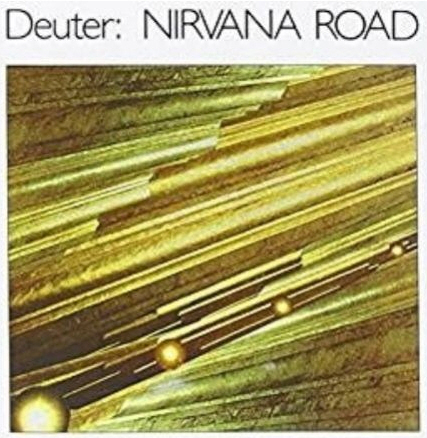
With over 70% of my hearing gone, I live my life in a fair amount of silence. Those of you who’ve been reading this blog since 2011, know that I used to select an album I liked and play it on a continuous loop while I worked on the manuscript for a novel.
Click on the image to see Deuter’s web site.
For The Sun Singer, the album was Georg Deuter’s “Nirvana Road.” For Sarabande, it was Mary Youngblood’s “Beneath the Raven Moon.” Deuter plays multiple instruments and his blending of them seemed to me very transcendent, a strong image I had for The Sun Singer. Mary Youngblood plays the Native American flute, and it speaks to me like a voice in the wilderness, at once a cry of pain and a hymn of praise, perfect for Sarabande. (I was listening while writing the first editions of both novels.)
I don’t recall how Youngblood found out about my use of “Beneath the Raven Moon” as a muse. Maybe “Google Alerts.” She contacted me, thanking me for enjoying and mentioning the recording. She said that since I already had that album, she would send me a copy of another album in exchange of a copy of Sarabande. So, we exchanged mailing addresses along with our latest work. I hope she had time to read it.
I have no words for describing what it meant to me to hear from her, for nobody plays the Native American flute better and every one of her albums spoke volumes to me. I was in a Blackfeet shop in Browning, Montana several years ago and one of the salespeople saw me looking at the flutes. When she asked if I wanted to buy one, I said, “Only if I start playing like Mary Youngblood.” She smiled and said, “Nobody plays like her.”
Click on the image to view her website.
I knew she had listened to Youngblood’s music because she not only knew the names of the songs but also held the opinion that Youngblood created voices with the flute that technically should be impossible to create. Sadly, I left the flute behind because I knew it would sound worse than a kazoo if I dishonored it by trying to play it.
Some years ago, I stopped playing albums while writing because I could no longer hear them. It was a loss because when I was listening to them, I never had writer’s block: the albums jumped started the writing every single time. I played Deuter’s and Youngblood’s albums so many times, that if I see (or recall) the name of a song, I can hear it within the silence of my imagination. Their albums are primarily instrumental, so there were no words to interrupt my chain of thought.
While writing the three novels in my Florida Folk Magic Trilogy, my imagination played the blues and gospel, primarily the same songs I mentioned in the novels. I grew up with the blues and gospel, in part from my parents’ 75 rpm records and partly from the appearances of many of the singers on early television variety shows. The one good thing about the music I hear into the silence in this way is that I can turn it up as loud as I want it without bothering either my wife or our two cats. It also hasn’t been ruined by today’s digital recording methods.
The blues in my imagination and memory were a very effective muse. When I was in high school and learned that Beethoven didn’t stop writing music when he lost his hearing. I didn’t understand how that was possible. Now I can.
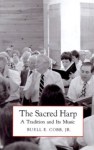
“On any Sunday afternoon a traveler through the Deep South might chance upon the rich, full sound of Sacred Harp singing. Aided with nothing but their own voices and the traditional shape-note songbook, Sacred Harp singers produce a sound that is unmistakable―clear and full-voiced. Passed down from early settlers in the backwoods of the Southern Uplands, this religious folk tradition hearkens back to a simpler age when Sundays were a time for the Lord and the ‘singings.’”
“Aside from the Holy Bible, the book found oftenest in the homes of rural southern people is without a doubt the oblong book of song called ‘he Sacred Harp.’ It is not a church hymnal, though its contents are religious songs.”
The Sacred Harp, an a cappella, Protestant-based singing style associated with the Southern United States, has a deep ancestry going back to England’s psalter hymnals and the influence of New England’s “Bay Psalm Book,” but the name, selection of songs, and the method are said to have begun with Benjamin Franklin White and Elisha J. King’s The Sacred Harp, published in 1844.
Tunebooks, as they were called, were also published W. M. Cooper in 1902 and by Seaborn and Thomas Denson in 1936. Singing groups had their favorites as did areas of the country.
Books and Styles
Those who are used to the church hymnals in most protestant churches quickly notice several distinctive differences between the books supplied on the backs of their pews and the Sacred Harp books used at sings: The Sacred Harp books were oblong (landscape format) and feature easily identifiable shape notes to allow people to easily participate without any knowledge of standard musical notation.
While audiences can and do appear at Sacred Harp sings, the singers sing for their own needs and those of their group, all facing inward toward the leader who sets the tempo by raising his arms up and down rather like the conductor of a symphony. Many of the singers, especially those in the honored down-front sections of each section, often duplicate the leader’s arm motions help the group stay synchronized. Many people refer to this as fasola singing.
Sacred Harp is based on old hymns sung the old way. Changes in the music world–gospel and other modern styles, organ or piano accompaniment, stylistic variations of the melody and words–are said to dilute the music. As Buell writes, “The Sacred Harp is–in tone, in musical effect, in the themes the songs focus on–an emotive and yet a disciplined music, austere and uncompromised.”
A Natural End in Itself
In her Beginner’s Guide to Shape-Note Singing, Lisa Grayson points out that the singing is an end itself and that should there be an audience, they are welcome to listen or join in but never applaud any more than they would applaud during a traditional church service, and that the gloomy nature of many of the hymns reflects old church and camp meeting beliefs before some churches turned to “all sweetness and froth.”
While there are never any soloists in Sacred Harp singing, the music emphasizes the human voice which is considered the greatest of all instruments in a natural setting. Many of the hymns contain references to fields, rivers, sky and mountains all of which are considered both natural and sacred.
There are wonderful indexes of Sacred Harp songs available at fasola.org and texasfasola.org which allow you to find tunes by title, first line, composer and meter. To illustrate the so-called gloomy nature, here is “The Weary Souls” written in 1804 as it appears in the Cooper tunebook:
Ye weary, heavy-laden souls,
Who are opprest and sore,
Ye trav’lers thro’ the wilderness
To Canaan’s peaceful shore.
Thro’ chilling winds and beating rains,
And waters deep and cold,
And enemies surrounding us
Take courage and be bold.
Farewell, my brethren in the Lord,
Who are for Canaan bound,
And should we never meet again
’Till Gabriel’s trump shall sound.
I hope that I shall meet you there
On that delightful shore,
In mansions of eternal bliss,
Where parting is no more.
Time and Space
In her thesis “Journey Into the Square: A Geographical Perspective of Sacred Harp,” Michele Abee writes that “Sacred Harp is a community identified around a common religious practice of a specific type of music. It is a practice that has continually adapted to its space through time and found a unique cultural identity in the American South. The opportunity geography provides Sacred Harp is its ability to define its religious practice according to its time and space. The music itself provides a unique perspective to religious geography as the physical environment represented in the lyrics of the hymns demonstrates that the nature surrounding man is divinely created.”
That’s an apt summary of an approach to worship through music that focuses intentionally on, as Sacred Harp singers see it, “the old road,” while modern churches and modern music have gone far afield through experimentation and creativity onto new roads. Both roads have their attractions. When listened to with an open mind, a Sacred Harp sing can be a powerful experience no matter how modern the listener believes himself or herself to be.
–Malcolm
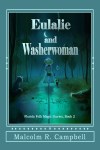
Malcolm R. Campbell’s new novel, “Eulalie and Washerwoman,” features a bit of the culture of of the Sacred Harp, necessitating many enjoyable hours of research into a form of religious singing that is quite different from the Presbyterian tradition the author grew up in.
Eighteen miles away, the story in the Athens newspaper began: A 60-year-old Jefferson woman and an unidentified man were killed in a Friday morning wreck in Banks County, according to the Georgia State Patrol’s post in Gainesville.
The “unidentified man” is Tony Ianuario and the “60-year-old Jefferson woman” is his wife Ann. His custom-made mandolins have been played by well known performers including Bill Monroe and Jesse McReynolds. The Smithsonian knows his work and Hearts and Hands: Musical Instrument Makers of America recognizes him as one of the top 250 instrument makers in the U.S.
His full white beard and costume (designed by Ann) have been transforming him into Father Christmas for local children for 17 years. Ann’s writing and her work as a Master Gardener are widely appreciated throughout the region. She was a long-time library and museum volunteer.
The local paper had more details: A well-known Jefferson couple was killed in a Banks county wreck Friday on Hwy. 63 at Hwy. 51. Killed were Tony and Ann Ianuario, Jefferson. The wreck reportedly involved a tractor trailer and a SUV, but no official details were available Saturday about the cause of the wreck.
The response of neighbors and friends was more personal, spread via phone calls and knocks on the front door, had we heard about Tony and Ann? When had we last seen them? Weren’t we planning to call with a new volunteer project? Hadn’t some of Ann’s writing just been posted? When was the next bluegrass jam session scheduled?
More often that not, I saw Tony and Ann at the local Food Lion as we raced up and down the aisles grabbing a few groceries for the week. A quick hello, small talk. and the latest news before they were off to pick up a half gallon of Mayfield Milk and I was off for another box of Cheerios.
They died together. That was for the best, people said. Even so, we wished there had been a moment for a last goodbye and an encore performance of one more song.

 She appeared as head nurse Dixie McCall throughout the entire 122-episode run of the action-adventure drama “Emergency!” from 1972 to 1977. The series focuses on the paramedics, firemen, and hospital support staff, showing (I think) a more accurate look at firefighting techniques than shows like “Chicago Fire.” London’s second husband Bobby Troup (to her right in the photo) was also in the cast. The show was produced by her first husband Jack Webb. Like London, Troup came from the music business.
 While I especially like the blues when sung with a piano or guitar accompaniment, I fully appreciate George Gershwin’s 1924 instrumental approach for piano and jazz band, “Rapsody in Blue,” that I first heard on my father’s 78 rpm records. The composition was controversial from the beginning because it mixed classical music and jazz.
 As a clarinet player in high school and college bands, that opening glissando caught my attention and never let it go. First, it was a perfect beginning to the piece. Second, I couldn’t play that 17-note gliding upward cry on my clarinet for love or money. (Not that anyone offered either.) You can hear a YouTube performance
  While the rest of the USA was listening to “Chances Are,” “Don’t Be Cruel,” and “All I Have to Do is Dream” in the 1950s, I was learning about jazz and the blues from my father’s large collection of 78 rpm records. My musical “philosophy” (haha, like I had one) came from a 1931 song by Duke Ellington, “It Don’t Mean a Thing if it Ain’t got that. . .” Well, you know.
 So naturally, I liked “I’ve Got It Bad and That Ain’t Good” by Duke Ellington and Paul Francis Webster released in 1941. A lot of other people liked it, too, since everybody who was anybody sang it, including Cannonball Adderley, Ivie Anderson, and Louis Armstrong. Cher, who–like me–wasn’t born when the song came out, sang the version I liked the best on her 1973 album “Bittersweet White Light.” Many think this album contains some of her best work, though it didn’t do well.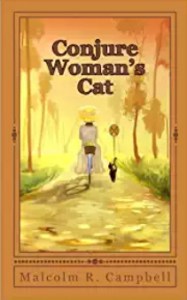
 You don’t know me, but I’ve listened to your music from the beginning. I liked everything about it until one day you switched to rock. Too many joints that day, Bob? I came back later and I’m still here except now I’m too hard of hearing to listen to music. Wanted to hear “Rough and Rowdy Ways.” No dice, don’t think twice, it’s wall right.


 When the song first came out, I was working at Northwestern University and discovered I was part of a group who couldn’t get the song out of my head once it was played on the radio 100000 times. With therapy, I finally got rid of it. Now it’s come back.



 Malcolm's Round Table