 “America’s best-ever political cartoonist is renowned for creating the Republican Elephant and popularizing the Democratic Donkey. He also created the modern images of Santa Claus and Uncle Sam, influenced five victorious Presidential elections, and satirically commented on seven administrations.” – John Adler’s website (This website is a treasure trove of Nast’s political cartoons and other drawings, including the iconic image of Santa shown here.)
“Thomas Nast, September 26, 1840 – December 7, 1902) was a German-born American caricaturist and editorial cartoonist often considered to be the “Father of the American Cartoon.'” – Wikipedia.
From the Publisher
“Summary review by 19th Century cartoon historian and author Richard Samuel West:
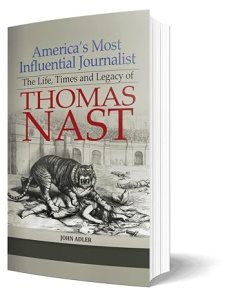 “‘After more than 100 years of having to rely on Albert Bigelow Paine’s entertaining but hagiographic and error-filled Thomas Nast His Period and His Pictures (1904), we finally have a biography of America’s greatest political cartoonist worthy of replacing it. John Adler has created a meticulous, comprehensive, fair, and accurate biography of the father of American cartooning. With more than two decades devoted to studying Nast’s entire massive output behind him, Adler is the perfect guide for 21st century readers interested in understanding Nast’s cartoons, learning about the politics that prompted them, and discerning the impact they had. At the end of journeying through this massive tome, we are left with an appreciation of Nast and his extraordinary achievement like never before.'”
“The power and influence of Nast’s cartoons largely emanated from their repetition over weeks or months as his stories unfolded and he banged his points home in Harper’s Weekly, whose financial strength, reach and dominance made it the country’s leading illustrated newspaper. This 830-page biography contains 1,000 Nast cartoons, illustrations, sketches, and paintings — 800 from Harper’s Weekly and the balance from Frank Leslie’s Illustrated Newspaper (25), New-York Illustrated News (47) and other publications, plus 100 cartoons on Nast-related topics by 20 other artists like Joseph Keppler of Puck — each with its principal characters identified and its content and context explained. The manually-created Index, predicated solely on Nast’s work — provides a unique, encyclopedic reference resource. Visualize the downfall of corrupt Boss (William M.) Tweed and his Ring of Thieves, the Civil War, Reconstruction, six Presidential campaigns, and Nast’s legacy: the Republican Elephant, modern images of Santa Claus and Uncle Sam (all created by him) and the Democratic Donkey (popularized by him).”
We studied Nast’s work in journalism school as well as American history classes. I’m pleased to see this definitive biography published last year and hope that it brings is work to a wider adience.
–Malcolm
 Of all her work, I most liked Glenda Jackson’s (9 May 1936 – 15 June 2023) portrayal of Queen Elizabeth I in the 1971 BBC TV docudrama more than any of the others in that role. Helen Mirren is a favorite of mine, and she did a good job, but I like Jackson’s work better. Jackson is probably best remembered for “Women in Love” and “A Touch of Class.” We can only guess what else she might have done as an actress had she not been gone almost three decades during her political career.
 “Elizabeth R” was the catalyst for multiple debates between my wife and me. She took English history in college and was very knowledgeable about the monarchs and issues. She could never quite understand my dislike of Elizabeth I for being as strong as it is, almost as though Elizabeth I were still on the throne causing more problems in Scotland, Ireland, and elsewhere. Few historically controversial people stir up stronger emotions in me than English monarchs, especially those constantly fighting Scotland.
 “Much of his writing deals with the United States Army in the West, especially in its confrontations with the Indian tribes. He wrote:
 While visiting my daughter’s family in Maryland for Thanksgiving, we all took a guided tour of Marietta House and learned more about slavery in Maryland. My daughter’s husband stayed home working on the Thanksgiving dinner. It was fabulous.

 Indigenous Peoples’ Day is a holiday that celebrates and honors

 Goodness knows I’ve seen enough fiction and quasi-documentaries about the assassination from Oliver Stone’s work to Jim Garrison’s approach. And then, too, there’s 111/22/63 by Steven King. That novel was freaky enough to make one wonder about the whole thing even if they never wondered about it before.
 When I was in high school, I read a lot of stories about time travelers heading into the past to try and undo crimes and other unfortunate events in the past. Early on in his genre, people were usually trying to save President Lincoln. Recently, tinkering with the past became more multifaceted on the TV series “Timeless.” King, as readers of 11/22/63 know, sends his main character back in time to try and save President Kennedy.
 and evil magic is best performed between midnight and 12:30 a.m. Hence we have the rationale behind the title of John Berendt’s 1994 bestseller, Pulitzer Prize finalist, and the inspiration behind the 1997 feature film.
 Portraits can reveal a lot about people and their times, if you know how to look for clues, notes Amanda Streeter Trum, curator of collections at MHS. Examining objects in the artwork, considering the backdrop, and observing the artist’s color palette reveal important information about the subject of the art.
 Malcolm's Round Table