Glacier Centennial: George Bird Grinnell

“Far away in Montana, hidden from view by clustering mountain-peaks, lies an unmapped northwestern corner- the Crown of the Continent. The water from the crusted snowdrift which caps the peak of a lofty mountain there trickles into tiny rills, which hurry along north, south, east and west, and growing to rivers, at last pour their currents into three seas. From this mountain-peak the Pacific and the Arctic oceans and the Gulf of Mexico receive each its tribute. Here is a land of striking scenery.” — George Bird Grinnell, “The Crown of the Continent” in The Century Magazine, 1901

Fish and Wilflife Service Archive Photo
Dr. George Bird Grinnell (1849 – 1938) was a hunter, anthropologist, naturalist, publisher, Audubon Society founder, and Indian rights advocate who has been called the Father of Glacier National Park and the Father of American Conservation. While he specialized in studies of the plains Indians, visitors to Glacier National Park during this centennial year will hear of his association with the Crown of the Continent and will see his name linked to a lake, mountain, point and glacier in the Swiftcurrent Valley.

When George was seven, the Grinnell family moved into Manhattan’s Audubon Park neighborhood, the estate of John James Audubon (1785-1851) managed by the ornithologist’s widow Lucy. George was fascinated by the specimens of birds stored in the barn and was lucky enough to become one of the children tutored by Madam Audubon.

In his 1939 tribute to Grinnell in “The Auk – A Quarterly Journal of Ornithology,” Albert Fisher wrote that “Madam Audubon gave Grinnell his first conscious lesson about birds. One of his early recollections was being called from the breakfast table one morning to look at a large flock of Passenger Pigeons that was feeding in a dogwood tree twenty-five or thirty feet from the house. There were so many of the birds that all could not alight in it, and many kept fluttering about while others fed on the ground, eating berries knocked off by those above.”

Speculating about the workings of fortune and fate, one can only wonder how the future of conservation and Montana’s Rocky Mountains were impacted by the pivotal moment encompassed by pigeons and a dogwood.

Also pivotal in Grinnell’s life were his volunteer experiences at 21 on a paleontology expedition to Nebraska. In his 2004 article in Bugle Magazine “George Bird Grinnell: The Father of American Conservation,” Shane Mahoney wrote: “His writings from this time also reflect his deep love of the hunt and his capacity to appreciate the sheer beauty and grandeur of wild and unspoiled lands. His memories of fireside gatherings after a vigorous day afield are testimony to his love of the land and the cultures of men who made it their obsession and home. While his keen scientific eye was always turned to gathering new insights, his soul and heart were expanding in the western frontier, beginning to form in him a fevered commitment to the preservation of wildlife and the hunt.”
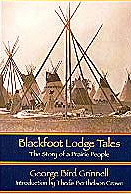
Grinnell served as a naturalist on an 1874 Black Hills expedition led by General Custer and on an 1875 expedition to Yellowstone. He found himself drawn west not only as a hunter of big game, but as a man impressed by the natural wonders he saw and by the lives and stories of the Pawnee, Blackfeet and other tribes he encountered and befriended. President Grover Cleveland would later appoint Grinnell as a commissioner to liaison with the Blackfeet and the Belknap Indians.

Grinnell’s articles about his experiences began appearing in “Forest and Stream,” a magazine he would later edit and then publish. He wrote not only of hunting but of the need to curtail the wholesale slaughter of animals for market purposes. His report of conditions in Yellowstone showed that game and timber were being stolen away by commercial interests.

As Mahoney noted, “Grinnell returned from the [Yellowstone] expedition determined to provide better protection for the park and to set before the American people a platform of discussion regarding just what a national park should represent. In so doing he was to lay the foundation for the national park system we have today.”
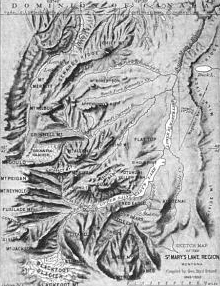
Century Magazine Sketch
Grinnell coined the phrase “Crown of the Continent” in his 1901 article in The Century Magazine. He included a sketch of the area that would ultimately bear a very close resemblance to the park that would be created nine years later. Luckily, the geologists and promoters who swarmed through mountains seeking gold, copper and oil found no viable deposits.

While Grinnell, with his high-level contacts and his reputation as an advocate for conservation, had been pushing for protected status for the Montana mountains for almost 20 years, he would say later that the Great Northern Railroad deserved most of the credit. Taking little or no credit for his accomplishments was a long-time Grinnell attitude that, even now, causes him to be overlooked in many assessments of early conservation activities.

At the time, Grinnell spoke to “Empire Builder” James J. Hill of the Great Northern about the benefits of a park. Hill, whose views leaned more toward the kind of playground the railroad might develop there than toward conservation, pressured Montana’s Congressional delegation to support the park. Ultimately, the legislation passed with little debate, and President Taft signed the legislation in May, 1910.

According to historian C. W. Buchholtz in Man in Glacier, George Bird Grinnell wrote that “the people of the Great Northern were entirely responsible for the creation of Glacier. In 1929, Grinnell stated: ‘Important men in control of the Great Northern Rail road were made to see the possibilities of the region and after nearly twenty years of effort, a bill setting aside the park was passed.'” In the years that followed, Grinnell would wonder if Glacier Park was truly safe, for he saw more commercialization there than he thought was proper.

Without the railroad as the final powerful catalyst, Glacier National Park might never have been created; the railroad saw a tourist destination where the natural resources could be managed and used. Grinnell had greater vision, one developed over the long term and one that has sustained us well for the last 100 years.

Copyright (c) 2010 by Malcolm R. Campbell, author of “The Sun Singer,” a mythic adventure novel set in Glacier National Park.

Each purchase benefits Glacier National Park

Glacier National Park Trivia

Did you know…

…The bald eagles seen on the western side of the park began showing up in 1916 when koanee salmon were introduced in nearby Flathead Lake.

…a snow field shaped like the continent of South America appears on the slope of Mt. Altyn at Many Glacier Hotel every year.

…after Many Glacier Hotel employees worked diligently through the night fighting the wind-driven inferno of the Heaven’s Peak fire of 1936 and wired the Great Northern Railway management that they had saved the company’s hotel, the return telegram said: WHY?

…Glacier National Park’s hotels were closed due to wartime austerity measures between 1943 and 1945.

…the light-colored limestone and dolomite of the Altyn Formation rocks along the Going-to-the-Sun highway show ripple marks and fossil algae from the warm seas of their birth.

…in 1900, there was a mining boom town named Altyn in Swiftcurrent Valley a few miles from the present day site of Many Glacier Hotel where copper, oil, gold and other minerals lured developers to what many thought would become a great mining center.

…the ice of Grinnell Glacier moves 30 to 50 feet a year.

…the rain and snow melt from Triple Divide Peak flows away from the park in three directions ending up in the Atlantic, Pacific and Hudson’s Bay.

…at 10,438 feet, Mt. Cleveland is the highest peak in the park.

…the monument where U.S. Highway 2 and the BNSF mainline go over Marias Pass attributing the discovery of the route through the mountains to John F. Stevens stems from Great Northern Railway mythology rather than fact–Native Americans as well as explorers had been using the pass for years.

…while Libby Smith Collins, the Cattle Queen of Montana, did come to the mountains of present-day Glacier National Park in search of copper in the 1890s, the “Cattle Queen of Montana” movie staring Barbara Stanwyck and Ronald Reagan has little to do with her life.

…while the Japanese lanterns hanging in Many Glacier, a Swiss Style Hotel, had little to do with the time, place or ambiance, the Great Northern Railway hung them there in 1915 to help advertise its steamship traffic between the U.S. and Japan.

…the glaciers in the park will probably have finished melting away by 2030.

…Civilian Conservation Corps (CCC) men logged off 5,000 acres of Glacier’s forests in the 1930s for use as fence posts and telephone poles.

…The park’s restored fleet of 1930s White Motor Company convertible tour buses will not run on either gasoline or propane.

…this year is the 100th birthday of the park.

TSScover2014–Malcolm R. Campbell, author of “The Sun Singer,” a novel set in Glacier National Park.


Submissions wanted for CAMAS Glacier Issue

Camas, the literary magazine of the University of Montana is dedicating its Summer 2010 Issue to Glacier National Park in concert with Glacier’s Centennial Anniversary. The deadline is March 15, 2010.

The magazine is seeking feature articles (2000-3000 words), essays (500-2000 words), interviews and profiles (250-2000 words), fiction (500-2500 words), and poetry of varying lengths.

For complete guidelines and submission information, click here.

It should be a great issue for fans of Glacier National Park.

–Malcolm, author of “The Sun Singer,” a novel set in Glacier National Park.

Glacier Centennial: Bears don’t eat beargrass

Often considered the park flower, common beargrass (Xerophyllum tenax) is one of the most popular wildflowers in Glacier National Park. Captain Meriwether Lewis collected a specimen in 1806 in Idaho and referred to it as a species of beargrass.

Flickr commons photo by Curt
Since this perennial, a member of the Lily family, isn’t similar to eastern plants named beargrass, Lewis’ rationale for the name are unclear. He did say that the horses wouldn’t eat it, and described watertight baskets made of the leaves and cedar bark by Native Americans.

In his book “The Old North Trail,” Walter McClintock reports that the roots of beargrass (eksisoke in Blackfeet) were ground up and boiled to stop bleeding from cuts and to fight the inflammation accompanying sprains and fractures by the Southern Piegan in Montana. It was also used to stop hair from falling out.

But bears don’t eat it, and it’s not actually a grass. Mountain goats eat the leaves and elk, deer and bighorn sheep eat the blossoms. Grizzly bears occasionally haul the plants into their winter dens for nesting materials.

Visitors to the park will find the creamy yellow, six-to-eight-inch dense raceme flowers on stalks up to six feet tall along the trails to Grinnell Glacier, Iceberg Lake, and Swiftcurrent Pass from June to August. The displays of this flower are often quite profuse, and few hikers with cameras come home without several striking photographs taken along forest trails and in sunny meadows.

When I worked in the park, we told guests that bears dried their paws on beargrass after trying to wash off the rather indelible juice from huckleberries. No doubt, today’s bellmen and bus drivers are still spinning a similar yarn.

If you’re planning a trip to Glacier during this centennial year and are interested in wildflower information, “Wildflowers of Glacier National Park” by Kimball and Lesica is a handy resource.

Copyright (c) 2010 by Malcolm R. Campbell, author of a mythic adventure novel set in Glacier National Park called “The Sun Singer.”

Glacier Centennial: Historic Red Buses

Glacier National Park’s fleet of 33 buses might just be the oldest working fleet of passenger vehicles in the world. Built by the White Motor Company between 1936 and 1938, each 15-passenger, convertible bus with a rollback canvas top has an estimated 600,000 miles on it. And each one has always been painted bright red, to match the berries of the Mountain Ash.

Sun Road - 1939 GNRR Brochure

The Cleveland, Ohio company that built them—once a leading maker of trucks and buses that began as a subsidiary of the White Sewing Machine Company—was purchased by Volvo in 1987. The similar White Motor Company buses that once ran in other national parks have long since been retired.

The noisy manual transmissions responsible for the bus drivers’ nickname “gear jammers” were replaced with automatic transmissions in 1989. The buses themselves were almost lost during the summer of 1999 when developing cracks in the chassis were discovered.

Author Ray Djuff wrote in a 1999 issue of the Glacier Park Foundation’s Inside Trail newsletter that “an expert on White Motor Company vehicles stated recently that, but for an unfortunate retrofitting project in 1989, Glacier’s reds might have run without major problems for another 60 years.” The power steering added when the transmissions were replaced created stresses on the vehicles’ frames.

Since repairing the fleet didn’t appear financially viable, the Glacier Park, Inc. transportation company, once a subsidiary of the Great Northern Railway, told the National Park Service that the buses should be retired. But the pubic saw it differently

After all, when “The Reds” were introduced, they became the most popular way to experience Sun Road or to travel the Chief Mountain Highway from Many Glacier Hotel on the east side of the park up to the Prince of Wales Hotel in Canada’s Waterton Lakes National Park. “Everyone rode them—including Clark Gable, Carol Lombard, William Randolph Hearst, and, more recently, then-Vice President George H. Bush, the Queen of the Netherlands, and Robin Williams,” wrote Amy B, Vanderbilt in On the Road Again: Glacier National Park’s Red Buses. “The Reds provided a memorable experience to every visitor and a reminder of when adventure.”

Designed by Count Alexis de Sakhoffsky, a famous industrial stylist and advocate of streamlining styles, the buses represented the park’s golden age when visitors arrived on the Great Northern Railway’s Empire Builder and Oriental Limited. The visitors were lured by western myths and a See-America-First advertising campaign that used some of the best writers and artists in the country. In 1999, the majority of the 7,000 comments received during the park’s General Management Plan review wanted the National Park Service to keep Glacier the way it was—including the historic buses.

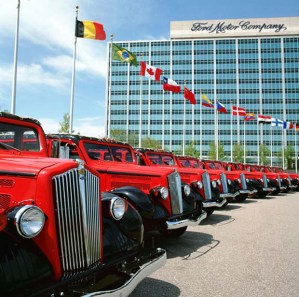
Refurbished Buses at Ford
An endowment was created through the contributions of park concessionaire Glacier Park, Inc, the Glacier Park Foundation and the Ford Motor Company to inspect and evaluate the fleet for prospective restoration. Ford was seriously interested in the project. The rehabilitation solution included a lengthened Ford F450 chassis, a 5.4L V8 bi-fuel power-train, and upgraded flooring, insulation, doors, wiring and instrument panel.

According to Vanderbilt, “The Red Bus project took more than 2 years and a team of over 200 experts from over six different organizations to make the dream of returning the historic Red Buses a reality. Ford completely renovated the Red Buses using new technology and its extensive expertise in alternative fuels. While preserving the exterior of the buses along with their historic charm, Ford used alternative fuel technologies to change the engine and drive-train, making them cleaner and quieter than the originals.” The buses now run on either gasoline or propane.

In the world of restoration, one might say that the buses are rather like the standard example of “Paul Bunyan’s Axe.” The handle is replaced, then the head is replaced, then later another handle is needed. Are these Reds the same buses the White Motor Company built in the 1930s? Yes and no. Even without the old symphony of whirring and squalling gears, the essential ambiance of the riding experience remained in 2002.

Sure, the bus drivers no longer jammed the gears as they double-clutched their ancient horses up over Logan Pass. But they were the once again the knights of the mountain roads who spun tall tales along the backbone of the world with the mysterious daring-do deportment of all minstrels who know how to enchant and steal hearts.

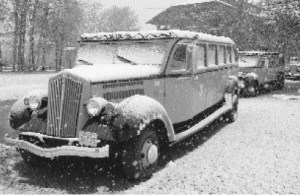
When the buses came back from their rehabilitation at Ford in June, 2002, the mountain gods chased the celebration inside with a heavy snow storm. It was a good sign.

Snowy Celebration - NPS Photo

Copyright (c) 2010 by Malcolm R. Campbell, author of “The Sun Singer,” a mythic novel set in Glacier National Park

Golden Eagle’s Gift

Píta, the Golden Eagle, leaned forward into Wind’s gentle breath and came to him on soft wings. David looked up to the outstretched legs uncomprehending like a lamb, tagged, docked, weaned and newly out of the pen into greened up spring. When the talons closed around his head, he saw pain and brighter light, then a sudden upward thrust of great wings pulled him free of the world.

Safe beneath the shadow of those wings, vision came to him as a pure chaos of cloud, as talons dangling above his head as from a mirror, as glimpses of earth. He was almost air. He heard elk mating, stones disturbed on high ridges beneath his feet, water clear and cold. The sky carried snow’s scent.

Manna flung back to heaven, he was limp and drugged by height and claws, his hands and arms flapped uselessly beside him, slightly feathered and somewhat wing. Blood trickled into his eyes and mouth.

He spat salt, choked and felt himself bank southward.

He blinked until his eyes were clear and there lay the world, horizons shattered and clarified out to uncommon distances. He saw the unseen.

He saw the Mokakínsi, the backbone of the earth, and its seven points of power from the crown of the continent running south shone like suns.

He saw Grandmother standing upon a great wall of rock above Apinákui-Píta, the falls of Morning Eagle, facing east, her arms raised to the sky.

He saw lives unfolding along great rivers that emptied into one ocean and in this land where substantial water is a treasure, the rivers flowed as liquid gold.

He saw ignorant men desecrating Mother Earth.

He saw old men telling stories, the smoke of pipes and camp fires rising to the sun.

He saw the far sides of clouds.

He saw the elements dancing naked as secret lovers.

He saw tomorrow and the day after.

He saw lambs waiting to be born.

He saw the seasons change beneath his feet in a spinning blur of white, then green, then the a rainbow resolving to gold, around and around, with sparkling lights and stirring music and bobbing horses, with laughter and tears.

He saw with absolute clarity that an absolute clarity of objects was a crafted illusion, there were no defined edges, no chasms between viewer and viewed, no spaces between here and there, no times between here and now.

The universe spoke, was speaking with Píta’s voice keeeee his vision clearing keeeee over a clarified world keeeee where he merged with his horizons. Lost in limitless light, he was an ocean of stars, a deep flowing tide of emotion, a flooding river of thought, wave after wave of energy, keeeee keeeee keeeee, heard the light coalesce and there the photons were named Mokakínsi, were named Grandmother, were named this person and that person, were named river, were named smoke rising, were named sun, were named cloud, were named lambs, were named autumn, were named God.

Copyright (c) 2010 by Malcolm R. Campbell, excerpted from “Garden of Heaven,” a work in progress.

COMING SOON

An interview with Smoky Trudeau, author of “Observations of an Earth Mage.”

Glacier Centennial: Nature is YOU

“That was the moment that defined my place in the natural world. The moment I understood that I, a human being, was not above the other creatures of Creation. Not better than the bees and the birds and the bears. Not superior to the snakes and the snails and the swallows. I was Nature. Nature was me.” –Smoky Trudeau, writing of an early childhood experience in Observations of an Earth Mage

Glacier
Like many visitors to Montana’s Glacier National Park, I enjoy the historic hotels, the ancient red tour buses, the launch trips on the lakes, and a fine meal in the dining room with a wide-windowed vista such as Waterton and Swiftcurrent Lakes.

The highlighted sites and activities in park service and hotel brochures hardly scratch the surface of what a park is–and what it could be.

There has always been a fight over what the parks are for. Are they wildlife habitats and protected ecosystems or are they recreation areas that must continue to be “developed” for use by visitors at the expense of that which is preserved?

Montana’s Glacier National Park and Alberta’s Waterton Lakes National Park form the world’s first International Peace Park, a designation they received in 1932. Since 1976, the parks have also been designated by the U.N. as Biosphere Reserves; and, since 1995, also has World Heritage Sites.

Biosphere Reserves focus, to great extent, on the relationship between man and nature. I like the idea, but see in that outlook the fiction that nature and man are opposing forces with different agendas. True, it often looks that way, and we have a lot of damage to show for it. Nonetheless, the biosphere approach and designation take us deeper into the heart of what wilderness is, deeper than the red buses and the old hotels, and the sightseeing approach to the natural world.

The National Parks Second Century Commission wrote in its recent “Advancing the National Park Idea” report that “In 1916, Congress created the National Park Service to manage a growing collection of special places ‘unimpaired for the enjoyment of future generations.’ The world has changed profoundly since that time, and so has the national park idea, adapting to the needs of a changing society. But at the core of the idea abides an ethic that embraces the preservation of nature and our shared heritage, and promotes regard for their significance inside the parks and throughout our country.”

I hope this report will help generate the positive discussions we need for ensuring that continuation of Glacier National Park as a safe haven for wildlife and a continuation of the natural world of the Crown of the Continent. What, indeed, will we have in here in this mountain fastness to celebrate 100 years from now. While public access and enjoyment is part of the picture, I see no entitlement there that allows access at the expense of what we are trying to preserve. Perhaps this means limits to daily visitor counts, the elimination of park overflights, the reduction of vehicle traffic, and other facilities and features that lend themselves more to crowds and theme parks than wilderness.

Not everyone wants to step off the historic red bus and get out on a trail. That’s fine, but it’s also a pity. For, as Robert Pirsig said in “Zen and the Art of Motorcycle Maintenance,” seeing the world from a car window is just like watching TV. I agree. One only experiences a fraction of his own heritage–as opposed to a separate nature heritage–by riding on launches and buses. And, attempts to sanitize and make nature overly accessible simply put the world of which we are a part at a further remove while creating unnatural eyesores where the mountains, lakes and forests are all that we need.

Copyright (c) 2010 by Malcolm R. Campbell

Glacier Centennial: Caroline Lockhart

Newspaper reporter, bestselling novelist and rancher Caroline Lockhart (1871-1962) was probably the first woman to go over Glacier National Park’s Swiftcurrent Pass. Working for a Philadelphia newspaper under the pseudonym “Suzette,” she came to Altyn, Montana in 1901 and spent the rest of her life in the West.

At the time, Altyn was a boisterous mining boom town in the Swiftcurrent Valley in present-day Glacier National Park, a town its promoters said would soon become the rich center for gold, silver, copper and even oil. (See my essay about Altyn and the Swiftcurrent Valley in the upcoming “Nature’s Gifts” anthology to be released in March.)

In Cowboy Girl, an excellent biography of Caroline Lockhart, John Clayton writes that “Suzette’s arrival represented major news for Altyn, which had been born less than three years previously, when a strip of land was taken from the Blackfeet Indians and thrown open to mining. Altyn’s prospectors believed that within a few years its destiny would be decided: ‘the richest and biggest camp on earth or nothing.'”

By all accounts, Lockhart was ornery, strong-minded, strong-willed, and outspoken. (She called novelist Zane Grey a “tooth-pulling ass!”) Some suggest that her liberated personality kept Lockhart and her novels–several of which were made into movies–from being better known over the long term. Her novels include Me-Smith, Lady Doc, The Man from Bitter Roots, and The Fighting Shepherdess.

Lockhart owned a newspaper in Cody, Wyoming, where she also served as the first president of the Cody Stampede. Her fight against prohibition would keep Lockhart and her paper in the public’s often-angry eye. Even though she came west as a Phildelphia “Bulletin” reporter, she had grown up on a ranch; she found her dream again when she bought a ranch at Dryhead, Montana near the Pryor Mountains. She increased the size of the ranch and became, in her mind, a true cattle queen. The ranch is now owned by the National Park Service as part of the Bighorn Canyon Recreation Area.

In his article “Project Slows Decay at Lockhart Ranch,” Clayton addressed challenges of restoration–historical authenticity vs. practicality–when he noted that “the research also provides delicious evidence of how characters of the past dealt with hardships. For example, Lockhart had an old-style plank floor in her kitchen. She liked the look of it, but mice could easily creep through its gaps. So she kept two bullsnakes in the house to kill the mice. Today, by contrast, the Park Service uses gravel fill beneath the planks to keep out the rodents.”

Lockhart came west via the Great Northern Railway looking for adventure. By all accounts she not only found it but became a part of it. According to a the National Park Service’s Caroline Lockhart page, the aging liberated lady wrote, “There are no old timers left anymore. I feel like the last leaf on the tree.”

Copyright (c) 2010 by Malcolm R. Campbell, author of two novels, “The Sun Singer” (set in Glacier Park) and “Jock Stewart and the Missing Sea of Fire” (set in an imaginary Texas town).

Glacier Park Centennial: Josephine Doody

Josephine Doody (1853-1936) was a moonshiner, mountain lion hunter, and a McCarthyville, Montana dance hall girl. Known as the “Bootleg Lady of Glacier National Park,” she married one of the park’s first rangers and fur trappers, Dan Doody. A mountain in the park is named for him, and Lake Josephine might be named for her or a mule.

McCarthyville was a railroad boom town on the Great Northern Railway line at Marias Pass. The town attracted the usual low lifes who follow railroad builders. Life centered around Slippery Bill’s Saloon. According to historian Jack Holterman, the hospital’s doctor was so bad “you never knew how many men had died until the spring thaw.”

Doody pulled her rifle on the railway man in charge of the town and persuaded him to get the town under control. He did. Reportedly, Josephine was wanted for shooting a man, possibly in self defense, down in Colorado where the law was looking for her. She hid out in Dan’s cabin until the whole mess blew over.

The Great Northern built a siding on Josephine and Dan’s ranch so Jim and Louis Hill’s private car could stop. The Hill family loved the little woman with her great cooking, rough language and big earrings. Meanwhile, Dan was one of those rangers who did a little trapping and poaching within the confines of the park he was being paid to police.

Josephine operated several stills on that ranch; railroaders knew to stop their trains there and blow the whistle once for each quart of refreshment they needed.

John Fraley writes about Josephine in his book Wild River Pioneers. “She was an incredible woman who lived across the Middle Fork, in a remote area, at one point she didn’t see another woman for seven years, she was a bootlegger, that’s why she’s called the Bootleg Lady of Glacier Park,” Fraley said.


Malcolm

Glacier Centennial: Helen P. Clarke

As the 2010 centennial of Montana’s Glacier National Park approaches, I’ve been looking at the histories and stories of those who are part of the park’s heritage.

Helen Piotopowaka Clarke (1843-1923)–known by many as “Miss Nellie”–was the first woman in the Montana Territory to be elected to public office (1880) when she became Superintendent of Public Instruction for the county now named Lewis and Clark. Previously, she had worked as a teacher in Ft. Benton.

After the Indian Allotment Act was passed by Congress in 1887, Clarke, helped the Blackfeet establish their allotments, and then was appointed as an allotment agent by President Benjamin Harrison in October 1890. She worked with multiple tribes out of the Ponca Agency in the Oklahoma Territory where she was the only female agent.

When prospectors and developers found gold, copper and other minerals on the Piegans’ mountain land in the years after the Civil War, public pressure forced the Federal Government into negotiations to obtain the land so that legal claims could be filed and worked. Helen helped her tribe in the negotiations that eventually led to the sale of the land east of the continental divide in today’s Glacier National Park in 1896. The boom–which included a mining town named Altyn in the current park’s Swiftcurrent Valley–lasted only a few years before it was obvious that the mineral deposits were insufficient to support mining operations. This mountain land has historically been called the ceded strip. The park was created in 1910.

Helen’s parents were a Scottish-American fur trader and rancher Egbert Malcolm Clarke and Kakokima (often spelled Cothcocoma), daughter of the Piegan (Blackfeet) Chief Big Snake. Malcolm Clarke had an excellent relationship with the Piegan in spite of the growing hostilities between whites and the Piegan at the time. His Piegan name was Nisohkyaiyo (Four Bears). In addition to Helen, he and Kakokima had three other children, Horace, Nathan and Isabel.

Helen P. Clarke’s name often surfaces in history as a survivor of the night when Piegan relatives murdered her father and wounded her brother Horace after weeks of disputes over Malcolm Clarke’s stolen horses. The Piegan side of Helen’s family had always been welcome on her father’s ranch on Prickly Pear Creek along with others from the tribe; most of the tribe mourned his murder. Helen blamed only Eagle Ribs (who killed Clarke) and Pete Owl Child (who wounded Horace). Owl Child was Helen’s mother’s cousin and Eagle Ribs was a son of Mountain Chief.

The public saw Clarke’s murder as another in a long series of incidents of unacceptable unrest in the territory and demanded retribution against the overtly hostile Mountain Chief. While a grand jury had indicted five Piegans in the murder of Malcolm Clarke and had requested their apprehension by the Army, General Philip H. Sheridan preferred to “strike” Indian Camps. William T Sherman, General of the Army, approved of Sheridan’s approach even though officers in Montana said the solution required a police-style approach.

Colonel E. M. Baker was sent with a troop to “chastise” Mountain Chief and his band of Piegans. The orders stated specifically that friendly Chief Heavy Runner and his band on the Marias River was not to be harmed. On the morning of January 23, 1870, Baker’s troop swept through the village of Heavy Runner, killing the Chief and 173 others, including 140 women and children. Even though he was told by his scouts it was the wrong camp, Baker would maintain later that he did not know this. Baker’s superiors supported his action. The action is now known alternately as “The Baker Massacre” and “The Marias Massacre.”

After the death of her father, Helen went east where she studied drama. Subsequently, she would perform for a short period of time to much acclaim, especially her Shakespeare, in London, Paris and Berlin. After serving as the school superintendent and the allotment agent, she taught briefly in San Francisco before returning to a ranch with her bother Horace in Midvale (now East Glacier) on land that came from their allotments.

Glacier Park Lodge in East Glacier, sits on a portion of Horace’s allotment which was purchased by the Great Northern Railway for the hotel site. The Hotel was built in 1913.

Although the source of Glacier National Park’s Lake Helen is debated, explorer, writer and friend of the Piegan Jame Willard Schultz attributes the name to Helen Clarke.

Author Jack Holterman has written that when Miss Nellie was in her 70s, she was described as a woman with a large bony, stooped frame, black sparkling eyes, beautiful white hair, and a deep theatrical voice. She is buried in the family cemetery at Midvale.

Today, more people know of her for her father’s murder than for her own good works. Helen’s Piegan name, Piotopowaka, is certainly apt. It is best translated as “The Bird That Comes Back.”

For More Information, consult the following books in addition to Internet resources:

Who was Who in Glacier Land, by Jack Holterman
Walking in Two Worlds: Mixed-Blood Indian Women Seeking Their Own Path, by Nancy M. Peterson
The Blackfeet: Raiders on the Northwestern Plains, by John C. Ewers

Copyright (c) 2009 by Malcolm R. Campbell author of “The Sun Singer,” a novel set in Glacier National Park.