Readers, tourists, hikers, and climbers who are fans of Glacier National Park will enjoy the Summer 2010 centennial issue of Montana: The Magazine of Western History beginning with the John Fery painting on the cover.
The issue not only contains a great overview of the park, but includes dozens of photographs and paintings in support of the text. Read it for the information, then keep it as a collector’s item.
Here’s what you’ll find inside:
“Conceiving Nature: THE CREATION OF MONTANA’S GLACIER NATIONAL PARK” by Andrew C. Harper
“Where the Prairie Ends and the Sky Begins: MAYNARD DIXON IN MONTANA” by Donald J. Hagerty
“Glacier National Park: PEOPLE, A PLAYGROUND, AND A PARK” by
Jennifer Bottomly-O’ looney and Deirdre Shaw
“The Miraculous Survival of the Art of Glacier National Park” by Hipólito Rafael Chacón
Cover Art: “The iconic mountain goat on the front cover is a detail from a painting by John Fery, one of the park’s foremost painters. Fery made it the centerpiece of his untitled collage of Glacier views (n.d., oil on canvas, 65″ x 115″) commissioned by the Great Northern Railway.”
Congratulations to the editors, writers and photographers on a wonderful commemorative issue.
“Empire Builder” James J. Hill (1838 – 1916) built the nation’s fifth transcontinental railroad across the top of the country without governmental subsidies. When he threw the weight of the Great Northern Railway behind the failed efforts to create Glacier National Park, Congress listened and the park was born.
Many Glacier Hotel in 1912 GN BrochureOnce the park was born, the railroad was subsidizing the government.
Louis W. Hill (1872 – 1948), who replaced his father as Great Northern CEO in 1907 and board chairman in 1912, made Glacier National Park his personal project. By 1917, the Great Northern Railway had spent twice as much as the Federal Government developing the park. Within another three years, the railroad had outspent the government by a factor of ten to one.
Early roads, trails, power systems, telephone systems, hotels and chalets were built by the railroad so quickly that one suspects that the plans for the region had been on the drawing board for years. As the playground evolved, Louis Hill’s “See America First” publicity campaign brought passengers to the park via Great Northern Trains: Glacier Park Limited, Oriental Express, Western Star, Empire Builder.
Swiftcurrent LakeAuthors Jennifer Bottomly-O’looney and Deirdre Shaw note in the current Glacier Park commemorative issue of Montana The Magazine of Western History that in spite of occasional friction between the railroad and the government, the park service had a sparse budget and welcomed the Great Northern’s investment.
Amrak’s Empire Builder still serves the park today and Great Northern Railway successor line Burlington Northern is the largest contributor to the 2010 Glacier Park Centennial.
Louis Hill visited the park often, taking frequent pack trips out of railroad-built Many Glacier Hotel. But the man who has been called “the Godfather of Glacier Park” was not a John Muir or a George Bird Grinnell. Like his empire builder father, he saw the park as a spectacular place that could also be very profitable.
He once said that “Every passenger that goes to the national parks, wherever he may be, represents practically a net earning.” Author C. W. Guthrie (All Aboard for Glacier) adds that he “had an artistic bent, and that gave him a real feeling for the park.”
Louis W. HillIn his 1988 book Stars Over Montana, Warren L. Hanna laments the fact that Louis W. Hill is relatively unknown today when compared with the other patriarchs of the park. Hanna says that Louis Hill did more than anyone else at the outset to plan and develop the park and make it known.
“In all of Glacier’s more than 1,500 square mils, there is no peak, pass, lake, valley, or road named for this remarkable pioneer,” said Hanna.
Louis Hill knew a good view when he saw one. He knew exactly where each hotel and chalet should be placed and how to connect them with roads and trails, and he knew best of all how to get the people there to see it all.
“Glacier National Park: People, a Playground, and a Park,” by Jennifer Bottomly-O’looney and Deirdre Shaw in Montana The Magazine of Western History, Summer 2010.
Each purchase of this Glacier adventure benefits the park.
Once upon a time, in those days now referred to as “the old days,” employees at Glacier National Park’s Many Glacier Hotel put on skits, talent shows, serenades and a weekly Hootenanny.
Return with us now to Swiftcurrent Valley on July 30 at 8 p.m. for a hootenanny presented as part of the Many Glacier Hotel employees reunion.
The program includes a folk-singing performance by ten groups of musicians drawn from employees of various eras in the Glacier Park Hotels. Musical performances have been presented in Glacier’s Hotels throughout their history.
Hootenanny programs were presented at Many Glacier from the 1960s to the 1980s, and have been revived since 2006. This program will celebrate the musical history of the lodges, engage visitors with fine talent and interpretation, and build community.
Maybe you’ll join in on some of the old songs and learn a few new ones.
“Our national parks and monuments support $13.3 billion of local private-sector economic activity and 267,000 private-sector jobs. Yet our national parks suffer from a $580-million annual operating shortfall and a backlog of maintenance projects that exceeds $9 billion. — National Parks & Conservation Association (NPCA)
According to the NPCA, tourism in the National Parks was up 5% last year. This brought money into many local economies as visitors stopped at restaurants and service stations, bought souvenirs, stopped at grocery stores for picnic supplies, and stayed in hotels that are either locally owned or that employ many people from the region.
To my way of thinking, investing in the National Parks isn’t optional. At a time when more funds are needed, the President’s requested National Park Service budget for 2011 is $21.6 million less than the 2010 budget. Bluntly put, this is backwards thinking.
We’re looking at a sinking ship that keeps taking on more and more passengers.
In 2008, Dr. Dwight Pitcaithley, a former NPS chief historian, said that “the chronic under-funding of the National Park Service is not now and has not been for the past 50 years a matter of money – it is a matter of priorities!” That year, the $5 billion needed for the park service represented only 0.002 percent of the President’s proposed budget.
As I think of this, I’m reminded of many people I’ve known who purchase a new car every other year, go out to eat several times a week, hold a weekly barbecue and beer party in the back yard for their friends, and then complain that they can’t put a dime in a savings account, attend a concert or buy a novel. They love having skewed priorities and then complaining about how the results are not their fault.
The parks are the same way. When we overlook the the cost of handling the crowds, maintaining roads and trails, fighting fires and floods, and keeping the entire NPS infrastructure sound, we justify the unconscionably low NPS budget request by saying “why the hell do we need to spend all this money on a bunch of trees and lakes?”
We need to spend it because it’s where we live. It’s where our children will live. And it’s all connected to our spirituality and our culture and our air quality and our food supply and our water supply and our weather and to each of us–even if we never set foot on a trail or take a canoe ride down a river.
Purchases of my Glacier National Park adventure novel “The Sun Singer” and the e-book edition of my contemporary mythic saga “Garden of Heaven” benefit Glacier National Park through Vanilla Heart Publishing’s “Drop in the Bucket” Program.
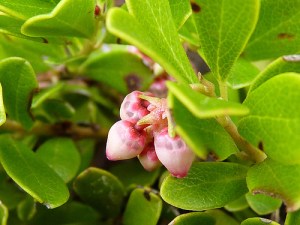
In the woods and along the lower slopes in Glacier National Park, it’s easy to walk past a low, trailing shrub called Kinnikinnik (also Kinnickinnik). It’s rather unobtrusive when the white and pinkish flowers aren’t blooming in June and when the bright red berries haven’t shown up yet in the fall.
from FancyLady on FlickrThe plant is better known as the Common Bearberry (Arctostaphylos uva-ursi), dwarf manzanita and other local names. You’ll find it in the northern hemisphere from Scottish heaths to California gardens to the mountains of the Rocky Mountain Front.
In folk medicine, the bark and leathery evergreen leaves have been used for teas and infusions, typically for their diuretic properties. The name Kinnikinnik refers specifically to smoking mixtures used by Native Americans that, in addition to tobacco, red willow bark, etc.) included the bearberry’s leaves and purplish-red bark. The name kinnikinnik rather stuck to the bearberry.
According to the Kinnickinnick Native Plant Society, “It is pronounced KINNY-kin-ICK, or Kinn-ICK-innick, and comes from the aboriginal – most scholars say the Alonquin – meaning “smoking mixture.” Although the plant was native here, it seems to have been the fur traders’ employees who brought the name west with them. Its other common name, Bear Berry, comes from its genus ARCTOSTAPHYLOS, from the Greek word for bear – Arktos and staphylos – a bunch of grapes, which its berries resemble. The species name of “uva-ursi” is apparently from the Latin “uva” (grape) and “ursus” (bear).”
In Glacier, the shrub often grows in large mats along park roads. You can see it along the lake level trails near Many Glacier Hotel.
In my novel “The Sun Singer,” Robert Adams was told he could always remember the name of this plant because it was spelled the same way from both directions.
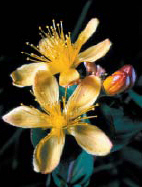
St. Johnswort - NPS PhotoWhen they arrive in Glacier National Park, it’s not necessarily by the dead of night, for seeds are so small most people don’t notice them. They’re blowing on the wind, carried by birds, hidden on your trousers and shoes, clinging to your backpack, and even on your car and pop-up camper.
We’re talking about plants out of place, better known as noxious invasive weeds such as St. Johnswort and spotted knapweed. Unfortunately, such weeds are hardy and adaptable. Worse yet, they disrupt the natural plants in otherwise well-balanced park habitats including wildlife.
Spotted Knapweed - NPS PhotoAccording to the Crown of the Continent Research Center, there are 126 invasive plant species in Glacier, fifteen of which are considered noxious. One of those–spotted knapweed–is so nasty that it kills nearby plants by secreting a toxic chemical into the soil!
Wanted: Dead, if Not Gone: Glacier’s Noxious Weeds
On Friday, July 30th, the park will hold its first annual Noxious Weed Blitz. Noxious Weed Blitz participants will be trained to assist Glacier’s Invasive Plant Management Program by learning to identify, map and pull invasive plants. They’re encouraged to bring water, clothes suitable for hiking, and heavy gloves.
The heavy gloves will be used after lunch as volunteers head out on the western side of the park to pull weeds. Interested in weeding Glacier National Park? Contact the Crown of the Continent Research Center at 406-888-7986 or via e-mail to sign up.
Volunteers will assemble at the West Glacier Community Building. The blitz will run from 10 a.m. to 4 p.m. Participants will be provided with a free lunch and a noxious weeds field guide.
– Sales of this Glacier Park novel benefit the park.
from NPS Glacier National Park: Visitor Center at Saint Mary - Wikipedia PhotoWEST GLACIER, MONT. – New exhibits now greet Glacier National Park visitors at the St. Mary Visitor Center. The new visitor center exhibit entitled “At Home in This Place” focuses on tribal perspectives about the place we today call Glacier National Park.
The new exhibits were installed in early July and were viewed by tribal leaders and elders Wednesday afternoon, July 14 during a dedication ceremony. As part of the dedication, tribal perspectives and remarks were offered by Peter (Rusty) Tatsey (Blackfeet), Vernon Finley (Kootenai) and Thompson Smith (Salish-Pend d’Oreille).
According to Glacier National Park Superintendent Chas Cartwright, “Several years of consultation with cultural experts from the Blackfeet, Kootenai and Salish and Pend d’Oreille tribes provided authenticity and a true tribal perspective on issues related to land, plants, animals, mountains and history of this area.”
There are five new main exhibits: 1) Welcome-panels from each of the tribes detailing local Native peoples and their historic and current relationship with the land; 2) Bittersweet Meanings looks at changes faced by tribes with the creation of Glacier National Park; some good, others difficult; 3) Backbone of the World provides native perspectives on the land, mountains, creation stories, and place names; 4) The Wisdom in Spoken Words features oral histories and traditions with video of stories about Glacier by tribal elders. The exhibit includes an indoor tipi setting for sitting and listening to these stories; 5) Animal Lessons is a large winter scene diorama featuring elk, wolves, coyote, and grizzly bear which includes animal stories told by tribal leaders.
Additional exhibits in the lobby focus on other park stories and help interpret resources seen from the building.
These include the following panels: Where the Prairie Meets the Mountains, Who Lives in the Meadows, and Glaciers on the Move.
There is also a new interactive 3-D park topographic map with optic fiber lights highlighting the following: Continental Divides depicts the Continental Divide, Hudson Bay Divide, Triple Divide Peak; Glacier’s 10,000-foot Mountains; Tourism and Early Park Days shows locations of historic hotels and chalets; and Goodbye to the Glaciers is an animated look at the disappearance of park glaciers from 1850 to 2020.
These new exhibits will be permanently on display at the St. Mary Visitor Center. Summer hours of operation at the St. Mary Visitor Center are 7 a.m. to 9 p.m.
Heaven's Peak Lookout - NPS photoWEST GLACIER, MONT. – Officials at Glacier National Park today announced plans to seek public comments for a proposed project to stabilize the existing Heavens Peak Lookout.
The National Park Service (NPS) has decided to prepare an environmental assessment (EA) for the project to review all possible resource issues from the proposed Heavens Peak Lookout stabilization. This environmental analysis will begin this summer (2010), with a goal of having the EA completed by spring 2011.
The goal of the project is to stabilize the historic Heavens Peak fire lookout that was built by conscientious objectors during World War II. Stabilization of the lookout would slow down the accelerating deterioration so that this historic structure can remain on the landscape as part of Glacier National Park’s cultural history.
Constructed in 1945, the Heavens Peak Lookout was listed in the National Register of Historic Places in 1986 and embodies the NPS rustic design philosophy of buildings that are “harmonious” with the landscape. The lookout is located on Heavens Peak, within recommended wilderness inside Glacier National Park. It lies within an area of high grizzly bear density.
Heavens Peak Lookout is structurally sound at this time, but the deteriorating roof and missing shutters threaten its long-term survival. The proposed project would repair the roof, shutters and exposed exterior wood surfaces, paint the exterior and stabilize the masonry. Glacier National Park Fund would pay for the stabilization as one of their legacy projects in honor of the park’s Centennial.
In addition to the proposed action, two other alternatives have been identified to date: 1) no action, in which case the lookout would eventually be lost, and 2) rehabilitation which would fully rehabilitate the lookout and re-build the trail access to the lookout.
Comments and concerns on the proposed Heavens Peak Stabilization project should be submitted online by Monday, August 16, 2010, at http://www.parkplanning.nps.gov/glac or mailed to: Superintendent, Glacier National Park, Heavens Peak Lookout EA, P.O. Box 128, West Glacier, MT 59936. There will be another opportunity for review and comment when the environmental assessment is completed.
–
This announcement appears to represent a change in plans. This fully funded Glacier Park Fund legacy project was supposed to get underway next month according to earlier announcements.
Every purchase of this mountain adventure novel set in Swiftcurrent Valley, the Belly River Valley and Chief Mountain benefits the Glacier National Park centennial committee.
Buy the book, then head for the park and follow Robert Adams’ quest yourself while celebrating the centennial.
A reception honoring the National Park Service Glacier Centennial Book A View Inside Glacier National Park: 100 Years, 100 Stores will be held at the West Glacier Montana Depot on August 3rd.
The reception and open house runs from noon until 4 p.m. Several of the authors included in this anthology of memories about the park will be on hand to read and discuss their essays and articles.
Book’s Description: 100 YEARS – 100 STORIES Celebrating the rich history of preservation and enjoyment through personal recollections or the land. Stories and experiences from 100 people whose lives have been enriched and who have been inspired by the grandeur and beauty of Glacier National Park. All proceeds from sales of this book support the Glacier Centennial Program. 371 pages. Black and white photography.
As an author of one of the book’s essays, I see this reception as a wonderful opportunity for area residents and other park visitors to learn more about the book and the great memories in contains from the last one hundred years.
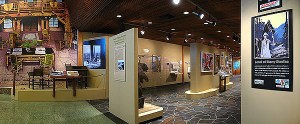
WEST GLACIER, MONT. – A Glacier National Park Centennial exhibit entitled Land of Many Stories is currently on display at the Montana Historical Society Museum in Helena, Mont., and now a virtual tour of the exhibit is just a mouse click away. The exhibit represents the rich history of the park and features a wide diversity of tangible artifacts from the early 1900s to today.
Montana Historical Society Exhibit - NPS Photo
The exhibit explores the many ways people have used and enjoyed the area now known as Glacier National Park from pre-European contact to present day and illustrates how, although much has changed over the years, a great deal remains the same for today’s visitor. There is also a traveling exhibit which parallels the theme and content of the major exhibition currently on display at the Montana Historical Society. The traveling exhibit is comprised of reproductions of historic photographs, graphics and accompanying interpretive text. The traveling exhibit is currently at the Central School Museum in Kalispell, Mont., through August 31 and then moves to the Museum of the Beartooths in Columbus, Mont. from September 1 through October 30.
The virtual Land of Many Stories exhibit is a collaboration to help make the exhibit accessible to more people. Deirdre Shaw, Glacier National Park Museum Curator and Jennifer Bottomly-O’Looney, Montana Historical Society Curator of Collections developed the content for the virtual exhibit; Glacier Interpretive Specialist David Restivo designed the on-line tour. Not every artifact is highlighted but the virtual tour gives viewers a taste of the exhibit through the use still photography to create the online experience.
Website visitors are able to get an overview of the exhibit and then take a closer look at items of interest. Virtual visitors can experience a wide variety of exhibits including ornate Glacier Park Hotel Company china, Native American tools and arrowheads, park ranger equipment and initials carved in a tree carved by one of Glacier’s first rangers.
Funded through a donation by the Burlington Northern Sante Fe Foundation (to the Glacier National Park Fund) the exhibit is the product of a partnership between Glacier National Park, the Montana Historical Society, Glacier National Park Fund.
The Land of Many Stories and virtual tours of the Going-to-the-Sun Road construction and a few popular park hikes are viewable here.
– Garden of Heaven – A new novel with action and vision quests in Glacier National Park.
A sweeping mythic novel of magic and quantum entanglements that fractures time and tangles the today and yesterday of a family’s lies, a lover’s secrets, and a seeker’s journey.
 Readers, tourists, hikers, and climbers who are fans of Glacier National Park will enjoy the Summer 2010 centennial issue of Montana: The Magazine of Western History beginning with the John Fery painting on the cover.






 Malcolm's Round Table